Joe Sewell
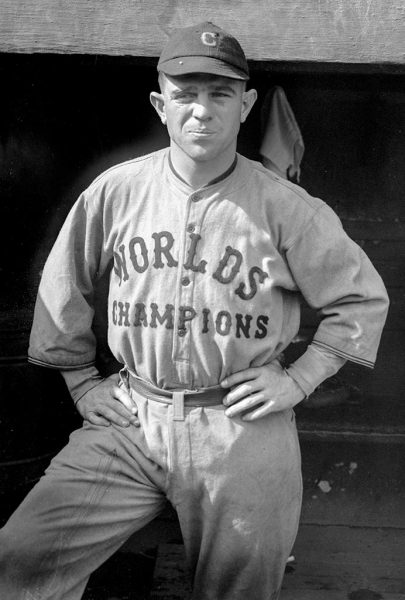
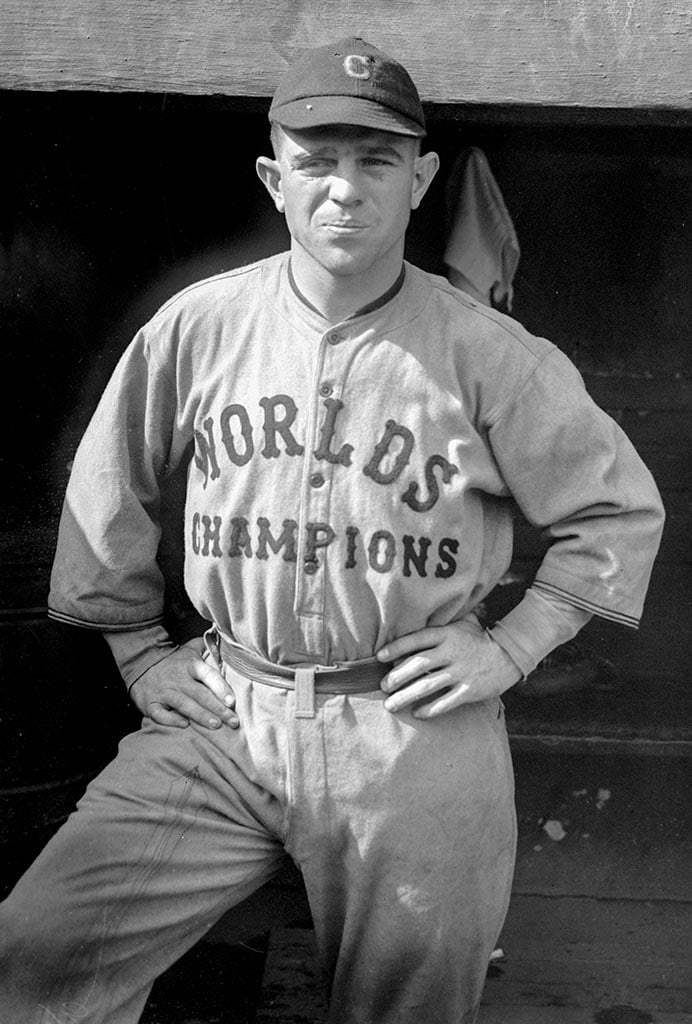
Elmore County native Joe Sewell (1898-1990) was a star shortstop and third baseman in the major leagues for the Cleveland Indians (present-day Guardians) and New York Yankees. He played for 14 seasons and on two World Series championship teams, the 1920 Cleveland Indians and the 1932 New York Yankees. He rarely struck out, which factored greatly into his election to the Alabama Sports Hall of Fame in 1970 and to the National Baseball Hall of Fame in 1977.
Joseph Wheeler Sewell was born on October 9, 1898, to Jabez Wesley Sewell, a physician, and Susan Hannon Sewell in Titus, an unincorporated community in Elmore County. He was one of seven siblings. Sewell’s father wanted Joe and his brothers to become doctors, but several of the sons preferred baseball. Joe’s brother James Luther “Luke” Sewell played major league baseball for 20 years (including nine years as Joe’s teammate on the Indians) and managed the St. Louis Browns (the present-day Baltimore Orioles). Joe’s brother Thomas “Tommy” Sewell played briefly for the Chicago Cubs. Joe’s cousin Truett Banks “Rip” Sewell pitched in the major leagues for the Pittsburgh Pirates and created the “eephus” pitch (a slow pitch with a steep and looping arc). In 1916, Sewell graduated from Wetumpka High School, where he starred on the baseball team. He entered the University of Alabama in Tuscaloosa, where he lettered in football from 1917-19 while also playing for the Alabama baseball team, which won four consecutive conference championships.
Sewell was a left-handed hitter, but like all shortstops, he threw right-handed. He would become known as a “contact hitter” for his consistency as a batter, a skill he attributed to his childhood hobby of tossing rocks and bottle caps in the air and swinging at them with a broom handle. After college, Sewell played minor league baseball in 1920 for the New Orleans Pelicans, playing in only 92 minor league games before he was signed to play for the Cleveland Indians to replace Ray Chapman, who died from head trauma on August 16, 1920, after being hit with a pitch; he is the only player in major league history to be fatally injured during a game. When Chapman’s replacement, Harry Lunte, pulled a leg muscle and could not play, the Indians purchased Sewell’s contract from the Pelicans. Sewell made his major league debut on September 10, 1920. Despite having very little minor league experience, Sewell performed well, hitting .329 in 22 games in September. In October, the Indians faced the Brooklyn Robins (the present-day Los Angeles Dodgers) in the World Series. Because baseball rules stipulate that players may only participate in the World Series if they are on the team’s roster by August 31, Sewell was ineligible to play; however, because of the Chapman tragedy, he was granted special permission to play. The Indians won the 1920 World Series, five games to two, when the series was a best-of-nine format.
Sewell married Willie Veal on December 31, 1921. They had three children and were married for 62 years until her death in 1984.
Sewell’s best year was in 1923, when he hit .353 and drove in 109 runs. Sewell played shortstop from 1920-28 before switching to third base, where he played from 1929-33. An above-average fielder, Sewell led the American League in fielding percentage three times and was in the top five in fielding percentage for shortstops six times.
On January 20, 1931, the Indians released Sewell from his contract. Within days, he was signed by the New York Yankees, where he played alongside Babe Ruth, Lou Gehrig, and fellow Alabamian Ben Chapman. He was their full-time third baseman when they won the World Series over the Chicago Cubs in 1932. Sewell broke a Major League Baseball record by striking out only three times in 1932. He previously struck out only three times in 1930, but, since it was not a full season, he did not break the record. In three other seasons, he struck out only four times in each season. During his 14-year career, he struck out only 114 times; in contrast, many major league hitters today strike out more than 114 times in one season. In baseball history, only Hall of Famer Wee Willie Keeler struck out less frequently than Sewell. Sewell finished his career with an impressive .312 lifetime batting average, 2,226 hits, and 1,054 runs batted in. Throughout his career in the major leagues, Sewell used only one bat, a 40-ounce model that he called “Black Betsy.”
After he retired following the 1933 season, Sewell coached for the New York Yankees in the 1934 and 1935 seasons. He then owned and ran a Tuscaloosa hardware store for 17 years. In the 1950s and 1960s, he worked as a scout for the Cleveland Indians and New York Mets, respectively. Sewell was hired in 1964 to manage the University of Alabama baseball team. The team won the Southeastern Conference championship in 1968. Over seven seasons, his collegiate team earned a record of 114-99. One of his pitchers was Ken Stabler, who also played quarterback for the Crimson Tide and later achieved fame as quarterback for the Oakland Raiders (present-day Las Vegas Raiders) in the National Football League. The University of Alabama baseball park was renamed the Sewell-Thomas Stadium in his honor in 1978 after he was elected to the National Baseball Hall of Fame; many people simply refer to it as “The Joe” after Sewell. After retiring from the University of Alabama baseball team in 1970, he worked in public relations for a Tuscaloosa dairy company for many years.
Sewell was inducted into the Alabama Sports Hall of Fame in 1970. Sewell was also inducted to the Cleveland Indians Hall of Fame, in 1951. The Baseball Veterans Committee voted Sewell into the National Baseball Hall of Fame in 1977, 44 years after his retirement. The Veterans Committee votes on players who have retired decades before but have been overlooked.
Sewell died on March 6, 1990, in Mobile, Mobile County. He is buried in Tuscaloosa Memorial Park in Tuscaloosa. After Sewell’s death, Elmore County created the Joe Sewell Memorial Award in his honor for Elmore County high school students who demonstrate excellence in character, leadership, academics, and sports.