Ben Chapman
Ben Chapman (1908-1993) was a baseball player for the New York Yankees and six other Major League Baseball (MLB) teams. He spent his formative years in Birmingham, Jefferson County. Chapman is best remembered today for his volatile temper and his racist taunting of Jackie Robinson on April 22, 1947, which made national headlines. Indeed, his antisemitic and racist taunts prompted frequent trades despite his talent stealing bases, which led to four trips to the All-Star game.
William Benjamin Chapman was born on December 25, 1908, in Nashville, Tennessee, to Harry “Tub” Chapman, a steelworker, and Effie Chapman, a homemaker. Harry, along with two of his brothers, played minor league baseball. Ben Chapman was an only child. Harry, Effie, and Ben moved to Birmingham in 1915.
In 1923, Ben Chapman served as batboy for the Birmingham Barons minor league team. He graduated from the city’s Phillips High School, where he was a star baseball and football player. From his earliest years as a baseball player, Chapman was an aggressive and fierce competitor. For instance, as a high school star pitcher, he threw pitches at batters’ heads to intimidate them. After frightening them, he found it easy to strike them out. Chapman helped Phillips High School win the 1927 Alabama state baseball championship against Warrior High School in Warrior, Jefferson County. He was offered a football scholarship by the University of Alabama, but he chose a baseball career instead.
Chapman was signed by the New York Yankees while in high school and, after his graduation, played in the minor leagues, in the Yankee farm system, from 1928-29, for the Asheville Tourists in 1928 and for the St. Paul Saints in 1929, before playing in the major leagues. He began as a third baseman but made so many errors that he was moved to the outfield, joining baseball icon Babe Ruth and fellow Alabamian and future Hall of Famer, Joseph Wheeler Sewell of Titus, Elmore County. The team won the World Series in 1932. Although he led the league in errors several times, he was known for his excellent throwing arm and great speed. In 1933, he was the leadoff hitter for the American League in the first ever All-Star Game, which the American league won 9-8, led by Chapman’s Yankees teammate Babe Ruth. He led the American League in stolen bases four times, earning the nicknames “Dixie Flyer” and “Alabama Flash” and was voted an All-Star for four consecutive seasons, from 1933-36. When he left the Yankees in 1936, he was second in team history with 184 steals.
Chapman married Mary Elizabeth Payne in 1931. Four years later, she divorced him, accusing him of domestic violence. Chapman married his second wife, Ola Sanford of Sylacauga, Talladega County, in October 1935; the couple had two sons.
Chapman had a reputation for poor sportsmanship and was a notorious “bench jockey,” someone who hurls insults at opposing players to gain a competitive advantage by distracting them. During a 1933 game in New York City, Chapman spiked (purposely hit an opposing player with the sharp metal spikes of the sole and heel of athletic shoes in order to hurt the opponent) the Washington Senators’ second baseman Charles “Buddy” Myer two days in a row because Myer had Jewish ancestry. This led to arguably the most intense brawl in baseball history, in which Chapman punched Myer several times and Senators pitcher Earl Whitehill as well; 300 fans from the stands joined in the fight. Jewish baseball star Hank Greenberg was another target of Chapman’s antisemitic verbal abuse. In 1934, 15,000 New Yorkers filed a petition requesting that the Yankees trade Chapman because of his antisemitism. Chapman once became embroiled in a heated argument with a fan and jumped into the stands to attack him; he chased the fan throughout the stadium and into the street.
Despite Chapman’s talents, the Yankees traded him to the Washington Senators in 1936, partially due to his vocal antisemitism and his hostile relationship with star teammates Babe Ruth and Lou Gehrig, and partially to make way for new center fielder Joe DiMaggio. Chapman played for the Senators until 1937, when he was traded to the Boston Red Sox. Viewing him as a bad influence on the other players, Red Sox manager Joe Cronin assigned him to play in the outfield every day to limit the time he spent in the dugout with his teammates. After Chapman argued with Cronin and punched him, the Red Sox traded him to the Cleveland Indians (1939-40), who then traded him back to the Senators (1941) when he led a team rebellion against Indians manager Ossie Vitt.
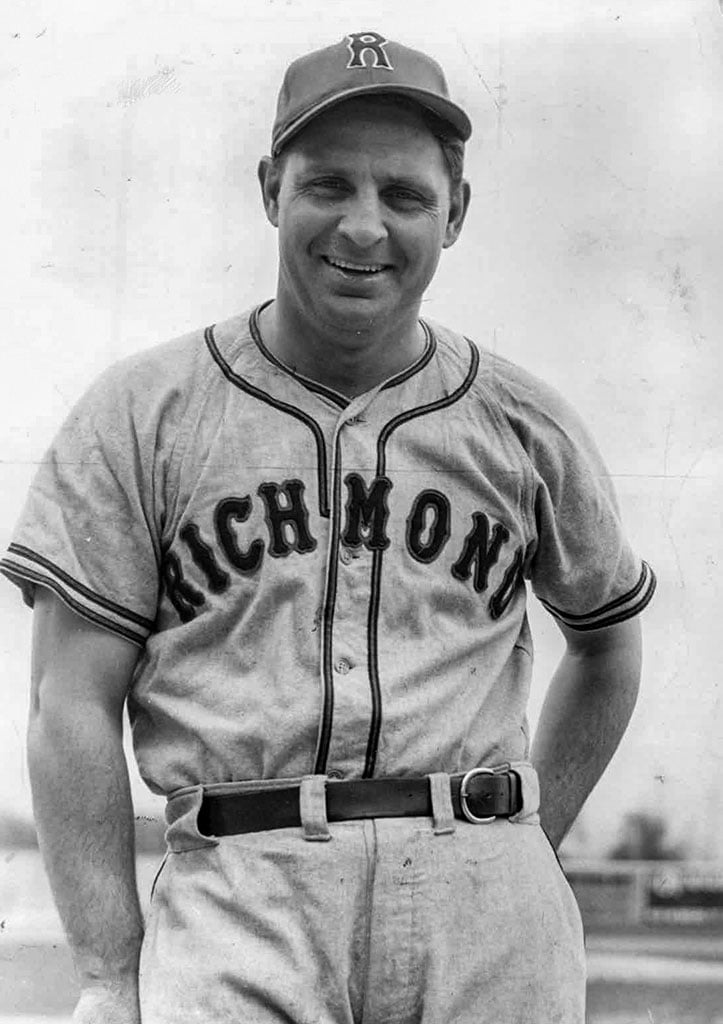
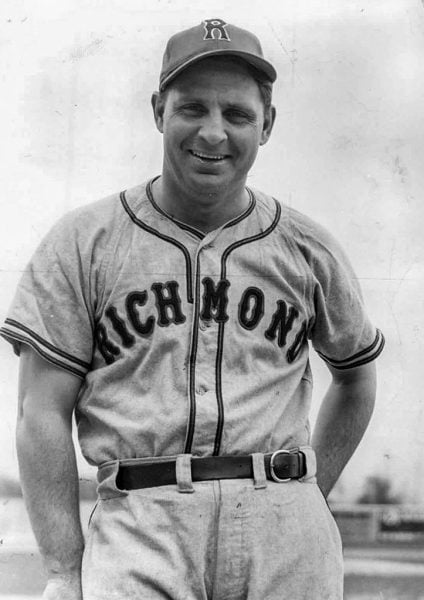
Chapman managed in the minor leagues in 1942 and 1944 for the Richmond Colts. (He was suspended for the 1943 season for punching an umpire.) Chapman then continued his major league playing career with the Brooklyn Dodgers and Philadelphia Phillies, for whom he became a pitcher. He then managed the Phillies from the second half of the 1945 season through the first half of 1948. His record as Phillies manager was not stellar at 196 wins to 276 losses. Although his average was considered poor, he had a better record as manager than his predecessor, Freddie Fitzsimmons.
Chapman became infamous on April 22, 1947, for relentlessly taunting MLB’s first Black player, Jackie Robinson, making every racist verbal attack and exploiting every racist stereotype he could devise. He even demanded that three of his Phillies players make racist remarks to Robinson throughout the game, which they did unwillingly. Robinson had encountered racist abuse before, but Chapman’s merciless taunts were more intense and far worse than any abuse he had experienced before. Several Dodgers players from the South, such as Eddie Stanky (who lived in Mobile), were unhappy about having a Black teammate, but that day and thereafter, they bonded in solidarity with Robinson because of Chapman’s abuse. The incident was featured prominently in the 2013 movie 42. Baseball commissioner Happy Chandler, bombarded with angry letters because of Chapman’s racism, ordered Robinson and Chapman to make peace. The two posed together with great reluctance for a widely circulated photo on May 10, 1947, with both men holding a bat but without touching. The Philadelphia City Council passed a resolution on March 31, 2016, 69 years after the event, to formally apologize for Chapman’s racist behavior and for a Philadelphia hotel’s refusal to serve Robinson in 1947.
Chapman bought the minor league Gadsden Chiefs (in Gadsden, Etowah County) baseball team in 1949 and became their manager. He also managed a bowling alley in Birmingham called Chapman Lanes.
Chapman maintained for the rest of his life that he was not a racist but rather a fierce competitor and bench jockey who insulted Robinson and others for a competitive advantage. Jackie Robinson said on the June 6, 1972, episode of The Dick Cavett Show that Ben Chapman did not hate Black people; he hated everyone. In addition to mocking people based on ethnic identity, he often mocked players for their physical appearance or falsely claimed that their wives were cheating on them.
Chapman had a lifetime batting average of .302 percent, with 90 home runs, and 977 runs batted in. He claimed in later years that he was not inducted in the Baseball Hall of Fame because of his racist taunts against Robinson, but many historians disagree, noting that he was a good but not great player. Chapman was inducted in the Alabama Sports Hall of Fame in Birmingham in 1971.
Chapman died of a heart attack on July 7, 1993, at his home in Hoover, located in both Jefferson and Shelby Counties; he was 84. He is buried in the Elmwood Cemetery in Birmingham.