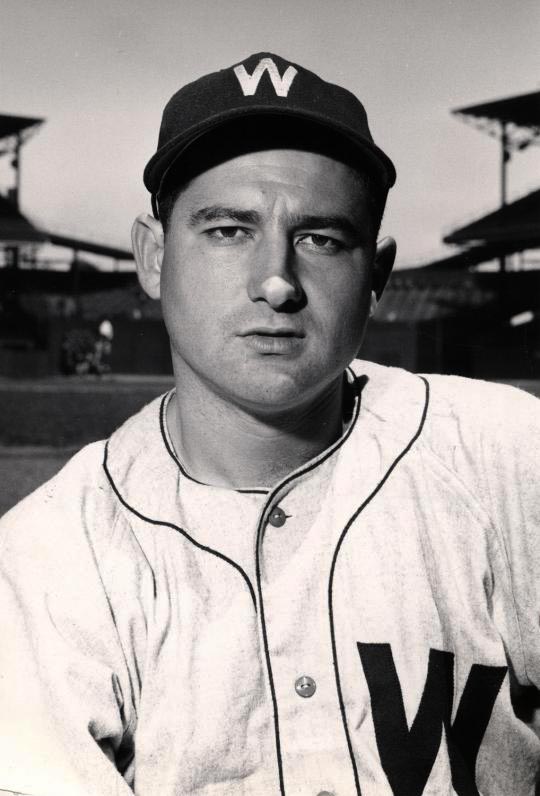
Early Wynn Jr.
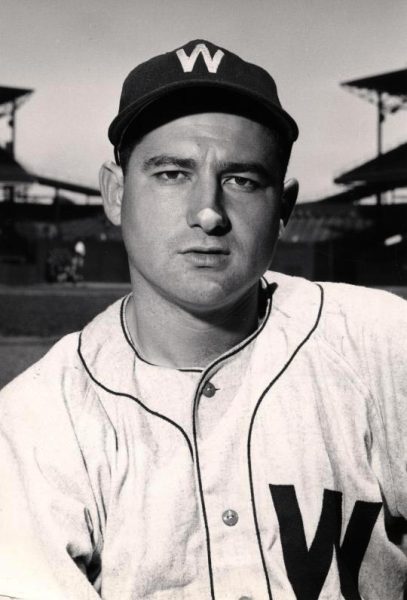
Geneva County native Early Wynn Jr. (1920-1999), nicknamed “Gus,” was a star pitcher for the Washington Senators, Cleveland Indians, and Chicago White Sox. Known for his fastball and his brushback pitches (deliberately throwing the ball towards a batter to unsettle him), he pitched in the major leagues for 23 years and won 300 games. He pitched in the World Series in 1954 and 1959, and he was selected to nine All-Star teams. He has been inducted into the National Baseball Hall of Fame, the Alabama Sports Hall of Fame, and the Florida Sports Hall of Fame.
Early Wynn Jr. was born on January 6, 1920, in Hartford, Geneva County, just above the Florida panhandle, to Early Wynn Sr., who played semiprofessional baseball, and Blanche Wynn. After watching his father play, Wynn was inspired to pursue a career as a baseball player. In high school, Wynn earned ten cents per hour transporting cotton bales. He was a star running back on the Geneva County High School football team but focused solely on baseball after breaking his leg during football practice.
In 1937, 17-year-old Wynn participated in a Washington Senators tryout in Sanford, Florida, where he impressed Senators’ scout Clyde Milan, who offered him a contract. Wynn accepted the contract, dropped out of high school, and joined the Senators’ Class D minor league team in Sanford. Wynn then pitched for the Charlotte Hornets of the Class B league for three years, 1938-40, before advancing to Springfield in the Class A league, where he excelled. In 1939, Wynn married Mabel Allman. Shortly after the birth of the couple’s first child, Mabel was killed in a car accident.
Wynn pitched briefly in the major leagues for Washington in September 1939 and September 1941 but was deemed unready until 1942, when he finally made the Senators squad at the age of 22. Although Wynn achieved some success as a starting pitcher for Washington from 1942-44 and 1946-48, he lost more games than he won. He later admitted that early in his career, he was more of a thrower than a pitcher, relying primarily on the speed of his fastball. In 1944, Early married Lorraine Follin; they would later have a daughter. Early’s pitching career for the Senators was interrupted by military service in 1945 during World War II, and he was stationed in the Philippines as part of the U.S. Army tank forces. He continued to play baseball with an Army team there and served until 1946.
In 1949, Washington traded Wynn to the Cleveland Indians, where pitching coach Mel Harder helped transform him into a star pitcher, teaching him how to throw curve balls, sliders, and knuckleballs, which are pitches with different movements, spins, and speeds. Wynn joined Bob Feller, Bob Lemon, and Mike Garcia in a pitching rotation that baseball historians consider to be one of the greatest in baseball history; all four were 20-game winners at some point in their careers, and Wynn led the Major Leagues with 23 victories in 1954.
Beginning in 1955, Wynn wrote a newspaper column for the Cleveland News entitled “The Wynn Mill” in which he provided his opinions about baseball. The column included observations about his team, umpires, and front office and league office policies, which were often negative. When Wynn was traded to the Chicago White Sox in 1958, the team included a clause in his contract preventing him from writing for newspapers.
Wynn pitched for the White Sox from 1958 to 1962. In the 1959 season, he would have the best season of his career, winning the Cy Young Award, the most prestigious pitching award in Major League Baseball, and finishing with a 22-10 record. Ironically, he had his best season at age 39; as he aged his fastball had lost some of its speed, causing him to rely more on off-speed pitches such as his knuckleball. That year, Wynn finished third in the Most Valuable Player (MVP) voting. He helped lead Chicago to their first World Series in 40 years, the first since the infamous 1919 “Black Sox scandal,” when several White Sox players took bribes to lose the Series on purpose. The Los Angeles Dodgers defeated the White Sox in six games.
Wynn finished the 1962 season with 299 career wins. Every major league baseball team considered him ineffective; by age 43, the speed of his fastball had diminished, and his gout hampered his playing abilities. But Wynn coveted 300 victories, partly because players and sportswriters in his day believed that any pitcher with 300 wins was guaranteed to make the National Baseball Hall of Fame. Unable to secure a full-season contract for 1963, Wynn stayed home and kept in shape. Some teams offered him one-game contracts, hoping that media attention would draw high attendance among fans who wanted to see Wynn earn his historic 300th win. Wynn held out for an annual contract, which he finally received from the Indians. Wynn pitched sparingly in 1963 and won only one game, but it gave him his desired 300th win. Wynn was the first Alabamian to achieve this feat; in 1986, Barbour County pitcher Don Sutton would join his ranks.
After his retirement, Wynn replaced Mel Harder as Cleveland Indians’ pitching coach and then moved to the Minnesota Twins. He next managed in the minor leagues for one year and then became a baseball commentator for the Toronto Blue Jays and the White Sox. Wynn owned a steakhouse and a bowling alley in Venice, Florida.
Wynn was inducted into the Alabama Sports Hall of Fame in 1970 and the Florida Sports Hall of Fame in 1971. He was inducted into the National Baseball Hall of Fame in his fourth year of eligibility in 1972. He was commemorated in Washington on the former Robert F. Kennedy Memorial Stadium Ring of Fame and is on the Washington, D.C., Sports Hall of Fame at Nationals Park, home of the Washington Nationals baseball team.
Wynn died on April 4, 1999, in Venice, Florida.