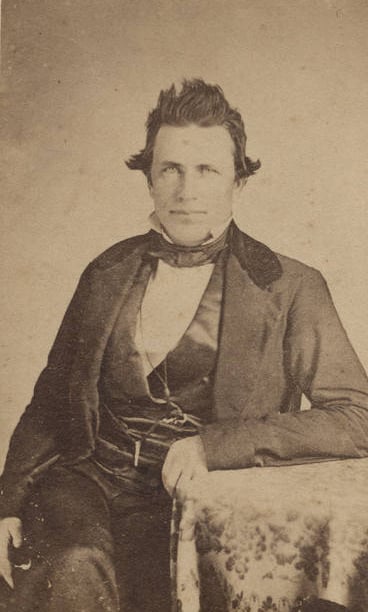
Thomas Williams
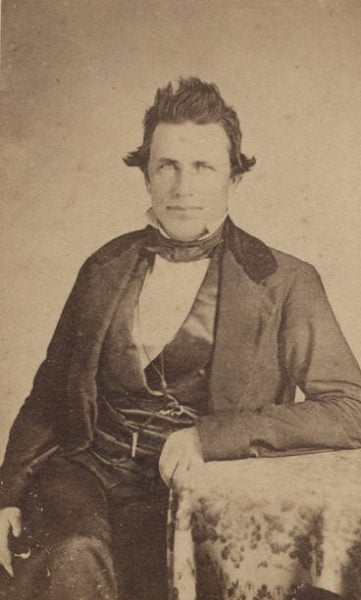
Thomas Williams (1825-1903) served three terms, from 1879 to 1885, in the U.S. House of Representatives, representing Alabama’s Fifth Congressional District as a Democrat. In addition, he was an Alabama state representative, state prison inspector, lawyer, planter, and justice of the peace.
Williams was born on August 11, 1825, to John Davis and Mary Johnson Williams in Greensville County, Virginia. His grandfather, also named Thomas Williams, was of Welsh descent and had fought and died in the Battle of King’s Mountain, South Carolina, during the Revolutionary War. John Davis Williams, a farmer and Baptist preacher, moved the family to the Wetumpka area and what was then Coosa County in 1834 (a portion of which was later incorporated into Elmore County upon its creation in 1866.)
After receiving a limited education in area schools, Williams taught school himself to earn money to fund his continued education. He graduated from the University of East Tennessee at Knoxville and was admitted to the bar in 1852. Also that year, Williams married Rebecca E. Judkins; the couple would have eight known children. He returned to Wetumpka to practice law. As of 1860, he had accrued great wealth, claiming ownership of 2,000 acres of farmland and 51 enslaved individuals. The 1860 Agricultural Census shows Williams’s farm had produced 3,000 bushels of corn, 250 bushels of oats, and 81 bales of cotton. In addition, Williams raised hogs, cattle, and owned 20 horses, 2 oxen, and 11 mules. Williams was a Methodist, a trustee of what would later become Auburn University, and served as a register for the chancery court.
Although Williams was often referred to as “Colonel Williams” in early biographical sketches, he never served in any military conflict. Rather, he worked as a prison inspector for the Alabama Penitentiary in Wetumpka from around 1849 until the 1870s. During the Civil War, Williams and other inspectors requested a military exemption under the revised conscription act from Gov. Thomas Watts in 1864, citing their value in Wetumpka as members of the Board of Aldermen. During the war, he was a proponent of releasing prisoners early in exchange for their service to the Confederacy. As prison inspector he assisted in reporting on the financial standing, personnel needs, prisoner health, and general status of the prison to the governor. While he occasionally advocated for the early release of selected offenders, Williams endorsed the practice of hanging recalcitrant prisoners by their thumbs if other forms of punishment were ineffective.
Williams was elected to the Alabama House of Representatives in 1878 to represent Elmore County. He served on the joint committee to divide the state into judicial circuits and introduced a successful joint resolution to support funding the improvement of navigation for state rivers and the Mobile Harbor. He supported the restriction of liquor sales around the Wetumpka area and churches in general. He was a member of the Committee on Appropriations and served as chairman of the Committee of Privileges and Elections.
Williams was further elected in 1878 to the U.S. House of Representatives on behalf of Alabama’s Fifth Congressional District, which then consisted of Autauga, Bibb, Chambers, Chilton, Clay, Coosa, Elmore, Macon, and Tallapoosa Counties. He took the seat from Robert Fullwood Ligon, who lost his reelection bid. Williams served for three consecutive terms, from 1879 to 1885 in the 46th, 47th, and 48th Congresses. He served on a number of committees, including the Committee on Public Lands, the Committee on Expenditures in the Interior Department, the Select Committee on Alcoholic Liquor Traffic, the Committee on Private Land Claims, the Committee on Ventilation and Acoustics, and the Committee on Agriculture. He was further credited with work on the Agricultural Appropriation Bill for the 1883 term. His personal letters from the period note his dislike of Washington, D.C., and its weather and his longing to be home with his wife. In September 1884, Williams lost the Democratic nomination for reelection to Thomas William Sadler, who ultimately won the seat for one term.
Meanwhile, as Williams continued his agricultural pursuits in the postwar era, he eventually turned to leasing convicts from the state to serve as farm workers. In 1891, Williams submitted a bid to the state of two dollars per month for Black women and boys under the age of 17, and three dollars a month for Black men. He lost his bid for adult male convicts to avowed convict leasing proponent and industrialist John Turner Milner and his associates with the Milner, Caldwell & Flowers Lumber Company.
In July 1891, Williams’s home, library, and a number of outbuildings, barns, and summer houses burned, with the loss estimated at $15,000. The cause of the fire was reported to be unknown, but had begun in a barn where meat, corn, and hay were being stored. The damages were reported to include fences and numerous oak trees and other landscaping, but efforts were made to rebuild the home.
Williams died on April 13, 1903, at his home, which was approximately three miles north of Wetumpka, Elmore County, having suffered a paralytic stroke two weeks prior. He is buried in the Wetumpka City Cemetery.