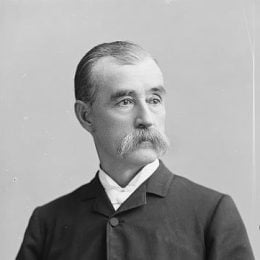
Thomas William Sadler
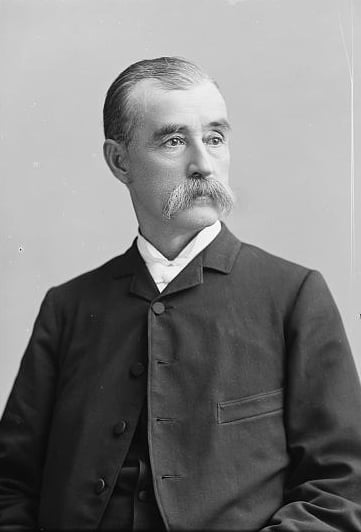
Thomas William Sadler (1831-1896) was a one-term U.S. representative for the state of Alabama during the 1880s. A Confederate veteran, his political career rose rapidly during Reconstruction, and he remained active in Democratic politics from the 1850s through his election defeat in 1886.
Sadler was born near Russellville, Franklin County, on April 17, 1831, to Allious Turner Sadler and Caroline Martha Owen. He was one of three children. After Allious Turner Sadler’s death in 1844, Caroline married clergyman Reuben Phillips, and they remained together until her death in 1884. In 1851, Thomas Sadler was hired as an assistant teacher at the Salem Male and Female Academy in Jefferson County. By 1854, he served as a member of the board of trustees for the school. He was married that year to Catherine Mims and the couple would have ten children, five of whom died in infancy. After her death in 1883, Sadler married Mary Bowen in 1884.
Sadler also operated a general store in Prattville, Autauga County, that he co-owned with Charles M. Booth. Records indicate that they sold the store in 1859. In 1860, Sadler served as the vice-president of the local anti-abolitionist political club in Prattville that supported the Southern Democratic ticket of John C. Breckinridge of Kentucky and Joseph Lane of Oregon during the 1860 presidential election. The ticket won Alabama, but it lost the national election to Republicans Abraham Lincoln and Hannibal Hamlin. Sadler briefly served as a co-editor of the Southern Statesman newspaper in Prattville in late 1860.
At the outbreak of the Civil War, Sadler joined the Confederate Army and served under Gen. Joseph Wheeler of Alabama in the 19th Alabama Infantry Regiment. In March 1862, Sadler was promoted to colonel and assigned to the 47th Alabama Infantry Regiment. The regiment was not fully complete until May of 1862, and by that time Sadler was no longer listed among the officers in the regiment. The regiment fought at the 1862 Battle of Cedar Mountain and the 1862 Battle of Second Bull Run in Virginia, the 1862 Battle of Antietam in Maryland, and the 1863 Battle of Gettysburg in Pennsylvania under various officers. Newspaper advertisements and articles frequently referred to Sadler as a colonel for the rest of his life, even after the defeat of the Confederacy.
After the war, Sadler returned to Prattville and served as a manager for the U.S. House election in October 1865. Until 1868, however, no former Confederate was permitted to serve in the U.S. Congress. In 1870, Sadler worked as the vice-president of the Prattville branch of the Mound City Mutual Life Insurance Company. In the middle of the 1870s, Sadler became a lawyer in Prattville and advertised frequently in local newspapers.
Throughout the Reconstruction era, he remained active in Democratic Party politics in Autauga County and Prattville. In 1874, he was a delegate for Autauga County at the Alabama State Convention of the Democratic and Conservative party, which supported the successful election of George Smith Houston for governor and Robert Fulwood Ligon for lieutenant governor. In 1876, he served as the president of the local political club in support of Democratic presidential ticket candidates Samuel J. Tilden and Thomas A. Hendricks, who lost to Republicans Rutherford B. Hayes and William A. Wheeler. He declined to run for the Fifth Congressional District seat in the U.S. Congress in 1876, and former lieutenant governor Ligon received the Democratic nomination for the seat instead. (The district was then represented by John H. Caldwell.) Sadler was an elector for Democratic presidential candidate, Maj. Gen. Winfield Scott Hancock during the 1880 presidential election. In addition to politics, business, and participation in the Freemasons, Sadler continued to focus on improving education in Alabama and served as the Autauga County Superintendent of Education throughout the early 1880s.
In 1884, Sadler ran successfully for the Fifth District seat in the U.S. House of Representatives, serving from 1885 to 1887. The seat had been held by Thomas Williams and the district then consisted of Autauga, Bibb, Chambers, Chilton, Clay, Coosa, Elmore, Macon, and Tallapoosa Counties. He served on both the House Private Land Claims Committee and the House Territories Committee and briefly worked alongside his former commander, Joseph Wheeler, when he served in Congress. In September 1886, he lost the Democratic nomination to Confederate veteran James Edward Cobb. His house in Prattville burned down shortly after he left office in 1887. By 1888, Sadler had reestablished his law practice in Prattville, where he continued to work until his death on October 29, 1896. He was buried in Prattville’s Oak Hill Cemetery.