Sugarcane and Sorghum Syrup Production
Sugarcane syrup and sorghum syrup were extremely valuable commodities in Alabama throughout the nineteenth and early twentieth centuries. Sweet sorghum cane (Sorghum bicolor, L. Moench) and sugarcane (Saccharum officinarum) are both still grown in the state, but mostly on small-scale farms for local production. Cane pressing and syrup production are popular demonstration activities at local historical and agricultural fairs.

Sugarcane and sweet sorghum cane are both members of the grass family (Poaceae). Sugarcane, which was likely first domesticated on islands in Polynesia before recorded history, is a perennial grass that became widespread in Asia and the Mediterranean. Following its introduction in the Caribbean by explorer Christopher Columbus, who received sugarcane plants as a gift from the governor of the Canary Islands, it became a plentiful cash crop. French colonists first introduced sugarcane into the present-day United States and the French colony of Louisiana in the 1750s. Sugarcane may have first been grown in Alabama by French plantation owners who lived in the Mobile-Tensaw Delta in the 1760s. It was by the late 1820s most likely that sugarcane had become a successful small-scale crop in southern Alabama. Sweet sorghum, typically grown as an annual, was brought via the slave trade to the Americas from Africa, where it had been domesticated several thousand years prior and was consumed primarily as a cereal grain. Because it thrived in cooler and dryer conditions, it quickly became a popular alternative to sugarcane for those who lived in colder climates.

Although sugarcane and sweet sorghum are related, they both have unique characteristics and growth requirements. Sugarcane is a tropical plant that needs warm temperatures and plenty of water and was therefore planted in the southern part of the state. Sweet sorghum is less demanding, as it can tolerate a wider range of temperatures and drought conditions, so it prospered more readily in the northern part of the state. The 32nd Parallel of Northern Latitude, which runs through the middle of the state of Alabama, was roughly the dividing line for sugarcane and sorghum cane production. Farmers south of the line could reliably grow sugarcane, and farmers who lived north of the line knew that sweet sorghum was a better option for their part of the state. This north-south division is still evident today.
Historical Overview
In the eighteenth and early nineteenth centuries, refined sugar was primarily a luxury item because of the high cost of importing it from the Caribbean. Only the wealthy could afford large quantities of refined sugar. Most residents of Alabama had to seek other options. Honey was a popular sweetener, but supplies were limited. Maple syrup was not a possibility because sugar maples (Acer saccharum) rarely grow in the Deep South. Cane and sorghum syrups were cheaper alternatives, especially for farmers with available acreage. Throughout this time, many Alabama families lived on small homesteads and dedicated small plots for sugarcane or sorghum cane. This crop could be harvested in the fall and quickly turned into syrup, which could be stored and used for many months. Most of the syrup was made for personal use or was sold to others in the local community.
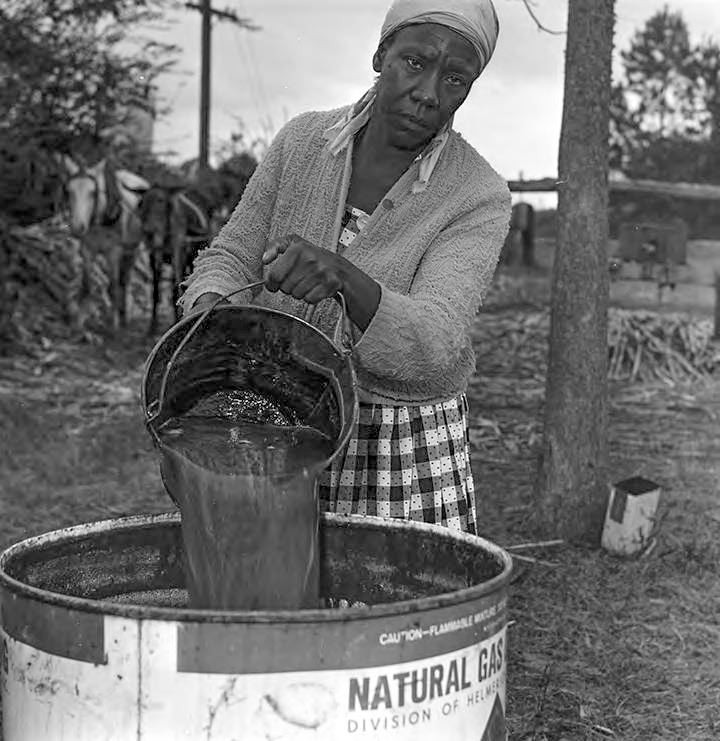
Syrup was a mainstay of southern cooking until the cost of refined sugar began to decrease in the second half of the nineteenth century as a result of the expansion of sugar refineries in Louisiana. It could be used as a substitute for sugar in any recipe and was highly prized as the perfect accompaniment for warm biscuits or even cornbread. Syrup made from both types of cane look similar. Sorghum syrup has a slightly darker, amber color and a complex, slightly earthy flavor, whereas sugarcane syrup is typically a lighter amber color with a milder, sweeter flavor.
Before the Civil War, many northern states produced sorghum syrup. In the South, sugarcane and sorghum cane were often harvested and boiled down into syrup by enslaved people. After the war, most of the production of sorghum syrup shifted to the South. The production of sugarcane syrup and sorghum syrup continued to gain importance after the Civil War. The 1900 U.S. Census indicates that 2,672,438 gallons of cane syrup had been produced in Alabama on 32,871 acres of land. The value of the syrup produced was estimated to be $1,003,922.00, which is equivalent to almost $39,000,000 today. Forty-four Alabama counties reported some production of sugarcane. In many counties, farmers would have dedicated small patches of one-half to one acre for sugarcane. Farms in the warmest part of the state often had larger tracts of 25 to 50 acres.

Demand for both types of syrup continued to be high for many years; in fact, the amount of local syrup produced rarely met the demand. This situation began to change in the 1920s as mass-produced table syrups became available in local markets throughout the year. Alabama-based brands such as ALAGA Syrup, a cane syrup manufactured in Montgomery , Montgomery County , and Golden Eagle Syrup, a blend of cane syrup, corn syrup, molasses, and honey, manufactured in Fayette, Fayette County, as well as national brand syrups, significantly lowered the demand for locally produced syrup. The onset of World War II and the rationing of refined sugar in 1941 did cause a dramatic increase in demand for locally made syrup, but this trend would only last until the end of the war. In 1945, approximately 2,860,000 gallons of syrup were produced in Alabama, but by 1954, the number had dropped to only 375,000 gallons. This decline has continued, and today locally made syrup is seen as a specialty item and is often only available at festivals, gift shops, or general stores.
Modern Economics
The value of sugarcane and sweet sorghum cane as an agricultural crop has changed dramatically in the past 50 years. Sugar’s cheap availability from global markets ended its value as a cash crop in Alabama, and nutritionists have criticized sugarcane syrup for its lack of nutritional value, but it is widely used in many popular table syrups and is prized for its flavor. In recent years, agriculturists and researchers at Auburn University and the University of Illinois have experimented with sugarcane in the production of biofuel because the juice can be fermented and easily turned into ethanol. There is the possibility that sugarcane may one day be an abundant source of jet fuel.
The future for sorghum is more certain. Sorghum syrup is high in vitamins and minerals and is regarded by many as a healthier option than sugarcane syrup. Many cooks and nutritionists recognize sorghum syrup as a delicious substitute for molasses and honey. Sorghum cane also has great agricultural value because of its versatility. The seed heads can be used as feed for chickens, and the grain, leaves, and stalks can be used as feed for livestock. In addition, once the juice has been removed from the cane, the organic waste can be easily composted and returned to the fields. As research continues, the benefits and uses of sugarcane and sweet sorghum cane continue to expand.
Syrup-Making Legacy
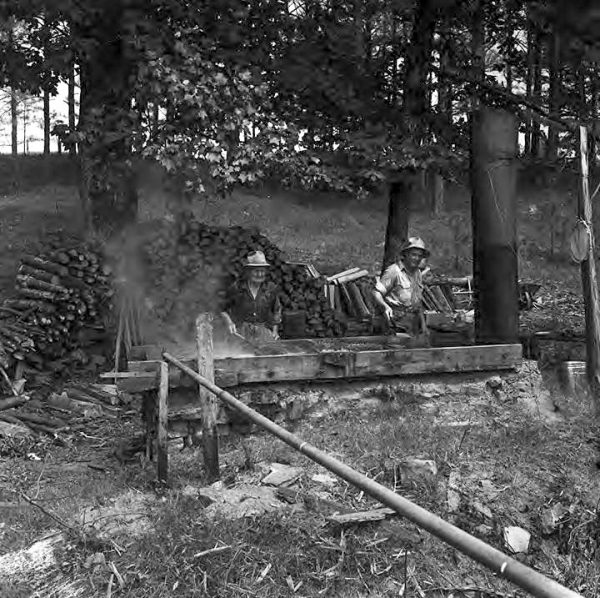
In the past, making syrup from sugarcane and sorghum cane involved several members of the family or the local community. Cane boilings, or cane grindings, as syrup making was also often called, were a yearly and highly anticipated festive fall activity. Many communities placed cane mills, which extracted the juice, and syrup kettles, in which the juice was slowly cooked, in central locations, allowing everyone in the community to watch and celebrate the event. Farmers with small holdings often brought their harvested cane to the site of the cane boiling and traded their cane for bottles of the finished syrup.
Two pieces of equipment were essential to syrup making: a cane mill and a kettle. Traditionally, the mill was powered by a mule or donkey that walked in a continuous circle as someone fed the cane into the mill. The juice was then filtered to strain out impurities before being poured into a copper or cast-iron kettle, where it would be heated up slowly. The size of the kettles varied. Some small kettles held only 50 gallons of juice, whereas others were much bigger and could hold 80 to 200 gallons of juice. The early kettles were heated over a wood fire that had to be carefully watched to ensure slow, even temperature. As the juice heated up, impurities rose to the top as foam that had to be carefully skimmed off the surface. (The skimmed portion was often used to make mash, an ingredient for moonshine, or illegally made liquor.) The juice was typically cooked for three to four hours. The amount of time the juice had to cook varied, and only a skilled syrup maker knew when the syrup was ready to be bottled. About ten gallons of juice were necessary to produce one gallon of syrup. Today, the syrup is typically cooked until it reaches a temperature of 240° Fahrenheit (~115.5° Celsius). Each rural community usually had one or two men who were recognized as skilled syrup makers, and very few people now have the expertise needed to produce quality syrup.
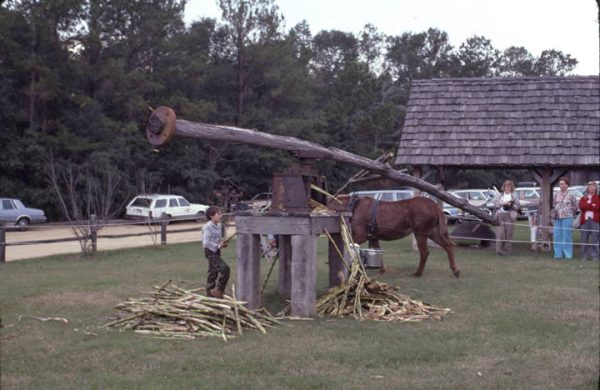
Over the years, a few innovations have made the syrup-making process easier. Many syrup makers now use an evaporator pan, which became popular in the late nineteenth century, rather than a kettle. This long, narrow pan allows the syrup to spread out more evenly and speeds up the cooking process. Today’s cane mills are often motor-powered, not mule-powered, and propane fuel is preferred over wood fires because heat from propane is simpler and more even and can be adjusted quickly. Syrup that has been overcooked will have a burnt flavor and is worthless. Today, there are a few hobbyists in the state who host private cane boilings and others demonstrate their skills at yearly syrup-making festivals open to the public.
In Alabama, there are several annual events where the art of syrup making is demonstrated, including Rikard’s Mill Historical Park in Beatrice, Monroe County; Syrup Soppin’ Day at the Lee County Historical Museum in Loachapoka, Lee County; Shelby Iron Works Festival in Shelby, Shelby County; the Clear Springs Syrup Festival in Robertsdale, Baldwin County; and Landmark Park, in Dothan, Houston County.
Additional Resources
- Bryan, Albert Hugh. Sorghum Sirup Manufacture. Sacramento, Calif.: Creative Media Partners, 2025.
- Ross, Bennett B. The Manufacture of Cane Syrup. Auburn, Ala.: Alabama Polytechnic Institute, 1905.
- Sitterson, Joseph Carlyle. Sugar Country: The Cane Sugar Industry in the South, 1753–1950. Lexington: University of Kentucky Press, 1953.