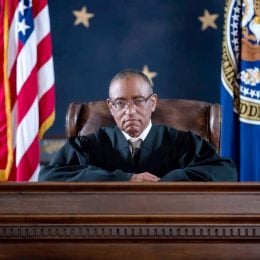
Myron Thompson

Macon County native Myron Thompson served as Alabama's first Black assistant attorney general and first Black chief judge. He has served as a federal judge for the Middle District of Alabama since 1980. In that capacity, he has made numerous important judicial decisions, including one involving the Ten Commandments monument that drew national attention. Thompson’s rulings have had a profound effect on the lives of Alabamians.
Myron Herbert Thompson was born in Tuskegee, Macon County, on January 7, 1947, to Lillian Glanton Thompson, a post office clerk, and Lawrence Thompson Sr., the owner of a shoe repair shop. Thompson has one brother. At the age of two, Thompson contracted polio; however, he underwent surgical procedures that led to his full recovery. For a decade, Thompson received treatment at the Infantile Paralysis Center on the Tuskegee Institute campus. Spearheaded by John Hume Franklin, it was the only facility in the nation that provided care for Black children with polio. Thompson’s father left the family when Myron was only five or six years old, and his mother eventually remarried. Thompson’s stepfather, Kenneth Leroy Buford, was minister of Butler Chapel African Methodist Episcopal Zion Church from 1956 until 1966, when it would be the heart of voting rights activism in Tuskegee. It hosted numerous mass meetings, including those promoting the Black boycott of White stores, known as the “Tuskegee Boycott” to protest redrawn voting boundaries that limited Black participation in city elections. The U.S. Supreme Court ruled those boundaries unconstitutional in Gomillion v. Lightfoot (1960). Thompson attended meetings there in his youth. Buford would become a field secretary of the National Association for the Advancement of Colored People (NAACP) in 1967.
Thompson went to nursery school on the Tuskegee Institute (present-day Tuskegee University) campus and then attended first through ninth grades at a private elementary school run by Tuskegee University and taught by its students and faculty. Thompson graduated as salutatorian from Tuskegee Institute High School, a public high school near the college campus, in 1965. Thompson then earned his bachelor’s degree in political science from Yale University in 1969 and his law degree from Yale Law School in 1972. Thompson earned the Yale Law School Award of Merit, the most prestigious award granted to Yale Law School graduates.
After Thompson graduated, Alabama attorney general Bill Baxley selected him as the first Black assistant attorney general in Alabama. Thompson served from 1972-74, at which time he went into private practice in Dothan, Houston County, his mother’s hometown. There, he became the county’s only Black lawyer. While in private practice until 1980, he encountered diverse types of law, ranging from civil rights and discrimination cases to employment and divorce cases. Thompson’s emphasis on civil rights litigation was unique among Dothan attorneys. In 1977, Thompson founded Alabama Legal Services Corporation, an organization providing legal assistance to low-income residents, which later merged with similar organizations to form Legal Services Alabama.
Thompson married Ann Nichelle Oldham in 1979, and they have four children. Two of the children, twins, have since died of sickle cell disease. In April 2025, Ann and Myron Thompson established the Lilly and Miles Oldham Thompson Fund, which supports the University of Alabama at Birmingham’s (UAB) sickle cell clinic, in their honor.
In 1980, Pres. Jimmy Carter nominated Montgomery-born civil rights leader Fred Gray for appointment to the U.S. District Court for the Middle District of Alabama to replace Frank Minis Johnson, but, due to his association with the civil rights movement, his nomination was not proceeding well. Recognizing that he was likely to be rejected, Gray approached U.S. senator Howell Heflin and offered to step aside if Thompson were nominated in his place. As a result, Carter nominated Thompson, who was approved by the U.S. Senate.

Thompson has served as a judge in the U.S. District Court for the Middle District of Alabama from 1980 to the present. He was a judge from 1980-2013, including chief judge from 1991-98, and senior judge, a semi-retired designation, since 2013. Thompson is the second Black judge in a federal district court in the state, after U.W. Clemon.
The Middle District is located in Montgomery and regularly makes important judgments regarding civil rights cases. During his tenure Thompson has ruled in numerous historically significant civil rights cases. In the 1983 Paradise v. Prescott case, Thompson ruled that, to counterbalance racial disparities, half of all Alabama state troopers promoted to the rank of corporal or above had to be Black. The case, under the name Paradise v. Allen, would later reach the Supreme Court, which upheld Thompson’s decision. In Dillard v. Crenshaw County (1986), Thompson found that at-large systems, in which all of a county’s citizens vote for each seat, diluted the Black vote. The case led to numerous related cases, including Dillard v. Baldwin County Commission (1988), in which Thompson determined that, to comply with the Voting Rights Act of 1965, the county must replace its at-large election system in favor of single-member districts that could allow for greater Black representation, including the potential for majority-Black districts. In Gay Lesbian Bisexual Alliance v. Sessions (1996), Thompson ruled that it was unconstitutional for Alabama’s colleges and universities to discriminate against gay groups and organizations by declining to fund them. In 1998, Thompson ruled that the use of hitching posts (horizontal bars used to handcuff an incarcerated person in a standing position) in Alabama’s prisons constituted “cruel and unusual punishment,” therefore violating the Eighth Amendment. In 2002, Thompson ruled that the granite monument of the Ten Commandments chief justice of the Alabama Supreme Court Roy Moore installed at the Alabama Judicial Building violated the First Amendment’s Establishment Clause and later ordered it removed.

In several recent cases, Thompson has ruled against abortion restriction laws in the state. In the 2014 case Planned Parenthood Southeast, Inc. v. Strange, he ruled that an Alabama law restricting abortion was unconstitutional because it intentionally implemented a substantial obstacle on women seeking abortions. In 2019, Thompson prohibited the Human Life Protection Act, which would have made it a crime for abortion clinics and doctors to perform abortions in the state, from becoming law in Alabama. In 2020, Thompson blocked the attempt to restrict abortions during the COVID-19 epidemic, ruling that a woman’s right to end her pregnancy superseded any possible harm from the virus. (In 2022, after the U.S. Supreme Court overturned Roe v. Wade in its Dobbs v. Jackson ruling, the Human Life Protection Act ultimately went into effect in the state.)
When the Montgomery bus station where the Freedom Riders were assailed in 1961 was scheduled for demolition, Thompson advocated for its preservation and helped foster its transformation into the Freedom Rides Museum in 1995. The Freedom Rides Museum is part of the United States Civil Rights Trail.
Over the course of his career, Thompson has been the recipient of awards from numerous organizations. They include the Harvard Civil Rights-Civil Liberties Law Review, the Yale Black Law Students Association, Faulkner University’s Thomas Goode Jones School of Law, the National Bar Association Judicial Council, and Stanford Law School. In 2017, Thompson was named an Alabama Humanities Foundation (present-day Alabama Humanities Alliance) fellow for his many contributions to the growth of the humanities in Alabama. In 2026, Thompson was selected for inclusion in the American Philosophical Association.