Faya Ora Rose Touré
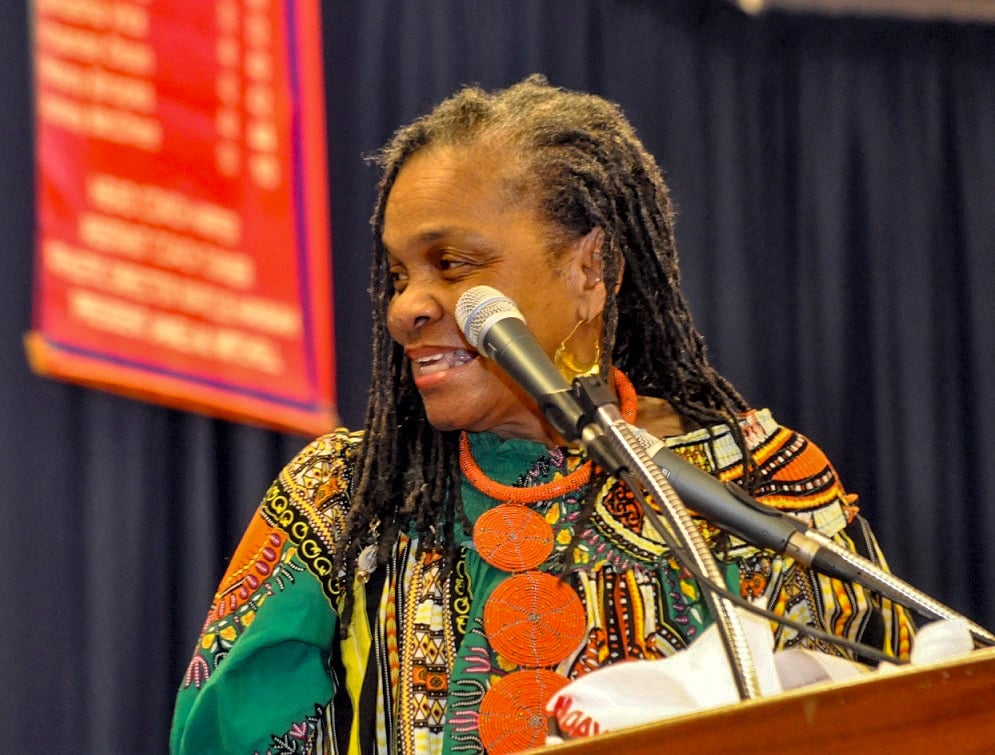
Faya Ora Rose Touré (1945- ) is a civil rights activist, civil rights attorney, and education activist based in Selma, Dallas County. Previously known under the name “Rose Sanders,” she changed her name in 2002, considering it her enslaved name; she took the name “Touré” in honor of Guinea’s first president, Ahmed Sékou Touré. Touré became Alabama’s first Black woman judge in 1973. She has been a polarizing figure in Selma, with some news outlets portraying her as a heroic civil rights leader who has greatly improved the lives of Black people in Alabama, while other media sources consider her a troublemaker and agitator.
Born Rose M. Gaines on May 20, 1945, in Salisbury, North Carolina, to Damon A. Gaines, a minister, and Ora Lee Gaines; she was one of six children. She graduated summa cum laude from Johnson C. Smith University in Charlotte, North Carolina, in 1966. In 1969, she graduated from Harvard Law School, where she won the Herbert Smith Fellowship. In 1970, she married Henry “Hank” Sanders, who also graduated from Harvard Law School; together, they have three children and raised four foster children. Baldwin County native Hank Sanders would serve in the Alabama Senate from 1983 to 2018 and was succeeded by daughter Malika Sanders-Fortier.
After Touré and Sanders graduated from Harvard Law School, the couple moved to Nigeria for a year before moving to Huntsville, Madison County, where they both worked as lawyers. Shortly thereafter, Touré wanted to move to Harlem, New York, but, at her husband’s prompting, they instead moved to Selma to help combat racial injustice in that city. In the ensuing decades, the couple would feature prominently in Selma’s politics, with both working as attorneys and playing a leading role in local movements. In addition to her legal career and local activism, Touré was elected as a judge for Selma’s municipal court in 1973, thereby becoming the first Black woman judge in Alabama; she served until 1977.
In 1972, while still known as Rose Sanders, she and Hank Sanders joined J. L. Chestnut as partners in the Selma-based law firm Chestnut, Sanders, Sanders, Pettaway & Campbell, LLC, which became Alabama’s largest Black law firm. Touré soon became known for her outspoken views. The firm secured a court-ordered legislative redistricting in 1983. The newly drawn map helped secure more Black representation in Alabama’s legislature, including the election of Hank Sanders to the Alabama Senate that same year. The firm’s most famous legal cases were the class-action lawsuits Pigford v. Glickman and the subsequent case Pigford v. Veneman. Heard in the U.S. District Court for the District of Columbia, the attorneys proved that the U.S. Department of Agriculture, then led by Dan Glickman (and later by Anne Veneman), repeatedly denied loans and other forms of assistance to Timothy Pigford and other Black farmers in North Carolina and gave preferential treatment to White farmers, causing many Black farmers to lose their land and livelihood. The Pigford cases resulted in more than $1 billion in damages being awarded to thousands of Black farmers and their heirs, most of whom received payments of $50,000 each.
In 1991, Touré and Marie Foster created the National Voting Rights Museum and Institute in Selma. Located adjacent to the Edmund Pettus Bridge, the museum opened to the public in 1993. This museum chronicles the civil rights struggle in Alabama and honors the heroes who made great personal sacrifices so that Black citizens could gain the right to vote and strive toward equality. It features exhibits dedicated to Selma’s civil rights history, Reconstruction, woman suffrage, Pres. Barack Obama, Jesse Jackson, Jim Clark (the notorious sheriff known for his role in Bloody Sunday), and the mass incarceration of Black Americans.
In 2001, Touré was threatened with arrest during a Martin Luther King Jr. Day parade for trying to topple the bust of Confederate general and Ku Klux Klan founder Nathan Bedford Forrest; the bust had been unveiled in 2000. She claimed that the bust, housed outside the Vaughan-Smitherman Museum and located in a Black neighborhood, was offensive and that monuments should honor activists who fought for voting rights, not Klan members. She told her supporters to tie a rope around the bust to topple it, cautioning them to avoid the bust’s neck to avoid simulating a lynching. The rope broke, and the bust was not destroyed. It was later placed in Selma's Old Live Oak Cemetery. Touré periodically removes Confederate flags at this cemetery.
Touré was arrested on July 16, 2018, for stealing campaign signs supporting county probate candidate Nicholas Switzer and leading the police on a four-block chase. She was charged with fourth-degree theft and eluding the police. The media coverage of this incident was noteworthy because it demonstrated the widespread disparity in reporting depending on the outlet. Sources differed on the number of officers present at Touré’s arrest (with one source citing only one officer and another citing seven officers), and they differed on their characterization of her motives and behavior. Touré sued the city of Selma, Police Chief Spencer Collier, and Officer Devon McGuire for $4 million for assault and battery, false arrest, unlawful imprisonment, and other charges; the Alabama Supreme Court ruled against her.
Throughout her career, Touré has been a dedicated education activist, working to improve public education in Selma. When district superintendent Norward Roussell was ousted by the White-majority school board in December 1989 for his efforts to reform the leveling system that often placed Black and White students on separate and unequal academic paths, she led community members in mass demonstrations and a boycott of public schools. Protest events included a student occupation of the Selma High School cafeteria and a six-week encampment outside of Selma City Hall that only ended when a judge ruled that the protest was interfering with city government.
Later, Touré served as president and co-founder of the 21st Century Leadership Project, a leadership development program that trains young individuals to become effective leaders in their community. She created the Coalition of Alabamians Reforming Education, which led to her co-chairing the State Commission of Standards, Performance, and Accountability, a working group focused on educational reform in Alabama. She also co-founded the McRae Learning Center, a community childhood education program for children from 12 months old through the second grade that focuses on reading, writing, math, and science. She also serves on the board of the Selma Center for Nonviolence, Truth, and Reconciliation. She has frequently spoken out against “tracking,” the directing of Black students toward remedial and unchallenging curricula, a practice common in many school systems.
In addition to her activism, Touré is also a playwright and songwriter, creating music such as the gospel song, “I’m Gonna Lift My Sister Up.” She has written more than 40 musicals, with her works addressing such topics as teen pregnancy, AIDS, and drug use. They have been performed at such venues as Selma’s Carl C. Morgan Convention Center.
Additional Resources
- Chestnut, J. L., Jr., and Julia Cass. Black in Selma: The Uncommon Life of J.L. Chestnut, Jr. New York: Farrar, Straus, and Giroux, 1990.
- Frances, Greg A. Harvest: The Story of How Black Farmers Won the Largest Civil Rights Case against the U.S. Government. Nashville: Forefront Books, 2021.
- Garner, Julianne. “‘It’s Not My History’: The White Counter-Narrative of Selma, Alabama, 1965–2015.” Master’s thesis, Auburn University, Department of History.