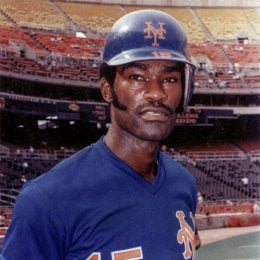
George Foster
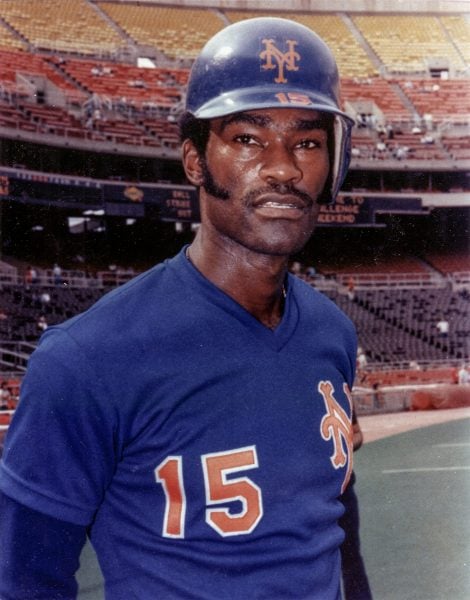
Tuscaloosa native George Foster, played major league baseball from 1969 to 1986, mainly for the Cincinnati Reds and the New York Mets. Primarily a left fielder, he was known as a powerful hitter who won the National League Most Valuable Player award (MVP) in 1977, was a five-time All Star, and three-time World Series champion.
George Arthur Foster was born on December 1, 1948, in Tuscaloosa, Tuscaloosa County, to George Foster and Regina Beale Foster. Beginning at the age of six, Foster earned extra money for his family by picking cotton, a job he found to be dull and difficult. After his parents separated when he was eight years old, he moved from Alabama to Hawthorne, California, with his mother and his two older siblings.
Foster graduated from Leuzinger High School in Lawndale, California. He played baseball and basketball in high school but stopped playing basketball when he broke his leg. After completing one year of college at El Camino College in Torrance, California, where he majored in accounting, Foster was selected by the San Francisco Giants in the third round of the 1968 baseball draft. He played in the Giants’ minor league system in 1968 and 1969 and was then promoted to the Giants in September 1969 for the last month of the season. The Giants returned Foster to the minor leagues in 1970, once again promoting him in September 1970 for the last month of the season. Foster played respectably well in the Giants’ system, but the Giants traded him to the Reds on May 29, 1971. (He joined fellow Alabamian Clay Carroll, a very successful relief pitcher for the Reds.)
Foster played for the Cincinnati Reds from 1971-81, when the team was dominating the West Division. In the 1972 National League Championship Series (NLCS) against the Pittsburgh Pirates, he appeared only as a pinch runner but scored the series-winning run in the fifth game of the series when the pitcher overthrew the catcher on a wild pitch. Although he had been playing well in 1973, the Reds returned him to their Indianapolis Indians Triple A minor league team, as the team had on several other occasions.
When Foster was given the opportunity to play every game in 1975, he blossomed into a hitting superstar whose talents contributed to the Reds’ consecutive World Series wins in 1975 and 1976 over the Boston Red Sox and New York Yankees, respectively. In game six of the 1975 World Series, he threw out Red Sox runner Denny Doyle from left field as Doyle reached home plate. Although the throw prevented the Red Sox from winning game six at that moment, the Red Sox won the game soon afterwards on Carlton Fisk’s iconic home run. The Cincinnati Reds went on to win game seven and the series. In 1976, Foster led the National League with 121 runs batted in (RBIs) and was first runner-up in the National League MVP Award voting, losing to teammate Joe Morgan. He won the award the following year in a landslide after having a very successful season, however.
In 1977, Foster hit 52 home runs, the most in MLB since fellow Alabamian Willie Mays hit 52 in 1965. He also led the majors with 149 RBIs and the National League with 124 runs scored. In 1978, Foster led the National League again in home runs (40) and RBIs (120), exhibiting great power. The following year, Foster led the Reds with 30 home runs and 98 RBIs as the Reds won the division for the first time since 1976 but lost to the Pirates in the NLCS. Foster was selected to the National League All-Star team five times, from 1976-79, and in 1981. During this time, Foster married Sheila Roberts on November 3, 1977. The couple would have two daughters.
After the 1981 season, Foster requested a five-year contract extension from the Reds, but the team refused, knowing that Foster was getting older and that his skills were declining. The team instead traded him to the New York Mets. On February 11, 1982, the Mets signed Foster to a 5-year, $10 million contract. In his years with the Mets, Foster’s power and range in left field declined notably. Foster remained productive as a hitter but not to the level he was with the Reds.
Foster was involved in two incidents in 1986 that led the Mets to release him on August 7. In July, the Mets and Reds were involved in a bench-clearing brawl and the Mets players were disturbed that Foster was too passive to support his teammates in the fight. Foster, a peaceful man who never cursed, drank alcohol, or chewed tobacco, stated that ballplayers are role models for children and thus should not set a bad example by brawling. A few weeks later, Foster lost his job as left fielder to Kevin Mitchell. While the Mets cited Foster’s declining performance, Foster claimed that they replaced him because he was Black. Many people did not take Foster’s racism claim seriously, partly because Mitchell was also Black. Mets management was insulted by the outfielder’s accusation of racism, so the team released him soon after he made this comment. After the Mets won the World Series against the Red Sox, they gave Foster a World Series ring (his third) and three-quarters of a share of the World Series bonus money. The Chicago White Sox then signed Foster but released him a few weeks later because the outfielder’s skills had clearly diminished. Foster finished his career with a .274 lifetime batting average, 348 home runs, and 1,239 RBIs.
After his retirement, Foster coached baseball at three high schools in Connecticut: Brien McMahon High School in Norwalk, Brunswick High School in Greenwich, and Sacred Heart University in Fairfield. These positions gave him the experience that led him to become a hitting instructor for Major League Baseball. Foster became a batting instructor for the Reds and later worked as a roving hitting instructor for them, alternating between teams in the Reds’ farm system. He created a baseball training facility in Cincinnati called the George Foster Baseball Clinic.
Foster was inducted into the Alabama Sports Hall of Fame in 2002 and the Cincinnati Reds Hall of Fame in 2003. Despite having an excellent career, Foster did not receive enough votes necessary for induction to the National Baseball Hall of Fame. Foster works as a consultant for Grand Slam, a company that operates 90 hitting facilities throughout the United States. He currently lives in Greenwich, Connecticut.