Robert O. Bowen
Robert Owen Bowen (1920-2003) was an author, editor, educator, and veterans advocate who spent much of his early writing career in Alabama. Over the course of five decades, he produced novels, short fiction, educational manuals, political texts, and editorial work. Bowen’s writing often reflected the influence of his military service, his academic training, and his experience as an American expatriate and later as a community leader. His earliest published work and much of his foundational development as a writer took place while he lived and studied in Alabama.
Bowen was born in Bridgeport, Connecticut, on May 7, 1920, to Charles A. and Irene (Johnson) Bowen; he was one of five children. He grew up in Connecticut and entered the U.S. Navy in 1937. At the time, he was only 17 years old and had completed just about two and a half years of high school. During World War II, he served in the Pacific and was taken prisoner in the Philippines, where he remained a prisoner of war in Japanese prison camps from 1942-45. Bowen was captured after the fall of Corregidor on May 6, 1942. He was first held at Camp O’Donnell, where prisoners faced extreme starvation and performed heavy labor, often working barefoot or with little clothing. Bowen was later transferred to Bilibid Prison and was liberated by U.S. forces on February 5, 1945. After returning from the war, he married Dorothy Edwards in 1947. The couple had one child together before their eventual divorce.
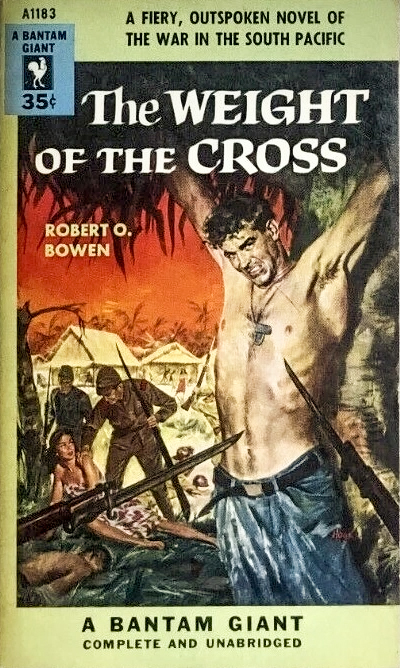
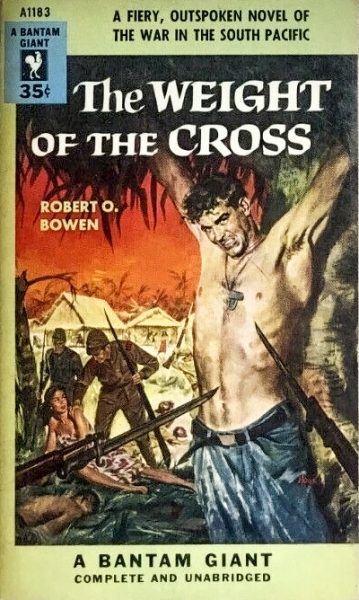
Following his military service, Bowen began his post-secondary studies. He attended the Junior College of Connecticut from 1945 to 1946 before moving to Tuscaloosa, Tuscaloosa County, to study at the University of Alabama under the GI Bill. There, he earned a bachelor’s degree in English in 1948 and a master’s degree in 1950. While at the university, Bowen studied under Hudson Strode, who was widely known for mentoring emerging writers. Bowen wrote his first novel, The Weight of the Cross, while a student in Strode’s program, and Strode praised the completed novel as one of the best produced by a student in his classes. Published in 1951, the book examines themes of guilt, spiritual recovery, and the possibility of moral renewal after extreme hardship. The novel follows Tom Daley, a Navy oiler who undergoes a breakdown before the bombing of Manila and is later captured by Japanese forces. The book was well-received by critics, who commended it for its psychological realism.
From 1952 to 1953, Bowen studied abroad at the University College of North Wales as a Fulbright Fellow. During these years, he began writing fiction and reviewing literature, contributing to major publications such as the New York Times Book Review. He also served as a consultant to the Library of Congress and several commercial publishers.
Bowen’s second novel, Bamboo (1953), was notable for its detailed depiction of prewar naval culture and cross-cultural tension between American sailors and Filipino civilians. His third book, Sidestreet (1955), was praised by critics for its frank depiction of postwar family instability and its focus on working-class psychological struggle. During the 1950s and early 1960s, Bowen held teaching and writer-in-residence positions at several universities, including the University of Alabama Extension Center, Birmingham (early 1950s), Cornell University (1953-55), the University of Iowa (1955-56), Montana State University (1956-58), and the University of Washington (1958-60). He subsequently served as an associate professor at the University of Santa Clara (1960-61), the University of Dallas (1961-63), and Alaska Methodist (1963-65).
Bowen continued writing into the late 1950s and early 1960s. In 1960, he published The New Professors, a novel exploring academic life and professional tensions within a university. That same year, his musical play, The Christmas Child, was performed by the Helena Symphony in Montana. In 1960, he also began work as an editor at Colonial Press in Northport, Tuscaloosa County. As part of his activities with Colonial Press, Bowen authored two books: College Style Manual (1962), an instructional guide for student writers, and The Truth About Communism (1962), a short nonfiction book reflecting Cold War political concerns. During this time, he also published Marlow the Master and Other Stories (1963), a collection of his short fiction exploring themes of memory, identity, and southern culture. Bowen was also an influential literary critic.
In 1963, Bowen moved to Anchorage, Alaska, where he began teaching at Alaska Methodist University and became involved in the local community. During this time, he also published An Alaskan Dictionary (1965) through Nooshnik Press, documenting regional vocabulary and reflecting his interest in local culture. Bowen remarried in 1968 to Naomi L. Misumi, and they had three children together. From 1970 to 1980, he operated the North Employment Agency in Anchorage.
He also edited several regional and national periodicals during his career, including the Dallas Review, the Alaska Review, and Fur Rendezvous Magazine. Bowen participated actively in several professional and community organizations, among them the Authors Guild, the Modern Language Association, the Alaska Press Club, the Montana Institute of the Arts, and the Mountaineering Club of Alaska. He was also a member and later president of the Anchorage Rotary Club. He remained engaged in veterans’ advocacy throughout his life and received the Alaskan of the Year Governor’s Award in 2002 for leading the creation of the Veterans Statue Project on the Delaney Park Strip in Anchorage.
Bowen remained active in writing, community involvement, and veterans’ organizations into the final years of his life. He died in Anchorage on June 9, 2003.
Works by Robert O. Bowen
The Weight of the Cross (1951)
Bamboo (1953)
Sidestreet (1955)
The New Professors (1960)
The Christmas Child (libretto). Performed by the Helena Montana Civic Symphony in 1960.
College Style Manual (1962)
The Truth About Communism (1962)
Marlow the Master and Other Stories (1963)
Alaskan Dictionary (1965)