Dixie Art Colony

The Dixie Art Colony was an informal art camp for adults that existed from 1933-45 and 1947-48. The brainchild of John Kelly Fitzpatrick and Sally Boyd Carmichael, the colony produced or promoted many noted artists of the South. Many of the Dixie Art Colony artists were known for their watercolor landscapes and still lifes in a style commonly labelled as regionalism.
The idea for the art colony was conceived around 1933 by Fitzpatrick and Carmichael, who envisioned it as a summer art school, an outgrowth of the school that Fitzpatrick directed and taught at Montgomery’s Museum Art School at the Montgomery Museum of Fine Arts. Sallie Carmichael and her husband, Malcom, provided financial and practical support for the gatherings, and Fitzpatrick served as the artistic leader. The Carmichael’s daughter, Warree Carmichael LeBron, who had studied under Fitzpatrick and elsewhere, also taught and served as a critic at the colony. The colony met in several locations throughout the years before finally establishing itself at the Carmichael family’s Lake Jordan property. Because the leaders only advertised locally, most of the participants throughout the years were from the South. A few participants attended just for amusement and were not serious artists, whereas for others art was foremost. Tuition was minimal ($15 per week or $25 for two weeks) and could be waived if a member was elevated to the level of critic for having work accepted at juried exhibitions. The colony’s only paid employees were a cook and a landscaper.

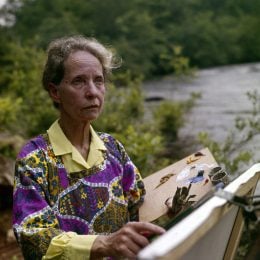
Fitzpatrick usually did not teach in a traditional sense. He believed very strongly that most art schools were too controlling; in contrast, he wanted students or artist participants to paint in their own way and develop their own style. He made himself available to give advice or teach if it was wanted. Often, though, he simply provided encouragement. Some instructors, like Frank Applebee, came on weekends and often lectured, probably in the evenings. This was also a time for participants to critique each other’s work. Despite Fitzpatrick’s encouragement of individual exploration, a number of observers, most notably Lamar Dodd, a prominent Georgia artist who visited the colony in the mid-1930s, commented that many students tended to adopt his deceptively simple style with enticing color. Most often, artists at the colony painted in watercolor because it dried quickly. In addition to popular landscapes, artists sometimes made portraits of each other or created still lifes, often with flowers. A mix of ages was typical for the colony; women typically outnumbered men.
From 1933-36, the colony met at various sites where its leaders could find a house big enough to accommodate participants. For recreation opportunities, they chose locations near bodies of water. In its first year, the camp was held for two weeks on an experimental basis at Camp Dixie, a former Boy Scout camp near Kowaliga Creek on Lake Martin in Elmore County; this prompted the colony’s name. Aside from Fitzpatrick, Carmichael, and Fitzpatrick’s friend Eloise Hawkins (later briefly a director of the Montgomery Museum), there were approximately nine participants. Sallie Carmichael’s other daughter, Caroline, assisted in preparing meals and accommodations for participants. From this first year, participants’ paintings were exhibited in the Montgomery Museum; this would become an annual tradition.

In 1934, there were two camps. The colony first gathered on the Gulf Coast at a camp in Seagrove, Florida, now part of Eglin Air Force Base, and later at a “Mr. Salzburger's place” on Spring Lake, north of Prattville, Autauga County. Beginning that year, the camp mailed out a typed information sheet to lure more participants and encourage others to return; it was likely written by Fitzpatrick. The first such sheet announced that Anne Goldthwaite, Alabama’s most highly recognized woman artist, would be a guest teacher. She taught at the Art Students League in New York and returned to her home in Montgomery for visits in the summer. Frank Applebee, head of the Art Department at Alabama Polytechnic Institute (present-day Auburn University), also participated in this second colony.
In the following two years, the colony was located on the western bank of Lake Jordan, on the Coosa River, just east of Deatsville in Elmore County. In 1935, the colony session expanded to a full month at a cabin owned by Mrs. Purnel Glass from August 6 to September 6. In 1936, the colonists met for a month at a summer home known as the Bradley cabin.

In those two years, several new participants joined who later became professional artists. In 1935, Ohioan Mildred Nungester, a public-school teacher raised in Decatur, Morgan County, joined. Her most famous work, a 1988 portrait of writer Eudora Welty, is now on display in the National Portrait Gallery in Washington, D.C. In 1936, Arthur Stewart joined the colony. Then a young man from Perry County, he had studied art as a child at the now-defunct Judson College in Marion County with Eva Lyles Wilkerson, a former student of Fitzpatrick; Stewart later found international renown as a portrait artist. Della Dryer attended several colony sessions beginning in 1935. She had had a long career and eventually settled in Birmingham, Jefferson County. An important Mississippi artist, Karl Wolfe, joined the colony in 1937 as instructor; he later married Mildred Nungester.
In 1937, the colony relocated to six acres of land on the edge of Lake Jordan owned by the Carmichaels. It was known as Noble's Ferry, for its location on Noble’s Ferry Road. After inheriting some money from Sallie’s sister, prominent Alabama educator Alice Boyd, the Carmichaels had frame buildings constructed to house and feed the colonists on the forested land. The main building, referred to as “the studio,” was a large rectangle with an extension for a kitchen with sleeping quarters for women below. Another smaller building nearby housed the men. Colonists who came by train to Deatsville, the nearest depot and mail location, could be picked up at the train station for a slight charge. Because that land had formerly been an Indian camp site, Sallie Carmichael gave it the name “Pokahutchi/Poka Hutchi,” a Creek word meaning “gathering place of picture writers," but the name Dixie persisted.

Around this time, a drawing of the studio building began appearing at the top of the information sheets. In the drawing, the studio was fully screened on the side facing the lake and partially screened on the two other sides. Colonists ate together, either in the studio or, in good weather, outside. A formal entrance to the colony was marked by a gate with the words “The Dixie Art Colony” at the top; a Confederate battle flag flew nearby. That flag had some importance, especially to people from Montgomery; as the first capital of the Confederacy, a romanticized memory of the Confederacy remained strong there.
The colony was known for its joyful atmosphere, mainly because of Fitzpatrick’s sociable and fun-loving nature, a result of trauma he suffered during World War I. Parties were held for many events, such as birthdays, and they were often masquerades. Colonists often played practical jokes on each other, and Fitzpatrick was often at the center. An automobile was available for painting excursions to nearby sites, including Jasmine Hill in Wetumpka, Elmore County, where Kelly Fitzpatrick’s cousins Ben and Mary Fitzpatrick had created beautiful gardens. For recreation, participants could swim or explore the lake and nearby creeks by boat. The colony had few rules, but swimming alone was forbidden.
The colonists’ art was exclusively visual, but some instruction was given in other media. For example, prominent Birmingham artist Richard Coe, who practiced etching, visited in 1937 to demonstrate that medium of printmaking. Karl Wolfe introduced ceramics, which could be fired from a simple hillside kiln Sallie used for china painting. Most continued in painting, however, with an emphasis on watercolor. Participants painted in a traditional, realistic style, eschewing modernist experimentation, as had Fitzpatrick.

The colony reached its height around 1940, with approximately 30 participants. Around that time, Louise Smith (Everton) joined as a new member because her art teacher in Birmingham, Hannah Elliott, attended. Genevieve Southerland, who had had a career as a teacher before motherhood, joined around 1942, arriving from the Mobile area, where she studied under Roderick Dempster MacKenzie. In fact, many of the participants were or later became teachers, coming from such locales as Birmingham and Mississippi. An important male artist in later years of the colony, Carlos Alpha “Shiney” Moon, who arrived in 1944, had had a career as a photographer in south Alabama, then became a prosperous women’s apparel merchant.
The colony began to decline after Sallie Carmichael suffered a stroke in late 1945, and sessions were not held in 1946. She recovered, but not enough to resume her previous tasks. Starting in 1947, Kelly Fitzpatrick and Warree Carmichael LeBron hosted the colony for two more years, but it became too difficult to sustain in practical and financial terms. The last sessions were held in 1948.

Inspired by the Dixie Art Colony, Genevieve Southerland organized similar artist colonies on the Gulf Coast in Mobile County at Mobile, Bayou La Batre, and nearby Coden from 1946 to 1953; the participants called themselves the “Bayou Painters.” Southerland, Fitzpatrick, and Shiney Moon were the major instructors until 1953, when all three died of heart attacks. After their deaths, Warree Carmichael LeBron held colonies on her family’s property in Rockford, Coosa County, for a few local artists in 1955 until into the 1960s. She called it the Dixie Colony, just like the original one, for the joy in painting together that the original one inspired. The Kelly Fitzpatrick Center for the Arts was established in Wetumpka in 2011 as both an art activity center and small art museum. The colony’s memory is maintained and promoted by the Dixie Art Colony Foundation, which was founded in 2015 by art historian Mark Andrew Harris, who catalogues paintings, archives newspaper articles and memorabilia, acquires colonists’ works, and lectures on the colony. In August 2024, the foundation moved from its location in Wetumpka to Prattville.
Additional Resources
- Ingham, Vicki L. Art of the New South: Women Artists of Birmingham, 1890-1950. Birmingham, Ala.: Birmingham Historical Society, 2004.
- Knight, Elliot, ed. Alabama Creates. Tuscaloosa: University of Alabama Press, 2019.
- Stuhlman, Jonathan, and Martha R. Severens, eds. Southern Modern: Rediscovering Southern Art from the First Half of the Twentieth Century. Chapel Hill: University of North Carolina Press, 2023.
- Williams, Lynn Barstis. “The Dixie Art Colony.” Alabama Heritage 41 (Summer 1996): 6-15.
- ———. The Bayou Painters: South Alabama’s Art Colony (1946-1953). Mobile: Mobile Museum of Art, 2006.
- Wolfe, Elizabeth, ed. Mildred Nungester Wolfe. Jackson: University Press of Mississippi, 2005.