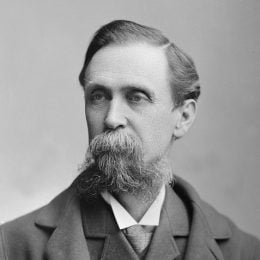
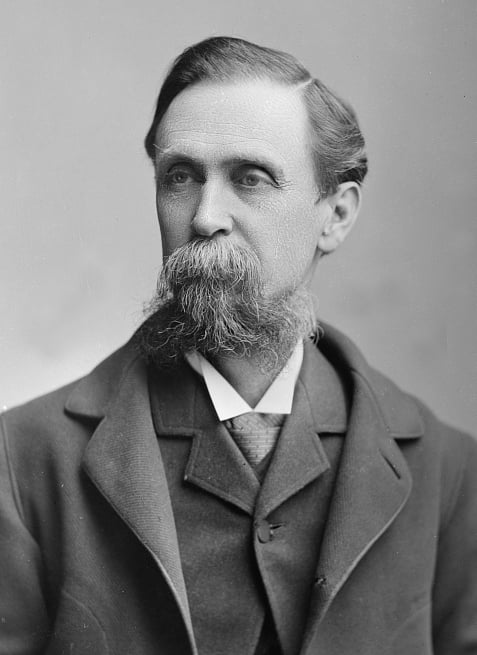
John Mason Martin
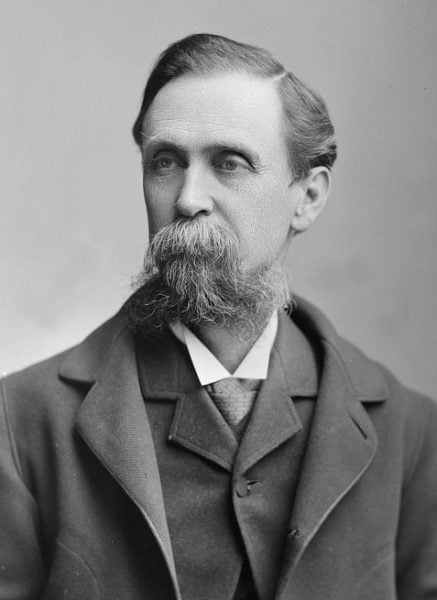
John Mason Martin (1837-1898) served as a state senator from 1871 to 1876 and as a U.S. representative from 1885 to 1887. He was a part of the rise of Confederate veterans who served in both state legislatures and the U.S. Congress following the Civil War and represents one of the last links of pre-Civil War political families to Gilded Age power, particularly in the South. Both his father and his wife’s father were important figures in the first half of the nineteenth century, and Martin’s replacement in the U.S. Congress represented a clear break with the formerly powerful planter elite, often known as the “Big Mule-Black Belt Coalition.”
John Mason Martin was born in Athens, Limestone County, on January 20, 1837, to Joshua Lanier Martin and Sarah Ann Mason Martin. One of the most prominent Alabama politicians in the first three decades of Alabama’s statehood, his father served as a U.S. representative for Alabama from 1835 to 1839 and governor from 1845 to 1847. In his youth, he studied under Henry Tutwiler, father of education reformer Julia Strudwick Tutwiler. He attended the University of Alabama before graduating from Centre College in Danville, Kentucky, in 1856. While there, he studied alongside several other future Confederate soldiers who later served in the U.S. House with him, including William Campbell Preston Breckinridge of Arkansas and James Bennett McCreary of Kentucky.
In 1857, Martin married Lucy Peck, who was the daughter of wealthy Whig lawyer Elisha Wolsey Peck. Martin and Lucy Peck had seven children together, only four of whom reached adulthood. Elisha Peck served as the Republican chief justice of the Alabama Supreme Court from 1869 to 1873, just as the young Martin’s legal career was on the rise. After studying under his father-in-law, Martin began his law practice in Tuscaloosa, Tuscaloosa County, in the late 1850s. By 1860, Martin owned three enslaved individuals and more than $12,000 in real estate. He continued as a lawyer until he joined the Confederate Army during the Civil War.
Martin returned to Alabama after the war and opened a law practice in Tuscaloosa during the late 1860s. He was elected to the Alabama State Senate in 1871, and he became the president pro tempore of the chamber in 1873. Martin was a delegate for Tuscaloosa County at the State Convention of the Democratic and Conservative party in 1874. He served in the state legislature until 1876, when he returned to his law practice. He also worked as a professor at the University of Alabama in the late 1870s and early 1880s.
In 1884, Martin successfully sought the Democratic nomination for the Sixth Congressional District seat after the retirement of fellow Confederate veteran Goldsmith Whitehouse Hewitt. The district then consisted of Fayette, Greene, Jefferson, Lamar, Marion, Pickens, Sumter, Tuscaloosa, Walker, and Winston Counties. The contest was difficult, and he defeated several candidates, including John Hollis Bankhead, who would later become the longest-serving Confederate veteran congressman in the nation. In the House, Martin reunited with fellow Centre College alumni and Confederate veterans James Bennett McCreary and William Campbell Preston Breckinridge, both of whom were also first-term congressmen. Martin served on the House Elections Committee and the House Patents Committee during his single term.
During the 1886 Democratic primary campaign, Martin again faced a formidable challenge from Bankhead for the Democratic nomination. Bankhead was an excellent campaigner, and he attacked Martin’s support for a tariff law proposed by the chairman of the House Ways and Means Committee, Democrat William Ralls Morrison of Illinois. Morrison proposed lower tariff rates for many commodities, and newspapers frequently criticized the plan as the “horizontal tariff.” The “horizontal” tariff meant that the tariff would be lower for many products rather than for a single commodity. Martin was a vocal supporter of the tariff, and most of his fellow Democrats opposed the measure for its widespread cuts and the lack of protections it provided for Alabama’s agricultural interests. Bankhead defeated Martin for the Democratic nomination after 154 ballots, and Martin never again served in public office.
In the ensuing years, John Mason Martin returned to practice law in Tuscaloosa. He died on June 16, 1898, on his way home from a visit to Centre College and his sister in Kentucky. He is buried in Greenwood Cemetery in Tuscaloosa.
Additional Resources
- Frederickson, Kari A. Deep South Dynasty: The Bankheads of Alabama. Tuscaloosa, Al.: The University of Alabama Press, 2022.