Marable v. Alabama

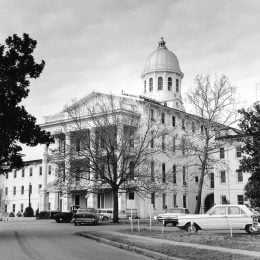
Marable v. Alabama Mental Health Board was a federal court decision in 1969 that ended racial discrimination and segregation in Alabama’s state hospitals for the mentally ill and the developmentally disabled. Marable was litigated in the U.S. District Court for the Middle District of Alabama at a time when Alabama operated two state hospitals in Tuscaloosa, Tuscaloosa County, with separate facilities for Black and White patients: Bryce Hospital, for psychiatric patients, and Partlow State School and Hospital, for people with intellectual disabilities. In addition, three facilities served only Black patients: Searcy Hospital, in Mount Vernon, Mobile County, and two institutions associated with Bryce Hospital, Treatment Center Number Two and the Bryce Hospital Farm Colony for Negroes, both in Northport, Tuscaloosa County.
Bryce Hospital had been established in 1852 as the Alabama Insane Hospital. It opened its doors to its first patients in 1861, with physician Peter Bryce as superintendent. Searcy Hospital, an all-Black psychiatric institution, was established in 1900 at the Mount Vernon Armory as the Mount Vernon Insane Hospital and was later named for Bryce superintendent James T. Searcy. It opened to patients in 1902. Partlow, also known as the Partlow State School for Mental Deficients, was established in 1923 and was the only facility in the state to treat the intellectually disabled until 1970. It was named for William Partlow, its first superintendent and a strong supporter of eugenics. Established in 1927, the Bryce Hospital Farm Colony for Negroes enlisted mentally ill patients to perform farm labor in support of the nearby Bryce Hospital. In 1962, Bryce Hospital opened Treatment Center Number Two, a modern 160-bed psychiatric hospital on State Farm Colony property in nearby Northport; it was intended to serve Black patients from Alabama’s northern and central counties.
Discrimination in Care and Facilities

Marable comprised three lawsuits, which were eventually consolidated into one case. The first was brought on November 17, 1967, by the state of Alabama against the U.S. Department of Health, Education, and Welfare (HEW). This suit alleged that HEW had unlawfully withheld federal financial assistance for noncompliance with Title VI of the recently enacted 1964 Civil Rights Act, which prohibits states from denying services funded with federal dollars to anyone on the basis of race, color, or national origin. The second was a class action brought by the Legal Defense Fund (LDF) against the Alabama Mental Health Board on behalf of Loveman Marable, a patient at Bryce Hospital, and Nathan Brown Jr. and James Nichols, patients at Searcy Hospital. The LDF claimed racial discrimination in Alabama’s mental health facilities violated the Equal Protection Clause of the Fourteenth Amendment. The third lawsuit was a counterclaim against Alabama by HEW to enforce Title VI of the 1964 Civil Rights Act.
In 1969, the level of care for patients in Alabama’s large state hospitals had been and continued to be woefully inadequate, due to underfunding and overcrowding, and conditions for Black patients were markedly inferior to those for White patients. At Bryce, there were 23 physicians, one for every 220 of the hospital’s 5,100 White patients. For Searcy’s 2,500 Black patients, there were five doctors, one for every 500 patients. There were no medical specialists at Searcy and four of its doctors were Cuban refugees who were not licensed to practice medicine in the state. Bryce had the services of nurses in training, but no nurses' training program had ever existed at Searcy. At the Partlow State School and Hospital there were significant differences in the quality of accommodations and care for White and Black patients. There were no Black professional staff members, such as physicians and psychologists, at any of the state institutions.

The Black patients on Bryce Hospital’s main campus in Tuscaloosa lived in inferior facilities known as Ward X and the Laborers’ Lodge, both located at the back of the hospital campus. The men and women housed in these buildings worked in the hospital laundry and its farm fields. They did not have access to the programs that were available to Bryce’s White patients. Although Treatment Center Number Two was a modern facility with operating rooms, a laboratory, and other amenities, it did not provide its patients with the range of benefits available at Bryce Hospital, eight miles away. The State Farm Colony for Negroes in nearby Northport was a 3,000-acre plantation that produced cash crops and foodstuffs for the support of Bryce Hospital. The only “treatment” available to its residents was farm labor or work in the Colony’s laundry.
Evidence of State Violations
Much of the evidence presented in the Marable case came from the investigative work of John LeFlore, executive secretary of the Mobile Branch of the NAACP, and Special Counsel Marilyn G. Rose from HEW’s Office of Equal Health Opportunity. LeFlore had been documenting conditions in Searcy Hospital for more than a decade and worked closely with the LDF to develop its discrimination case. Rose’s fact-finding tours of Alabama’s state institutions in 1967 provided critical evidence in support of HEW’s action. LeFlore and Rose documented Black patients from Searcy who worked on the Bryce Hospital farm and at the Negro Farm Colony, substandard wards for Black patients living at Bryce Hospital, censorship and theft of Searcy patients’ mail, and female patients at Searcy forced to fill and cart wheelbarrows of coal from the pile to the hospital kitchen. Rose’s evidence was initially presented as part of the case argued by the HEW before Administrative Law Judge Irving Sommer with the Social Security Administration’s Bureau of Hearings and Appeals, in April 1967. Sommer found Alabama in breach of the Civil Rights Act. He recommended that the U.S. Surgeon General and the Secretary of Agriculture terminate and refuse grants or continue federal financial assistance for the operation of the Alabama mental health system until such time as it ended its noncompliance. Federal funding for mental health services was then frozen until the federal government determined that Alabama was in compliance with Title VI.

Alabama reportedly received between $500,000 and $800,000 annually for its mental health program through grants from the federal Public Health Service and in the form of surplus food commodities from the Department of Agriculture. Alabama, however, had made it clear that it did not intend to bring its hospitals into compliance with Title VI. Hospital superintendent James S. Tarwater and his staff began integrating Bryce and Searcy hospitals in April 1966 by transferring 30 White patients from Bryce to Searcy. They also began moving the same number of Black patients from Searcy to Bryce and relocating the patients from Bryce’s “work wards” into its main wards. But Gov. George C. Wallace, in turn, ordered that all of the patients be returned to their former facilities, and the State Mental Health Board complied. Tarwater then notified the Public Health Service in June that his board would take no further steps toward complying with Title VI.
Case Adjudicated
On February 11, 1969, the court’s three-judge panel, consisting of Circuit Judge John Godbold, District Judge Thomas Pittman, and District Judge Frank M. Johnson, ruled in Marable that segregation and discrimination in the operation of Alabama's mental health system violated the Equal Protection Clause of the Fourteenth Amendment. The state was given one year to desegregate Bryce and Searcy hospitals and three months for Partlow. In its decision, the Court states that its order will put Alabama in compliance with the requirements of Title VI, permitting it to be eligible again for federal assistance for its mental health program. Partlow was totally integrated within a few months. The desegregation of Bryce and Searcy was completed by the end of December 1970, with patients from the southern third of the state placed at Searcy Hospital and those from the northern two-thirds placed at Bryce. A similar case, Wyatt v. Stickney, had been filed in federal court in October 1970; it alleged inadequate care for mentally ill patients at Bryce and later included patients at Partlow and Searcy. This long-litigated case would eventually lead to improved care and better advocacy for these patients.
Additional Resources
- Smith, Kylie M. Jim Crow in the Asylum, Psychiatry and Civil Rights in the American South. Chapel Hill: University of North Carolina Press, 2026.
- Smith, Kylie M. “No Medical Justification: Segregation and Civil Rights in Alabama's Psychiatric Hospitals, 1952-1972.” Journal of Southern History 87, no. 4 (November 2021): 645-672.
- Stefan, Susan. “Wyatt and ‘Psychiatric Jim Crow.’” Law & Psychology Review 46 (2021-2022): 229-240.