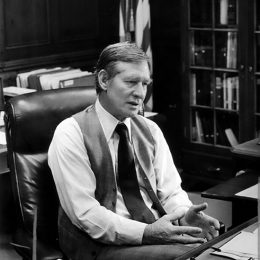
Thomas Virgil Pittman

Thomas Virgil Pittman (1916-2012) was a U.S. District judge for the Middle and Southern District Courts of Alabama who later served as chief judge of the Southern District. He then was senior judge until his March 28, 2006, retirement on his 90th birthday. Pittman was known for his judicial rulings that broke down racial barriers and extended civil and voting rights in Mobile, Mobile County, and southwest Alabama. His decisions, some highly controversial, led to the hiring of more Black police officers, desegregation of schools, improvements to county jails, and most notably the election of Black candidates to local government offices following the 1980s Bolden v. Mobile case.
Pittman was born on March 26, 1916, in Enterprise, Coffee County, to Walter Oscar Pittman and Annie Lee Logan Pittman. Following his graduation from Enterprise High School, Pittman received a bachelor of science degree from the University of Alabama in 1939 and a law degree from the University of Alabama School of Law in 1940. He was a special agent for the Federal Bureau of Investigation from 1940 to 1944, serving as an undercover agent in Ecuador investigating Nazi financial activities in South America, then, probably in classified work, on the Manhattan Project in New Mexico. Pittman served in the U.S. Army Reserve from 1938 to 1942, then in the U.S. Navy Reserve from 1944 to 1946 as a lieutenant junior grade aboard the troop transport ship USS Wharton (AP-7) in the Pacific theater of operations. In 1944, while on active naval duty, in Cambridge, Massachusetts, Pittman married Floy Lassiter, with whom he would have two children. (He later married Lily Lea Verneuille several years after the 2000 death of Floy.)
Following his discharge from the U.S. Navy, Pittman practiced law in Gadsden, Etowah County, from 1946 to 1951. He then became a circuit judge of the 16th Judicial Circuit Court of Alabama, from 1951 to 1953, and presiding judge of that circuit from 1953 to 1966. He was also a lecturer at the Gadsden Center of the University of Alabama from 1948 to 1966.
On June 13, 1966, Pres. Lyndon B. Johnson appointed Pittman as judge of the U.S. District Courts in a position jointly serving both the Middle and Southern Districts of Alabama. He was confirmed by the U.S. Senate on June 29, 1966, and received his commission on June 29, 1966. For several years, he traveled a circuit of federal courthouses in Montgomery, Mobile, Selma, Dothan, and Opelika. Pittman made history by appointing the first female foreman of a federal grand jury in Mobile in 1968 and by hiring the first Black law clerk in Mobile federal court a decade later. During this time, he also served with fellow Middle District Court judge Frank M. Johnson Jr., who would also gain fame as a supporter of civil rights. On June 2, 1970, Pittman’s joint assignment ended, and he was reassigned to the Southern District, whereupon his service in the Middle District ended. He served as chief judge of the Southern District from 1971 to 1981.
The 1960s and 1970s were turbulent times, and the Middle and Southern Districts were ground zero for the enforcement, over massive resistance, of the Civil Rights Act of 1964 and the Voting Rights Act of 1965. Some of Pittman’s important decisions enforced these two statutes. He ruled in 1968 that the Choctaw County school system had to have at least one Black teacher for every six White teachers and that majority White schools must have a Black enrollment of at least 20 percent within two years. In 1971, he ruled that Black Mobile police officers, because of historical discrimination against them, should be given an advantage over Whites when computing seniority as part of promotions. In 1976, he declared that the city of Mobile's commission form of government was unconstitutional because it discriminated against Black candidates and voters. No Black person had ever been elected city commissioner in an at-large race.
In 1978, Pittman ordered the reinstatement of two teachers after finding unconstitutional a Mobile County school board policy that allowed the board to ratify personnel decisions of principals without granting the affected employees a hearing. Also that year, he ordered the Mobile Police Department to promote three Black officers to sergeant and to develop a new system to evaluate and promote police employees. Later, he enforced a wide-ranging 1980 order to improve conditions at the Choctaw County jail in Butler, including prohibiting officials from serving meat from animals killed on roadways, or “roadkill.”
In 1981, Pittman declared that the Mobile County jail was "grossly inadequate," that 110 inmates had to be removed, and that the jail must be upgraded. He began fining the county $5,000 per day for jail overcrowding, with fines eventually reaching almost $4 million. The county actually paid $175,000, which Pittman used to set up a program to help some poor defendants make bond.
In perhaps his most significant ruling, Bolden v. Mobile, Pittman struck down the city of Mobile’s system of electing its city commissioners at large, a system that had effectively disenfranchised the city’s sizable Black population since 1911. Although the decision was reversed by the U.S. Supreme Court, the case was settled in 1983 favorably to the Black plaintiffs after evidence of discriminatory intent in establishing the at-large system became known. This historic decision virtually ended unfair racial discrimination in local elections, not only in Mobile but in many other jurisdictions. It also led to a widespread backlash from local White politicians and media. For example, Mobile school board member Dan Alexander in 1982 called Pittman a “gutless wonder,” and the Mobile Press-Register editorial page regularly criticized his decisions during the 1970s and 1980s. The backlash was such that Pittman stopped going to church for several months out of fear that his presence might put others in danger. In contrast, James Blacksher, the prominent Birmingham civil rights lawyer who unsuccessfully argued the Bolden case before the Supreme Court, has noted that Pittman and Judge Frank Johnson delivered justice to Black people at a time when the courts were their last refuge. Blacksher also considered Pittman and Johnson among the greatest judges who have ever served in Alabama.
Like Johnson and other courageous federal judges in the Deep South, the public perception of Pittman’s judicial decisions and reputation changed with the times. He received the 2007 Howell T. Heflin Award from the Mobile and Baldwin County Bar Associations, an annual award presented to judges and lawyers who have brought honor to the legal profession. The Mobile-Press Register later apologized to Pittman for its criticism of his rulings in the Bolden case. Pittman was a member of First Baptist Church of Mobile, where he taught Sunday School and was a member of the Board of Deacons. He was elected to the Samford University board of trustees in 1974 and later became a life trustee. While a federal judge, Pittman volunteered for a meals-on-wheels program, delivering meals to the elderly. Scrupulous about court finances, he would not make personal long-distance phone calls in his judicial chambers to be certain the calls would not be charged to taxpayers. Pittman died on January 6, 2012, at the age of 95. He is buried at Pine Crest Cemetery in Mobile.
In 2022, Pittman was elected to the Alabama Men’s Hall of Fame, a decision supported by both of Alabama’s U.S. senators, Democrat Doug Jones and Republican Richard Shelby, and all judges of the Southern District of Alabama. His nomination was also encouraged by many other legal authorities and scholars in the state, including Bryan A. Stevenson, the founder and executive director of the Equal Justice Initiative, Neal Berte, the president emeritus of Birmingham Southern College, Henry C. Strickland III, the dean of the Cumberland School of Law at Samford University, and Bryan K. Fair, the Thomas E. Skinner Professor of Constitutional Law at the University of Alabama School of Law. In 2021, the city of Mobile and the Dora Franklin Finley African American Heritage Trail erected an historic marker dedicated to Pittman and Wiley Bolden, co-plaintiff in the Bolden case, at the intersection of St Joseph Street and St. Louis Street.