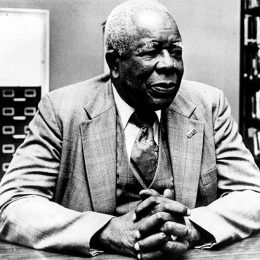
Nixon v. Brewer

Nixon v. Brewer originated in the U.S. Middle District of Alabama on January 13, 1970, when Edgar Daniels (E.D.) Nixon, a prominent Montgomery civil rights organizer, brought a class action lawsuit against Gov. Albert Brewer on behalf of the Black voters of Montgomery, Mobile, and Jefferson Counties, claiming that Alabama voter apportionment did not offer equal voting power to Black voters. The case was later consolidated into Sims v. Amos (1974), where the decision was affirmed by the U.S. Supreme Court in a summary affirmance, meaning the court determined that the lower court’s decision would stand.
Historical background
Although the passage of the 1965 Voting Rights Act led to a dramatic increase in Black voting, by 1970, no Black state senators had been elected in Alabama since the Reconstruction era. The lack of Black representation was due, in large part, to the district system of the legislature. Civil rights leader E.D. Nixon sued Alabama governor Albert Brewer in 1970 with the aim of creating a fairer legislative apportionment system with greater potential to elect Black state senators.
Until the 1960s, Alabama had elected its state legislators by county under the apportionment rules set in the 1901 Constitution. Alabama’s population had shifted dramatically since then, with a large proportion of people moving from rural areas to cities, particularly Birmingham, Montgomery, and Mobile. The apportionment rules were based on population patterns from more than half a century before, thereby giving more power to rural voters than urban ones. Because Alabama’s biggest cities had a higher concentration of Black voters than White voters, the rules effectively diluted Black voting power.
This precedent changed with the Baker v. Carr (1962) decision, which held that state apportionment issues could be heard in federal court. In Reynolds v. Sims (1964), the U.S. Supreme Court held that both houses of state legislatures had to have districts that were roughly equal in terms of population. Alabama adopted a new system of representation as a response to Reynolds; however, the new system still greatly limited Black voting power. Some districts elected multiple senators on an at-large basis, with the candidates who received the most votes winning the seats, while the remaining districts elected only one senator each. The three counties with multiple senators were Mobile County, Jefferson County, and Montgomery County, which elected 2, 7, and 3 senators, respectively. No Black state senators were elected under the new system, despite the large Black populations in those three counties. In 1970, Fred Gray (the noted civil rights attorney who had represented Rosa Parks and Martin Luther King Jr., among others) and Thomas Reed (then a teacher at present-day Tuskegee University) became the first Black representatives to be elected to the Alabama House of Representatives since Reconstruction. Gray and Reed both represented Barbour, Bullock, and Macon Counties for the Democratic Party and the National Democratic Party of Alabama, respectively.
Going to Court
Represented by the recently founded Southern Poverty Law Center, Nixon first argued for a preliminary injunction against the system and lost, partially because the courts hoped that the legislature would act. After the state legislature failed to address the issue, the Nixon case, along with one other case, was later consolidated with Sims v. Amos. In the consolidated case, the plaintiffs argued that the system failed to give Black voters adequate representation and that it aimed to prevent Black candidates from winning elections. This case was heard by a three-judge panel consisting of Richard Rives of the Fifth Circuit Court of Appeals and U.S. District Court judges Frank Johnson and Daniel Thomas, who served in Alabama’s Middle District and Southern District, respectively. Both Rives and Johnson had prior history in civil rights cases, with both ruling in favor of desegregating Montgomery’s buses in Browder v. Gayle in 1956 and desegregating Alabama’s public schools in Lee v. Macon County Board of Education in 1967. Thomas’s record on civil rights was mixed. In Birdie Mae Davis v. Board of School Commissioners, Mobile, filed in 1963, he allowed Mobile to adopt a slow “freedom of choice” school desegregation plan, while also making findings of fact in favor of civil rights in other cases.
In the case before the court in 1970, the facts were relatively clear. No Black candidates had won election in 1966, and none had won since Reconstruction. The judges heard arguments about whether or not the courts were the proper place for redress (because the legislature had failed to act, the court held that they were) and whether an election should be ordered in 1972, half-way through the four-year term, in order to fix the errors of the previous map (the court held that it did not need to do this). The maps suggested by the plaintiffs, including Nixon, were approved. This system created single-member districts, rather than the mix of single and multiple representative districts. This change in voting was important, as no longer could a county be represented by multiple people, or a group of counties be represented by multiple people. This meant that each legislative district elected a single representative, and prevented a county from creating a system that would deny Black representatives the chance to win.
Results
The maps eventually resulted in more Black representation, and fairer representation in general. Before the 1972 legal victory, only two Black legislators had been elected since Reconstruction, but, by 1974, some 15 Black legislators were serving in the Alabama legislature. This was due in large part to the fairer districts that were created. Political participation continued to increase throughout the next 50 years. While this lawsuit addressed apportionment at the state level, it should be noted that, as of 2026, no Black Alabamians have served as U.S. Senators and only seven Black Alabamians have been members of the House of Representatives (with three of those serving during Reconstruction).
Additional Resources
- Blacksher, James, Edward Still, Jon M. Greenbaum, Nick Quinton, Cullen Brown, and Royal Dumas. “Voting Rights in Alabama: 1982-2006.” Southern California Review of Law and Social Justice 17, no. 2 (2008): 249-281.
- Gaillard, Frye. Cradle of Freedom: Alabama and the Movement that Changed America. Tuscaloosa: University of Alabama Press, 2004.
- King-Meadows, Tyson D. When the Letter Betrays the Spirit: Voting Rights Enforcement and African American Participation from Lyndon Johnson to Barack Obama. Lanham, MD: Lexington Books, 2011.
- Rhodes, Jesse H. Ballot Blocked: The Political Erosion of the Voting Rights Act. Stanford, CA: Stanford University Press, 2017.
- Ross, Deuel. “Voting Rights in Alabama, 2006 to 2022.” University of Pennsylvania Journal of Constitutional Law 25, no. 2 (2023): 252–310.