Sylacauga
 Avondale Mills, Sylacauga
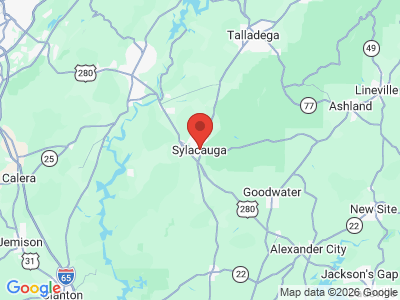
Often referred to as the Marble City, Sylacauga sits atop a bed of mostly white Madre Cream marble 32 miles long, a mile and a half wide, and 400 feet deep. In 1905, this marble drew Italian sculptor Giuseppe Moretti, who created Red Mountain's Vulcan statue, to the area to establish a marble works and a studio. Sylacauga is also notable as the site of the only documented instance of a meteorite hitting a living person, Ann Hodges of the Oak Grove community, who was struck while napping in her home on November 30, 1954. The city was also home to a large textile manufacturing center owned by the Comer family. Located in the southeast corner of Talladega County, Sylacauga lies in the Coosa River Valley along the lower reaches of the Appalachian Mountain Range. The city has a mayor/council form of government. Actor and singer Jim Nabors was born in Sylacauga, and a section of U.S. Highway 280 that runs past the town was named the Jim Nabors Highway in his honor. Congressman William Flynt Nichols spent the majority of his life in the town, as well.
Avondale Mills, Sylacauga
Often referred to as the Marble City, Sylacauga sits atop a bed of mostly white Madre Cream marble 32 miles long, a mile and a half wide, and 400 feet deep. In 1905, this marble drew Italian sculptor Giuseppe Moretti, who created Red Mountain's Vulcan statue, to the area to establish a marble works and a studio. Sylacauga is also notable as the site of the only documented instance of a meteorite hitting a living person, Ann Hodges of the Oak Grove community, who was struck while napping in her home on November 30, 1954. The city was also home to a large textile manufacturing center owned by the Comer family. Located in the southeast corner of Talladega County, Sylacauga lies in the Coosa River Valley along the lower reaches of the Appalachian Mountain Range. The city has a mayor/council form of government. Actor and singer Jim Nabors was born in Sylacauga, and a section of U.S. Highway 280 that runs past the town was named the Jim Nabors Highway in his honor. Congressman William Flynt Nichols spent the majority of his life in the town, as well.
Early History
On December 18, 1832, the Alabama State Legislature created Talladega County from Creek land ceded in March under the Treaty of Cusseta, and settlers streamed in. The city's name, however, can be traced to a group of Shawnee warriors who came south from Ohio in 1748 and established the town of Chalakagay. Over time, the name evolved to Souillacouga and then to Syllacoga by 1838. It became Sylacauga in 1887. The commercial marble quarries that became a signature for Sylacauga began operations a few years later.
Physician Edward Gantt, who had purchased quarry land near Sylacauga as early as 1834, moved to the area in 1849 and, with partners Edward Sims and Henry McKenzie, developed marble quarries north and south of present-day Sylacauga. The Gantt's Quarry company village associated with the Alabama Marble Company is named for him. The other name most often associated with the earliest Sylacauga marble quarries is George Herd, a Scottish immigrant who developed related businesses with his four brothers. The population of the town of Sylacauga remained below 500 as late as 1890, with agriculture being the other important aspect of its economy. By 1910, as the quarry industry expanded, the population increased to 1,456 residents.
Economic Development
 Marble Quarry, 1935
As in the rest of the South, the Civil War disrupted Sylacauga's commercial development, but after the Eastern Alabama Railway extended its line to Gantt's Junction in 1886, the local economy again began to thrive. The Alabama Marble Company incorporated in 1908. Maj. John Sewell, along with Henry Mitchell King, Raymond M. Gardner, William P. Harrison, and William H. Runge, invested in the Alabama Marble Company. Sewell was a structural engineer who had documented the effects of the San Francisco earthquake in 1905 for President Theodore Roosevelt. King was a businessman from Georgetown in Washington, D.C., who married Marjorie Van Winkle, a student of sculptor Giuseppe Moretti, and Harrison was a banker from South Carolina. The five men built homes in the company village of Gantt's Quarry and developed a successful business. Giuseppe Moretti also helped establish several quarries in the area, including Gibson-Moretti and Moretti-Harrah. He built a home and studio near Sylacauga and lived there on and off between 1905 and 1925.
Marble Quarry, 1935
As in the rest of the South, the Civil War disrupted Sylacauga's commercial development, but after the Eastern Alabama Railway extended its line to Gantt's Junction in 1886, the local economy again began to thrive. The Alabama Marble Company incorporated in 1908. Maj. John Sewell, along with Henry Mitchell King, Raymond M. Gardner, William P. Harrison, and William H. Runge, invested in the Alabama Marble Company. Sewell was a structural engineer who had documented the effects of the San Francisco earthquake in 1905 for President Theodore Roosevelt. King was a businessman from Georgetown in Washington, D.C., who married Marjorie Van Winkle, a student of sculptor Giuseppe Moretti, and Harrison was a banker from South Carolina. The five men built homes in the company village of Gantt's Quarry and developed a successful business. Giuseppe Moretti also helped establish several quarries in the area, including Gibson-Moretti and Moretti-Harrah. He built a home and studio near Sylacauga and lived there on and off between 1905 and 1925.
The textile industry also played an important role in the economy of Sylacauga around the turn of the twentieth century. Braxton Bragg Comer, who served as governor of Alabama from 1907 to 1911, established the Avondale Mills in Sylacauga in 1906 and contributed greatly to the area's economic development. The mills operated as part of the family-owned company until 2006.
During World War II, the DuPont chemical company was contracted to build plants for producing deuterium oxide, commonly known as "heavy water," for the Manhattan Project's nuclear bomb efforts. This type of water slows the fission process in nuclear reactions. Three sites were chosen: the Morgantown Ordnance Works near Morgantown, West Virginia; the Wabash River Ordnance Works, near Newport, Indiana; and the Alabama Ordnance Works, near Sylacauga. The Alabama Ordnance Works had been completed in 1941 to produce components for explosives and artillery, and the heavy water plant was completed in November 1943. At the height of its capacity, the plant employed upwards of 25,000 people. The plant ceased operations in 1945 and was sold off in 1977.
In recent years, the marble industry in Sylacauga has expanded, shifting from structural and dimensional stone to crushed marble. Today, the two major quarry operators are the French-owned Imerys, which maintains the largest operating calcium carbonate mine in the world at Sylacauga, and Omya Alabama Inc., a subsidiary of the Swiss Omya Inc. Recently, the reorganized Alabama Marble Company has returned to the practice of quarrying block marble for structural use.
Demographics
According to 2020 Census estimates, Sylacauga recorded a population of 12,132. Of that number, 66.0 percent identified themselves as white, 29.5 percent as African American, 2.4 percent as Hispanic, 1.6 percent as two or more races, 1.0 percent as American Indian, and 0.8 percent as Native Hawaiian and Other Pacific Islander. The city's median household income was $37,093 and the per capita income was $22,269.
Employment
According to 2020 Census estimates, the workforce in Sylacauga was divided among the following industrial categories:
- Educational services, and health care and social assistance (27.9 percent)
- Manufacturing (22.8 percent)
- Arts, entertainment, recreation, accommodation, and food services (8.9 percent)
- Retail trade (6.6 percent)
- Finance, insurance, and real estate, rental, and leasing (6.5 percent)
- Other services, except public administration (6.0 percent)
- Transportation and warehousing and utilities (4.7 percent)
- Professional, scientific, management, and administrative and waste management services (3.9 percent)
- Public administration (3.7 percent)
- Agriculture, forestry, fishing and hunting, and extractive (2.5 percent)
- Construction (2.5 percent)
- Wholesale trade (2.3 percent)
- Information (1.6 percent)
Education
The Sylacauga City Schools system has two elementary schools, a middle school, and a high school as well as the Aggie Enrichment Center alternative campus that features a drop-out intervention program and a short-term behavior intervention program for grades 6-12. Present-day Sylacauga High School was originally established in 1895 as the Agricultural School and Experimental Station. During the 1920s, it served as a high school named the State Secondary Agriculture School, becoming known statewide for its academic and athletic achievements.
Transportation
Sylacauga lies on County Road 21, which provides connections to U. S. Highways 280 and 231. Three major railroads serve the city—Norfolk Southern, CSX, and the Eastern Alabama Railway—along with eight major motor freight carriers, two of which maintain local terminals. Lee Merkle Field is the local airport.
Events and Places of Interest
 Isabel Anderson Comer Museum and Arts Center
The Sylacauga Public Library, founded in 1936, moved into a new Works Progress Administration building in 1939 and was renamed in honor of local factory owner and former Alabama governor B. B. Comer. The present building, erected in 1979, was refurbished and expanded in 2003 to include meeting rooms and a conference center. The B. B. Comer Memorial Library Foundation, formed in 1991, supports education, enrichment, and entertainment for parts of several counties and has won a National Award for Library Service from the Institute of Museum & Library Services. The library's popular Brown Bag lunch series offers a wide range of subjects and often draws crowds in excess of 100 people.
Isabel Anderson Comer Museum and Arts Center
The Sylacauga Public Library, founded in 1936, moved into a new Works Progress Administration building in 1939 and was renamed in honor of local factory owner and former Alabama governor B. B. Comer. The present building, erected in 1979, was refurbished and expanded in 2003 to include meeting rooms and a conference center. The B. B. Comer Memorial Library Foundation, formed in 1991, supports education, enrichment, and entertainment for parts of several counties and has won a National Award for Library Service from the Institute of Museum & Library Services. The library's popular Brown Bag lunch series offers a wide range of subjects and often draws crowds in excess of 100 people.
The Isabel Anderson Comer Museum and Arts Center opened in 1985. Housed in the former city library, the museum contains an exhibit of the geological history of Sylacauga marble along with works by Giuseppe Moretti, his assistant Geneva Mercer, and contemporary artists Frank Fleming and Craigger Browne. The museum's Native Sons Gallery honors U.S. congressman William Flynt Nichols, U.S. Army Lieutenant General James W. Crysel, whose 33-year military career included receiving the Distinguished Service Medal, and singer and actor Jim Nabors, a 1947 graduate of Sylacauga High School.
In 2009, Sylacauga held its first marble festival as part of a cultural exchange with Pietrasanta, Italy, in connection with the Alabama State Council on the Arts. The community has since made this festival an annual event. Sylacauga offers many other opportunities for outdoor activities, including Noble Park, with a playground and picnic and grill areas as well as a quarter-mile walking track; the Marble City BMX Track and skate park; several neighborhood parks; and the Sylaward Trail, a 15-mile hiking and mountain-biking trail that runs through the Talladega National Forest.
Additional Resources
- Cook, Ruth Beaumont. A Brief History of Sylacauga Marble. Sylacauga, Ala.: B. B. Comer Memorial Public Library Foundation, 2009.
- Dodd, Ed. "A Brief History of the Marble Industry in Sylacauga." Alabama Heritage 20 (Spring 1991): 35-39.
- Glover, A. S. Geology of Gantt's Quarry and the Sylacauga Marble. Sylacauga, Ala.: Georgia Marble Company, 1983.