Geneva Mercer

Marengo County native Geneva Mercer (1889-1984) was a sculptor, painter, teacher and author. Among her best-known works are Joyous Boy (1923) and Flimp Fountain (1937). She was a protégée of Italian-born sculptor Giuseppe Moretti and worked as his long-time assistant while also creating her own work. Mercer was inducted posthumously into the Alabama Women’s Hall of Fame in 1989.
Mercer was born in the tiny town of Jefferson, Marengo County, on January 27, 1889, to Thomas Barton Mercer and Emma Berry Mercer. In her teenage years, she attended the Livingston Female Academy and State Normal College (present-day University of West Alabama). Progressive reform activist Julia Tutwiler, the college president, was so impressed with several of Mercer’s small clay sculptures that she took them with her to a luncheon hosted by Birmingham’s Commercial Club (forerunner of today’s Chamber of Commerce). Her objective was to solicit donations for further study.
In attendance at that luncheon was sculptor Giuseppe Moretti, who had opened a marble quarry and studio (Monte Pino) near Talladega soon after completing his huge cast iron statue of Vulcan. Moretti, too, was impressed with Mercer’s talent and offered her an apprenticeship in his studio and a home with him and his wife, Dorothea Long. She accepted the offer with the blessings of Tutwiler, her teachers, her art tutor, and her family. Mercer would become a long-time member of the household and a close friend of Dorothea, who was much younger than Moretti.
Mercer quickly learned to cast plaster, retouch wax for bronzes, and handle the finishing of marble. She assisted Moretti with the building of armatures (frameworks) and preliminary clay models while further honing her own sculpting skills. He taught her by having her sculpt hands in every imaginable position and copy famous works as well as some of his own sculptures. One of her copies, a plaster of Paris version of Moretti’s Head of Christ, is installed in the sanctuary at St. Jude Catholic Church in Sylacauga, Talladega County.
In 1909, Mercer completed a marble bas relief titled Pied Piper. Depicting children dancing along to the Pied Piper’s music, this work eventually became part of a collection at the Alabama Department of Archives and History in Montgomery. (In the traditional tale, the Pied Piper is hired to lure rodents away from the German town of Hamelin with his magical pipe music; when the town does not pay him for his services, he uses the instrument’s power to lure away the townspeople’s children.)
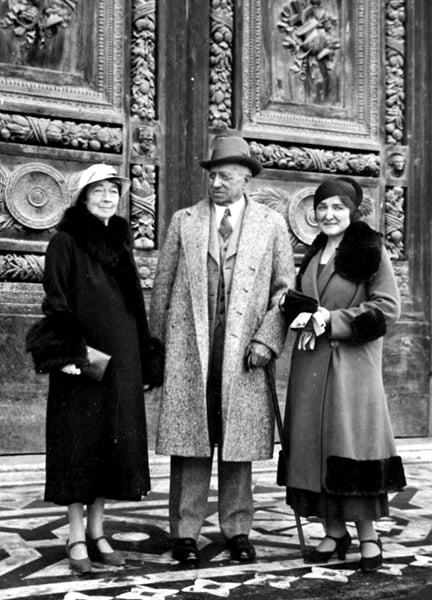
During the early 1920s, Mercer and the Morettis lived and worked in Pittsburgh, Pennsylvania; Havana, Cuba; and Florence, Italy. When they returned to Alabama in 1925, Moretti again opened a marble quarry and built a home and studio at its edge; however, he soon realized it would be far cheaper to live and work in Italy, so Mercer and the Morettis moved first to Florence and then settled into a villa at San Remo on the Mediterranean coast.
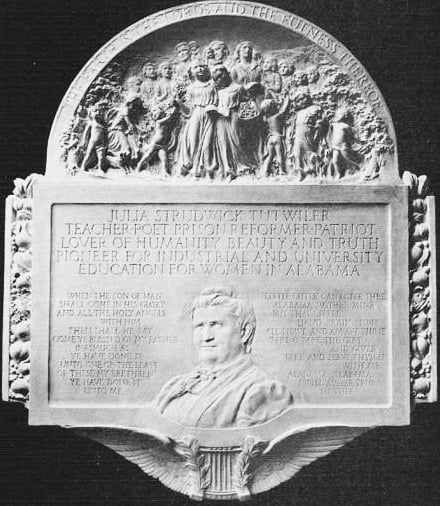
In the spring of 1933, Mercer completed an imposing Italian white marble bas relief to memorialize Julia Tutwiler, who had died in 1916. This work was commissioned by the Alabama Centennial Commission and placed in the Capitol Rotunda in Montgomery, in recognition of Tutwiler’s contributions as a teacher, poet, prison reformer, and pioneer of industrial and university education for Alabama women. Mercer also sculpted Tutwiler memorials for the University of Alabama and the University of Montevallo.
After Moretti’s health began to fail in the early 1930s, Mercer was able to help him complete his last several commissions before he died of cancer in January 1935. She designed a dark green granite headstone for his grave.
In 1937, Mercer completed Flimp Fountain, a bronze work covered in tiny, elf-like creatures. She named her fanciful creatures “flimps” by combining the words “flower” and “imp.” Flimps, she explained, are the capricious fairies and wood sprites (mythical creatures associated with trees) who create the wonderful explosion of color in gardens every spring. Flimp Fountain is now part of the Montgomery Museum of Fine Art’s (MMFA) permanent collection. Each April the museum holds a Flimp Festival on its grounds.

Before Moretti died, he advised his wife and his assistant to remain in Italy, but he did not foresee that war would soon threaten their peaceful and economical way of life. By 1939, it was clear to the two women that they should return to the United States. They sailed for Boston, Dorothea’s birthplace, and lived there together until her death in 1958. While in Boston, Mercer sculpted and painted, taught art, and gave lectures. After 1958, she lived with a niece in Larchmont, New York, before returning home to Marengo County in 1964.
Mercer continued to sculpt, paint, write, and raise flowers until she died in Demopolis, Marengo County, on March 2, 1984, at the age of 95. Shortly before her death, she published Devotional Meditations, a collection of personal thoughts and prayers. Reflecting on her contentment at the end of a long life of creativity, she wrote that she had found joy in natural beauty throughout the world but also right at home in her own flower garden.
Laird Cottage in Demopolis houses the Geneva Mercer Museum, which is operated by the Marengo County Historical Society. It was once the home of Mercer’s sister Dora and her family.
Additional Resources
- Cook, Ruth Beaumont. Magic in Stone: The Sylacauga Marble Story. Montgomery: NewSouth Books, 2019.


