Temple B'Nai Sholom
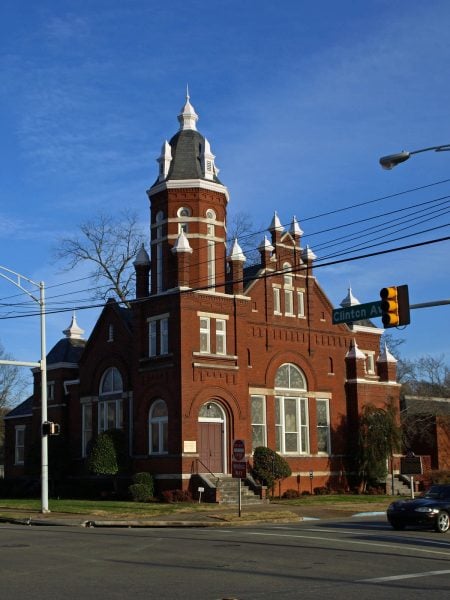
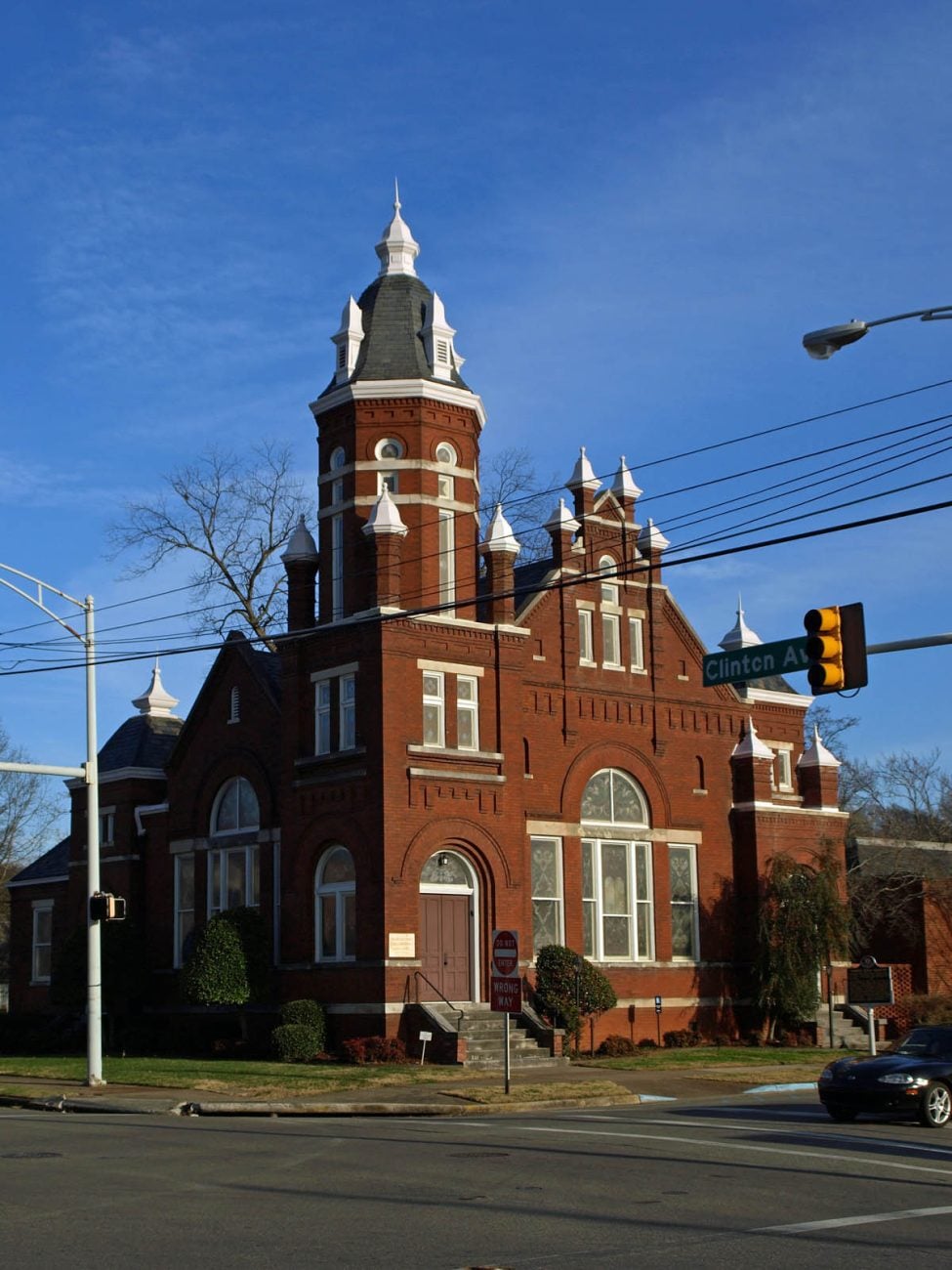
Temple B'nai Sholom (Sons of Peace), in Huntsville, Madison County, is the oldest synagogue in Alabama in continuous use. The Reform congregation, which values Judaic tradition through innovation and inclusion, was established in 1876; the temple was completed in 1899.
Records show a Jewish presence in Madison County as early as the 1820s, with business owners operating in Huntsville by 1829 and Jewish marriages at least as early as the 1840s. Jewish Huntsvillians worked primarily as merchants and cotton factors, and they acquired real estate in the surrounding area. In the pre-Civil War period, some owned slaves, and most supported the Confederacy during the Civil War. A Jewish section was added to Maple Hill Cemetery, the city’s oldest, in 1874.
Following the Civil War, an influx of Jewish citizens from eastern and northern states led to the formation of a congregation in the 1870s. The initial push to organize resulted in the founding of Esora Lodge, a local chapter of the fraternal organization B’nai B’rith (Children of the Covenant) in 1875. On July 30, 1876, 32 families formed a “Hebrew Congregation” (so called in contemporary newspapers and city documents, delineating it from the already-established Christian churches) and drafted a constitution and bylaws to guide the business proceedings of the congregation. The constitution was officially adopted the following year. Individuals wishing to join the congregation were required to provide a fee of at least $5.00 and submit an application to be voted on during a regular or special meeting of the congregation. The Hebrew Congregation officially adopted the name Temple B’nai Scholum [sic], the “Sons of Peace,” during a special meeting on September 10, 1876, and began meeting every Friday for Divine Services that December. In June 1877, the families applied for membership in the Union of American Hebrew Congregations (UAHC), maintaining the membership according to available finances. (Now the Union for Reform Judaism, the UAHC was formed to unite American Jewish synagogues and establish a sustainable rabbinic seminary.) In 1880, B’nai Sholom’s membership consisted of 23 families and grew to 38 families in 1907 but would decline in the coming decades due in part to the congregation’s inability to sustain a full-time rabbi and later due to financial effects of the Great Depression.
The trustees set up committees to guide finances, a Sabbath (religious) school, and a choir. At that time, the religious functions of hazzan (prayer leader or cantor) and shamas (caretaker and assistant) were performed by lay leaders of the congregation. The title of “hazzan” was later changed to “rabbi,” the individual who performed all duties of hazzan, in addition to conducting regular and special services, performing funerals, leading the school, and teaching students. Another member trained the choir and instructed in liturgy. These activities, along with the establishment of the Hebrew Ladies Aid Society (a philanthropic and charitable sorority) by 1879, were the first in a long history of volunteerism within the congregation.
In the congregation’s early history, various meetings were held at the Helion Masonic Lodge on Lincoln Street (the oldest in the state), with the Temple leadership working meticulously to appropriately furnish the lodge as a worship hall. After the death of faithful lay leader Abe Newman in 1890, the congregation determined to seek a full-time rabbi, and on November 23, 1892, Rabbi A.M. Bloch became the first ordained religious leader of the congregation. His services ended in July 1893, however, after congregants became upset at his habit of rebuking absent members from the pulpit, among other grievances. He was replaced by Isaac E. Wagenheim, who served from 1894 to 1897. Wagenheim was the first of several rabbis who remained for a short time before transferring to larger congregations.
Shortly after Rabbi Wagenheim’s departure, the congregation purchased land at the corner of Lincoln and Clinton Streets in Huntsville for $1,500 on May 10, 1898. The six-member building committee contracted with Reuben Harrison Hunt of Chattanooga, Tennessee, to design the temple and William Myers to build it. Hunt was the principal-in-charge of one of the South’s most prominent architectural firms (R.H. Hunt Company, active 1880s-1930s), and known for specializing in churches, public buildings, and skyscrapers. The finished building was dedicated on November 26, 1899, under Rabbi Nathan Michnic.
The sanctuary’s interior features a high, timber-vaulted ceiling with 24 sloping planes of southern heart pine. The sanctuary itself, from entries to pews to the bima in one corner (the platform where the Torah is read), is situated on a 45-degree angle. The floor slopes to improve viewership of the bima. Flanking the bima are 12 tall stained-glass windows, of which there are two sets of five windows each topped with a semicircular stained-glass window. The exterior of the temple is in the Romanesque Revival style, with some Baroque influences. It has a gray-green slate gabled roof, a central 90-degree axis structure (a floor plan that is structured using right angles for stability and a central reference line for visual balance), and flanking unequal-height towers. The use of red-brown pressed brick creates a monolithic look.
North Alabama’s Jewish population was relatively small in the early 1900s. By the 1930s, Jews in Decatur, Morgan County, and Athens, Limestone County, routinely traveled to B’nai Sholom to worship. The Great Depression hit the industrial center of Huntsville hard, impacting even the houses of worship. By 1933, B’nai Sholom’s trustees voted to reduce the cost of membership dues and even decided to not hire a visiting rabbi for High Holidays (a rare occurrence in the congregation’s history), along with other reductions in cost including fixed fees for its small part-time staff, limited choir, and reduced fire insurance.
Along with the rest of the nation, Huntsville Jews followed the news on Jewish persecution in Nazi Germany and in countries later taken over by the Nazis during the 1930s. As U.S. leaders debated how to deal with the many Jewish refugees fleeing continental Europe in the late 1930s, local congregations were working to provide as much aid as possible. One example of this is the Goldsmith family (a founding family of B’nai Sholom), who attempted to extract family members from Germany, even calling in favors from John Sparkman, the congressman who helped secure the placement of present-day Redstone Arsenal in Madison County. Temple B’Nai Sholom congregants contributed to the United Jewish Appeal, a joint fundraising campaign that combined the American Jewish Joint Distribution Committee, the United Israel Appeal, and other relief organizations in January 1939 to aid and rescue European Jews. There were also national groups like the Hebrew Sheltering and Immigrant Aid Society which attempted to help refugees, sometimes even in opposition to what the U.S. government was willing to do. The refugee efforts in the communities of north Alabama, which extended into the next two decades, were the philanthropic precursor to the Jewish Federation of Huntsville and North Alabama (JFHNA), a 501(c)3 nonprofit organization founded in 2004. JFHNA is dedicated to the support and advancement of Jewish life through cultural, social, educational, and philanthropic programming, as well as fundraising.
From 1940 to 1970, Madison County’s population increased by approximately 180 percent, with the addition of many Jewish scientists, engineers, and other professionals attracted to the city because of the opportunities provided by Redstone Arsenal and related aeronautics research and development. Consequently, the Jewish population in Madison County increased from about 100 individuals in 1937 to approximately 700 in 1968. (Jews at Redstone have recounted in oral histories that they preferred avoiding the German rocket scientists in public life.) The resulting increase of membership at B’nai Sholom (from 16 households in 1945 to 102 households in 1970) allowed for the expansion of services within the congregation. Rooms were added to the Sabbath school and bar and bat mitzvah ceremonies were reinstated. The neighboring building, the Carlisle Davis House, was purchased in 1956, and then demolished; it was rebuilt as an education annex by 1967. The congregation began using student rabbis for High Holy Day services, and eventually biweekly services, from 1948 to 1963. And in 1963, Sherman Stein, the first full-time rabbi since 1913, began his leadership. The congregation was able to purchase a house for him. The congregation would continue to employ full-time rabbis in subsequent decades.
In 1997, Temple B’nai Sholom became the home for a Holocaust Torah. These are Torah scrolls from Eastern Europe that the Nazis stole and stored in Prague, the present-day capital of the Czech Republic. This particular scroll, one of approximately 1,500 such scrolls, came from an unknown town in the Czech Republic. Local philanthropist and engineer Louis Weiner spearheaded the acquisition of the Torah, and dedicated it in memory of his daughter Julie Ann, who had died in 1971 at age 11. It is on permanent loan from the Memorial Scrolls Trust in London, England, which is the repository for these sacred scrolls.
The interior and exterior of the Temple B’nai Sholom building were renovated in 1975, 1993, and 1994. Preservation methods included updates to some materials (for instance the galvanized metal ornaments, gutters, and flashing were replaced with copper, painted to look like the original) with an emphasis on visually and architecturally maintaining the original integrity as closely as possible.
In the early 2000s, the temple became caught up in a legal paradox when the city of Huntsville simultaneously ordered it to demolish a deteriorating house on its property due to safety concerns, while the Huntsville Historic Preservation Commission blocked it from doing so. The city then pursued a criminal misdemeanor conviction against the temple for failing to comply with the conflicting orders. The temple filed suit in 2001, citing violations of the Religious Land Use and Institutionalized Persons Act (RLUIPA) and both the U.S. and Alabama Constitutions, with the Becket Fund for Religious Liberty and the Alabama attorney general joining on the temple's behalf. The case was settled in 2003, when the city agreed to purchase the house for $25,000 and relocate it, while also committing to work with the temple on its expansion plans; although the city pointedly refused to acknowledge RLUIPA or the Alabama Religious Freedom Amendment as valid laws.
In 2017, Temple B’nai Sholom opened the Huntsville Jewish Heritage Center at Temple B’nai Sholom. It explains the religion and traditions of Judaism, provides a history of Huntsville’s Jewish population, and shares the many contributions of the Jewish community to Huntsville’s civic and cultural life. In 2026, the congregation celebrated its 150th anniversary: a yearlong celebration including special divine services, storytelling, outdoor festivals, and a capstone event with the Huntsville Symphony Orchestra. All anniversary events point to the continued legacy of philanthropy, volunteerism, historic preservation, and education.
Temple B’nai Sholom is included as a supporting structure in downtown Huntsville’s Old Town Historic District, which was designated by the city in 1974. The district itself was listed on the National Register of Historic Places in 1978. The Temple was placed on the Alabama Register of Landmarks and Heritage in 1977. It received a historic marker from Alabama Historical Association in 1997.