Pettway Family Quilters

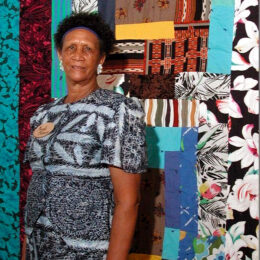
Spanning several generations, the extended Pettway family of Gee’s Bend (more formally Boykin), Wilcox County, is renowned for their quilting skills, imaginative patterns, and artistic expressions. Although an exact count is not known, it is estimated that several generations of the family have made approximately 1,000 quilts in this tiny community. Some members were also part of the Freedom Quilting Bee, which was established in 1966 to provide work for the women of the community. Members of the Pettway family, along with other quilters in the area, gained fame when influential individuals from the New York City art and fashion world took notice. A resurgence of interest from art collectors and museums in the early 2000s generated numerous shows and additions to collections, and that interest has continued.
The family traces its origins in Alabama to 1816, when Joseph Gee brought their enslaved ancestors from North Carolina to work on his cotton plantation in present-day Wilcox County. Gee’s heir, Mark H. Pettway, took over the estate not long before the American Civil War ended in 1865. After emancipation, many formerly enslaved Pettway family members remained on the plantation and cultivated the land as sharecroppers and tenant farmers, taking the Pettway surname as their own.

Even prior to the end of slavery, many Pettway women were creating quilts of complex geometric imagery and subtleties of color, intuitively reimagining the colors, shapes, and patterns familiar to them in their day-to-day lives. Each woman hand stitched her unique vision of the world into vibrant abstract patterns. The Pettway women’s quilts were also an expression of the cultural survival of this tightly knit African American community, in spite of racial bigotry, geographic isolation, and poverty. The Pettway women traditionally created these quilts from scraps of cloth after long, exhausting days of manual labor working beside the Pettway men in the fields, plowing and planting, as well as taking care of domestic and parenting chores.
The artistic significance of Gee’s Bend quilts and the Pettway women at its center became a surprising cultural phenomenon of the 1960s. At that time, some of their quilts made their way into the hands of trendsetters in the art and fashion capital of New York City. Influential individuals such as Diana Vreeland, fashion editor of Vogue magazine, interior designer Sister Parish, furniture designers Ray and Charles Eames, and jazz singer Mabel Mercer promoted Gee’s Bend quilt sales at auctions where even more celebrities bought them and turned the quilts into a fashion trend.

In 1967, the internationally known abstract painter Lee Krasner happened to hear the Gee’s Bend quilters mentioned while visiting Alabama for a show of her own paintings. She convinced her dealer, Donald McKinney of Marlborough Gallery, to take her to Gee’s Bend. They were so impressed by the combination of simplicity and sophistication they saw in the quilts that they each bought several on the spot. In the late 1990s, writer, editor and art collector Bill Arnett was expanding his collection of African American art, especially works by Black southern artists he had championed since the mid-1980s. He helped push forward these self-taught artists largely ignored by museums, including the Pettway quilters.
In 2002, the first touring exhibition, The Quilts of Gee’s Bend, opened at the Museum of Fine Arts, Houston. It traveled from there to the Whitney Museum of American Art in New York City. This showcase for past and present quilters from the 1930s into the 2000s was hosted at 11 museums across the country before closing in 2006. The exhibition broke museum attendance records in the cities where it appeared. The Pettway family quilters became art-world notables of the moment. A companion book by the same name as the exhibition was co-published in 2002 by the museum and Atlanta-based Tinwood Books, founded by Bill Arnett,
A second exhibition, Gee’s Bend: The Architecture of the Quilt, followed in 2006. These two shows elevated quilt-making, long dismissed as merely folk art by the mainstream art world, into the realm of sophisticated abstract art. Prominent art critic Robert Hughes described the Gee’s Bend Pettway family quilts he saw in the 2006 exhibition as objects possessing a unique radiance that made them worthy of being shown in a museum. In a November 29, 2002, New York Times article titled, “Jazzy Geometry, Cool Quilters,” art critic Michael Kimmelman pronounced the quilts some of the most miraculous works of modern art America has produced. Some of the more renowned quilters are discussed in-depth below, but there have been many others, including Jorena Pettway, Nancy Pettway, and Minsie Pettway.
Notable Quilters

Missouri Pettway (1902-1981) created her Blocks and Strips Work-Clothes Quilt in 1942 out of the cotton and corduroy remnants of her husband’s old work clothes after his untimely death. Sewing by hand, Missouri Pettway pieced it together with all-purpose stitching. At the time of her husband’s death, she was a 41-year-old mother of 10 children. Her quilt, an elegy in cloth, explicitly links the Gee’s Bend quilt-making tradition to her love and her loss. Sixty years after Missouri Pettway created Blocks and Strips Work-Clothes Quilt, it became a centerpiece among 70 quilts dating from the 1930s to 2000 in The Quilts of Gee’s Bend exhibition at the Museum of Fine Arts, Houston. This quilt now hangs in the permanent collection of the National Gallery of Art in Washington, D.C., a gift of the Souls Grown Deep Foundation.
Lucy T. Pettway (1921-2004) stood out among the quilting women of her generation for her ability to create patterns in her imagination and not rely on designs previously created by older women in her family. She loved to sew. At about five years old, Lucy started cutting pieces from worn-out cloth scraps until she accumulated enough small pieces to create a whole quilt. She made her first quilt at age 13 in the “Lazy Gal” pattern, which consists of a few horizontal strips in contrasting colors. Next, she made a “Nine Patch,” a common pattern of nine squares that is considered one of the easiest designs for beginners. She later became an expert at the complex “Snowball” pattern, which she learned from her mother. It is a complex field of small circular shapes against a background of contrasting colors that look like small snowballs in rows.

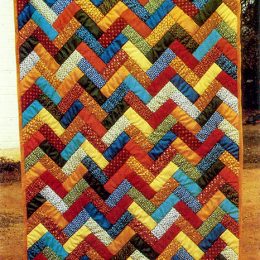
Jessie Pettway (1929-2023) was nine years old when her aunt began teaching her to quilt. She was allowed to cut out cloth pieces for the adult women to sew into quilts when they gathered in her aunt’s home in the evening. Jessie began completing patterns by herself at age 12. The “Bricklayer,” an hourglass form of pyramid-shaped sections that meet in the center, became her preferred design. In 2006, Jessie Pettway was among the eight Gee’s Bend quilters honored by the U.S. Postal Service with the commemorative Gee’s Bend American Treasure postage stamp series.

Loretta Pettway (1942- ) began her first quilt, a “Nine Patch,” at age 11. She resisted learning the craft, complaining that she disliked sewing, but her grandmother insisted. In an unlikely turn, Loretta emerged in adulthood as a preeminent quilt maker, known for her bold designs and stylistic improvisations. Her “Roman Stripes” and “Medallion” quilts are featured on U.S. postage stamps. In 2015, she won a National Heritage Fellowship from the National Endowment for the Arts. Her quilts are included in the collections of the Metropolitan Museum of Art, the Philadelphia Museum of Art, and the Museum of Fine Arts, Houston.
After surprising the art and fashion world more than half a century ago, many Pettway women continued to create quilts of complex geometric imagery and subtleties of color within the rural isolation and poverty of Gee’s Bend. These women intuitively reimagined the colors, shapes, and patterns familiar to them in their day-to-day lives and shaped them into vibrant, abstractly patterned quilts with enduring historical and cultural impact.
Additional Resources
- Arnett, Paul, and William Arnett, eds. Souls Grown Deep: African American Vernacular Art of the South, Vol 1. Atlanta, Ga.: Tinwood Books, 2000.
- Arnett, Paul, Joanne Cubbs, and Eugene W. Metcalf Jr., eds. Gee's Bend: The Architecture of the Quilt. Atlanta, Ga.: Tinwood Books, 2006.
- Beardsley, John, et al. The Quilts of Gee's Bend. Atlanta, Ga.: Tinwood Books/Houston Museum of Fine Arts, 2002.
- Beardsley, John, et al. Gee's Bend: The Women and their Quilts. Atlanta, Ga.: Tinwood Books, 2002.
- Kalina, Richard. “Gee’s Bend Modern.” Art in America 10 (October 2003): 104-109, 148-149.