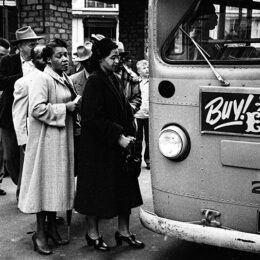
Odetta

Jefferson County native Odetta Holmes Felious Gorden (1930-2008), known simply as “Odetta,” was an influential and highly regarded folk singer in the latter decades of the twentieth century. She inspired musicians like Joan Baez, Bob Dylan, Pete Seeger, Harry Belafonte, Janis Joplin, and Carly Simon, all of whom credited her as instrumental to their creative development. Furthermore, her music helped form the soundtrack of the civil rights movement of the 1950s and 1960s.
Odetta was born on December 31, 1930, in Birmingham, Jefferson County, to Reuben Holmes and Flora Sanders; she had an older half-brother and a younger half-sister. Her parents’ marriage was short-lived and unhappy, and her natural father was not part of her life. In 1933, Flora would marry Zadock Felious, who adopted Odetta and gave her his surname. She spent her earliest years in Birmingham’s Ensley neighborhood. Ensley was hard hit by the Great Depression, and many of the men in Odetta’s family and neighborhood lost their steel-industry jobs. In 1937, after her stepfather was diagnosed with black lung from years of inhaling coal dust while working as a miner, the family moved to Los Angeles, California, in search of a healthier climate and better economic opportunities. There, her stepfather found work as a janitor, and her mother found domestic work.
Encouraged by her opera-loving mother, Odetta developed an early interest in classical music, eventually leading her to train as an opera singer and she often sang in that style. Her stepfather would sometimes take Odetta and her half-sister, Jimmie Lee, to see jazz acts, such as Duke Ellington, Nat "King" Cole’s trio, and Count Basie, at the Paramount Theater. Early on in her school years, Odetta’s teachers began to recognize her vocal talents and encouraged her parents to sign her up for voice lessons. Following her stepfather’s death, the family relied on the wages Flora earned as a domestic worker and later as a janitor at The Turnabout, a popular Los Angeles club featuring puppetry and musical theater. Despite the family’s poverty, Flora set aside money whenever she could to provide for Odetta’s musical training. Eventually, one of the owners of the Turnabout discovered her talent and sponsored voice lessons with renowned contralto Janet Spencer. Odetta would perform at the Turnabout frequently throughout the subsequent years.
Odetta later noted that, from her earliest years, she held a deeply rooted anger toward the many injustices she witnessed throughout her childhood. She recalled the indignity of segregated seating on the bus ride from Birmingham to Los Angeles at six years old and the pain of reading the romanticized depictions of slavery in her first history textbooks. The internment of her Japanese American neighbors after Japan’s 1941 attack on Pearl Harbor further fueled that anger. Her social consciousness grew through her attendance at Mt. Hollywood Church, where she sang in the choir. She was inspired by minister Allan Hunter, whose progressive church preached a social justice message and had been one of the first integrated congregations in Los Angeles.

After graduating from Belmont High School, she studied classical music at Los Angeles City College, funding her coursework with various jobs, including factory and domestic work. At age 19, she performed in a professional production of the musical Finian’s Rainbow at the Greek Theatre in Los Angeles. Several years later, she rejoined the show’s cast at San Francisco’s War Memorial Opera House for a two-week revival. While there, she attended an impromptu party at childhood friend Jo Mapes’s apartment, where the group sang folk songs. The music had an immediate and profound impact on Odetta. She later noted that folk music, which often featured the stories of incarcerated or enslaved people, gave her an outlet for her anger about social injustice.
After she returned to Los Angeles, she quickly learned the guitar and immersed herself in the city’s folk scene. In 1952, she adopted the natural hairstyle that was later known as an “Afro.” Such a choice was highly uncommon at the time, and it was often viewed as a political statement. That year, prominent folk singer Pete Seeger saw her perform at a Topanga Canyon party and praised her widely. In 1953, Odetta performed for the Southern California Peace Crusade to a group of 1,300 people, and later that year, she was the opening act for Paul Robeson, in front of 2,000 people.
Odetta performed at various San Francisco venues, including the Tin Angel, where audiences were captivated by her memorable interpretations and emotional depth. She was soon asked to perform at the prestigious Blue Angel club in New York City, and she became a regular in its budding folk scene. There, she caught the attention of singer Harry Belafonte, who was inspired by her voice and style; the two became lifelong friends and would work together frequently. Later in 1953, she returned to San Francisco and began to call herself Odetta when marketing her performances, as her last name, Felious, was frequently misspelled and mispronounced. She released her first album, The Tin Angel, in 1954. It was originally titled Odetta & Larry, for her frequent collaborator at the Tin Angel, singer and banjo player Lawrence Mohr.
In 1956, Odetta’s rise to fame accelerated after she began working with music manager Dean Gitter. He owned the fledgling Traditions label, with which she recorded the iconic album, Odetta Sings Ballads and Blues. That album that would inspire young Bob Dylan to temporarily trade in his electric guitar for an acoustic one. The album featured the sequence of three spirituals that would later be called the Freedom Trilogy: “Oh, Freedom,” “Come and Go With Me,” and “I’m On My Way.” Alongside “We Shall Overcome,” this sequence became one of the civil rights movement’s most essential pieces of music. Other prominent songs from the album included the sea shanty “Santy Anno” and Odetta’s version of the Lead Belly song “Alabama Bound.”
The following year, Gitter moved to England to study acting, abruptly dissolving his partnership with Odetta. She then began working with manager Albert Grossman, who owned Chicago’s Gate of Horn club, where Odetta performed frequently. (As Odetta’s fame grew, Gitter would later successfully sue her for concert royalties.) Odetta was Grossman’s first client, and her magnetism and talent attracted many other musicians, including such international stars as Bob Dylan, Peter, Paul, and Mary, Janis Joplin, and Gordon Lightfoot. With Grossman, Odetta recorded the album At the Gate of Horn, which featured the songs “He’s Got the Whole World in His Hands” and “Take This Hammer,” both of which influenced many folk singers of the day. In December 1959, Odetta gained further national recognition when Harry Belafonte chose her as his co-star for the television special Tonight With Belafonte. In 1961, Odetta performed in two notable acting roles: in the film adaptation of William Faulkner’s novel Sanctuary, and later in a single-episode role in the popular western television series Have Gun–Will Travel.

The height of the civil rights movement coincided with a revival in American folk music, and Odetta was at the center of both. By that time, hits from Peter, Paul, and Mary, the Kingston Trio, and the Rooftop Singers broke into the Billboard Hot 100 and brought folk music into the mainstream. Odetta, however, never reached the Billboard singles charts, despite her nearly universal critical acclaim, her 1963 Grammy nomination for the album Odetta Sings Folk Songs, and her far-reaching influence on folk musicians. Through her friendship with Harry Belafonte, she met Martin Luther King Jr. and became widely known for her performances at many notable civil rights events. She sang at the 1963 March on Washington and the March 25, 1965, Selma to Montgomery march, along with numerous lesser-known civil rights events and fundraisers.
Odetta was married Leo Vincent Daniel “Danny” Gordon from 1959 to 1966; the couple lived separately throughout most of those years. In 1960, the couple started the company Dandetta Productions in the hopes of managing singers and producing films, but the project saw little commercial success. Although some sources state that she later married Garry Shead in 1966, the two were only ever engaged.
As folk music declined in popularity, with younger audiences favoring rock music, Odetta frequently encountered financial difficulties. She continued to perform regularly, but in smaller venues. She also regularly performed at benefits for various charitable causes, including anti-Vietnam War protests and numerous performances benefiting arts and education in Black communities. In 1970, she produced her only rock album, entitled Odetta Sings, which featured the original songs “Hit or Miss” and “Movin’ It On,” as well as songs by Elton John, Paul McCartney, James Taylor, and Mick Jagger and Keith Richards. Although the album was well-received by critics, it failed to generate commercial success. (After her death, several of the songs from this album, particularly “Hit or Miss,” became some of her most popular among streaming audiences.) She also acted several more times in the 1970s, first in a television version of The Autobiography of Miss Jane Pittman (1974), and, later, in a stage performance of The Crucible (1975) in Stratford, Ontario. She would not record another album until 1988, when she released Christmas Spirituals.

In 1999, Odetta’s career saw a resurgence when she joined M.C. Records to record the album Blues Everywhere I Go. Highly regarded by audiences and critics, the album’s success launched her into a busy touring schedule; the following year, it earned a Grammy nomination. In 1999, she was awarded the National Endowment for the Arts National Medal of Arts by Pres. Bill Clinton. The Kennedy Center awarded her its Visionary Award in 2004, and the Library of Congress awarded her with its Living Legend Award in 2005. Also in 2005, she received her third Grammy nomination for the folk album Gonna Let It Shine. In the final year of her life, she continued to tour despite substantial health issues; she required artificial oxygen and performed from a wheelchair.
Odetta died of heart disease on December 2, 2008. In 2018, she was posthumously inducted into the Alabama Music Hall of Fame.
Additional Resources
- Barnett, LaShonda Katrice, ed. “Odetta.” In I Got Thunder: Black Women Songwriters and Their Craft . New York: Thunder’s Mouth Press, 2007.
- Zack, Ian. Odetta: A Life in Music and Protest. Boston: Beacon Press, 2020.