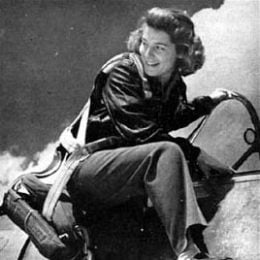
Nancy Batson Crews
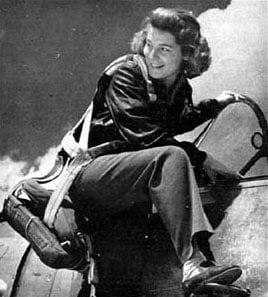
Birmingham native Nancy Batson Crews (1920-2001) was a pioneering pilot during World War II as a member of both the Women's Auxiliary Ferrying Squadron (WAFS) and later the Women’s Air Force Service Pilots (WASP). She and a small cadre of other women ferried aircraft from factories and air bases to where they were most needed during the war. She later built a successful commercial flying enterprise in California and later in life developed property in St. Clair County. She was the first woman inducted to the Alabama Aviation Hall of Fame, in 1989.
Batson was born in Birmingham, Jefferson County, on February 1, 1920, to Stephen R. Batson, a successful contractor and builder and Jefferson County commissioner in the 1930s, and Ruth “Muddy” Philips Batson, who had worked as a teacher prior to her marriage. Batson was the third of four children, and the family resided in the city’s Norwood neighborhood. Her sister Amy would marry Luther Strange Jr. and give birth to future politician Luther Strange III. Her maternal grandmother, Mary Jane, also lived with the family and had raised Ruth in a confining, restrictive home. As an adult, Ruth rejected this upbringing and pushed the boundaries of prescribed female behavior. She defied such conventions by driving her own car and frequently took the family on road trips. Discussions about politics and civil discourse were frequent and included all of the children, and so Batson always felt comfortable expressing her opinions. The family lived near a municipal airport, and Batson later recalled being transfixed by the planes as a child.
Batson attended local public schools, graduated from Ramsay High School in 1937, and then entered the University of Alabama (UA). Her drive to achieve led to her appointment on several important campus committees and eventual election as president of the Women’s Student Government Association in 1940, during her senior year. While at UA, she met her future husband, Paul Crews, among a group of friends there.
Batson first got her chance at flying in fall 1939, when UA announced its participation in the Civil Aeronautics Authority Flight Training Program. It was a nationwide civilian pilot training program established by Pres. Franklin D. Roosevelt in December 1938, as tensions were rising in Asia and Europe. (This program also led to the creation of the Tuskegee flight training program at present-day Tuskegee University and the Tuskegee Airmen.) The program allowed one woman for every ten men, and Batson’s parents readily supported her in her efforts to become a pilot. She was first named an alternate but was allowed to join the training on October 31, 1939; she excelled and earned her license on June 15, 1940. Upon returning to UA, she learned that the university would be selling off the planes the students had trained on, and Batson convinced her father to buy one; however, she instead ended up with a better plane, a Piper J-4 Cub Coupe, sold by an instructor who wanted to upgrade. Batson graduated with a bachelor's degree in history in 1941.
When the United States entered World War II that year, Batson tried to join what would soon become the Air Transport Command, a unit that ferried aircraft to locations of greatest need, but she was told that only men could apply. She then entered a training program for flight instructors and was licensed in March 1942, but she was again told that only men could fill those positions. A fellow woman pilot soon offered her a job as an air traffic controller in Miami, but Batson was quickly bored with what she viewed as a “desk job” and took a job at the nearby Embry-Riddle Aeronautical Institute as a flight instructor.
On September 5 of that year, Batson was contacted by pilot Nancy Love, head of the newly created WAFS, headquartered at New Castle Army Air Force Base in Wilmington, Delaware. WAFS was tasked with flying planes from factories to air bases and occasionally from base to base. Batson completed the required training and was hired in mid-October. She joined a group of 27 other women, under the command of Love. In spring 1943, they were divided among four command centers in Dallas, Texas; Long Beach, California; Romulus, Michigan; and Wilmington. Batson had hoped for a leadership position at one of the new centers, but she was assigned to remain in Wilmington. Women were prohibited from piloting more advanced aircraft, so she spent much of the year flying PT-19 trainers and P-26 Peashooters from an air base in Maryland north to bases in Canada. After Love and her superior, Maj. Gen. Cyrus Smith (who left his position as CEO of American Airlines to serve during the war and returned to the company afterward), complained to senior commanders, the Army lifted the restrictions.
In July 1943, tragedy struck the Batson family when Stephen Batson, Nancy’s older brother, was killed in a training accident in Texas. A graduate of the U.S. Military Academy at West Point, he was a captain in the Army Air Corps at the time of his death. One month later, the women’s military pilot program was reorganized as the WASP (Women’s Army Service Pilots) under pilot Jacqueline “Jackie” Cochran, the first woman to fly a bomber across the Atlantic. By late fall, WASP personnel had trained on a variety of planes but not in navigating by instruments. In December, Batson was one of four women admitted to the U.S. Army’s Pursuit Training School in Palm Springs, California. The women trained on several notable aircraft, including the renowned P-51 Mustang flown by the Tuskegee Airmen.
Despite their service and the dangers of their work, WASP members were not technically in the U.S. military and thus had no access to the insurance, pensions, or other benefits offered to service personnel. Congressman John Costello of California introduced legislation to make the women part of the military in September 1943, and Batson and many other women pilots entered Officer Training School in anticipation of its passage, but it failed to pass, and they remained in professional limbo until the end of the war. The WASP were officially disbanded on December 20, 1944, and Batson and her fellow pilots celebrated a final dinner in Wilmington on that evening.
Batson returned to Birmingham and was at loose ends for some time, being used to the constant action and danger of her service. She also lost the man she was dating, military pilot Charlie Miller, to a crash in the Pacific theater. With flying behind her, Batson found purpose in joining her father’s business, S. R. Batson Construction. In addition, her college friend Paul Crews returned from service in January 1946 and they soon reconnected. The couple married on February 1, and the newlyweds moved to a St. Clair County farm just outside Birmingham on Nancy’s father’s land. The couple eventually had three children. In June 1950, Paul was called up for service in the recently created U.S. Air Force and the family moved to Robins Air Force Base in Georgia. They later moved to Washington, D.C., and then to Anaheim, California, in 1956. The following year, Paul was offered a position with aerospace giant Northrup Corporation in Hawthorne, California, and left the Air Force, retiring as a colonel.
Crews spent the next few years raising children and competing locally in golf tournaments, but she got a taste for flying again when her family attended a fair that offered plane rides. After the deaths of her sister and father, she began to rethink her future. In February 1964, she took flying lessons at the Orange County Airport (present-day John Wayne Airport) and had renewed her commercial pilot’s license by June. In November 1965, she earned her commercial and instructor certifications and took a job as a flight instructor at Hawthorne Airport, near Inglewood, California, where the family then resided. Around this time, Paul was diagnosed with diabetes and heart issues, and he took a less demanding job with Northrup and became support staff for Nancy’s flying endeavors.
Although Crews had been living in progressive California for nearly ten years, she had been shaped by her upbringing in segregated Alabama. Indeed, she campaigned for George Wallace when he visited California during his presidential run in 1968. The two had been classmates at the University of Alabama and were friendly. She ceased any connection with her oldest son when he married a Japanese woman until shortly before her death.
In 1969, friend and fellow former World War II pilot Barbara “B. J.” London invited Crews to a presentation on glider aircraft at the Crystalaire Airport in California’s San Gabriel Mountains. Crews was intrigued, purchased a Piper PA-18 Super Cub plane, and joined the company as a tow pilot. Crews was once again behind the controls of her own plane. She became fascinated with gliders and earned her commercial glider certification in 1970.
During this period, Crews reconnected with fellow WASP alumni who had formed the Order of Fifinella in 1944 as a member organization for the women pilots. She joined the reunions in 1969 and then became so involved with the group that she was elected president at the next reunion in 1972. In September 1976, the members successfully lobbied to have the women pilots’ status officially changed to that of World War II veterans.
While participating in the 1975 Power Puff Derby, a multi-day air race across the United States, Crews returned to Birmingham to meet with relatives regarding the family real estate business. Her mother had died in April of that year, and she took on the role of manager of the land holdings and construction business. After Paul Crews died on March 10, 1977, Nancy moved to California City in the Mohave Desert to pursue her gliding business full time. By 1979, she was elected to the East Kern County Airport District board of directors. The following year, she was elected mayor of California City, but she often clashed with city employees and residents. She resigned midway through her second year, left the airport board of directors as well, and returned to Alabama, living on the farm where she and her husband had once resided.
No longer able to make a living at flying, she earned a real estate license to develop the land she and her relatives had inherited from her parents. She owned 20 of the 80 acres and sold her plane to buy out the other heirs for the remaining 60 acres, which she developed into a large subdivision, one house at a time. It later became known as Lake Country Estates and now lies largely within Odenville, St. Clair County.
Crews also continued flying for pleasure, joining the Birmingham Aero Club and the Soaring Society for glider enthusiasts. In October 1989, she became the first woman inducted to the Alabama Aviation Hall of Fame, located at the Southern Museum of Flight in Birmingham. And in 1992, Crews joined other veterans of the WAFS and WASP programs at a special program for the 50th anniversary of their founding, hosted by the International Women’s Air & Space Museum in Centerville, Ohio. Eight former members participated in a panel discussion that was broadcast on the local cable station. She also served on the board of the St. Clair County Airport Authority during the 1990s. In 1997, she was inducted into the International Forest of Friendship, a memorial park in Atchison, Kansas, that honors people who have contributed to the development of aviation and aerospace.
In 1999, Crews helped organize a reunion of many of the remaining WAFS members that included a press conference and panel session at the Southern Museum of Flight. Birmingham author Fannie Flagg sponsored a dinner and Mother Angelica interviewed a smaller group of pilots on the Eternal Word Television Network. That same year, Crews qualified as a co-pilot by training on the advanced flight simulator at the Simcom Training Center in Scottsdale, Arizona, and helped shuttle American Equity Insurance Company executives.
In her last public appearance, in April 2000, she lectured on the WAFS at the U.S. Air Force Museum in Dayton, Ohio. She died on January 14, 2001, from lung cancer and was buried in Birmingham’s Elmwood Cemetery. The Southern Museum of Flight collection includes her Mooney M-18 "Mite" plane, which she donated to the museum in 1989.
Additional Resources
- Rickman, Sarah Byrn. Nancy Batson Crews: Alabama’s First Lady of Flight. Tuscaloosa: University of Alabama Press, 2009.