Terry Moore
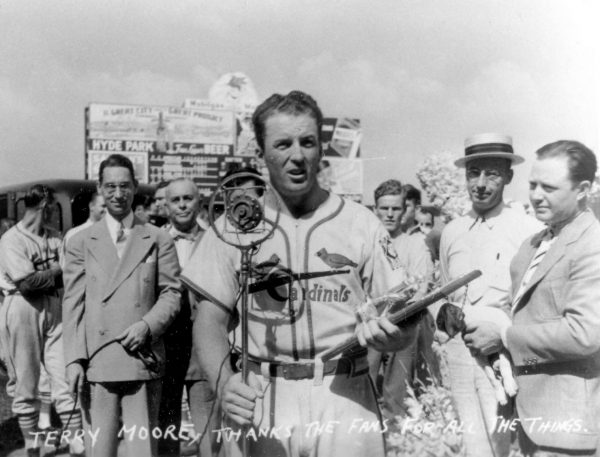
Lamar County native Terry Moore (1912-1995) played center field for the St. Louis Cardinals in the 1930s and 1940s. Considered by some to be one of the most talented outfielders of all time, he was known for his great range, large hands, and determination to catch any ball he could reach. A four-time All-Star between 1939-42, Moore helped the Cardinals win the World Series in 1942 and 1946, against the Yankees and the Red Sox, respectively. Moore’s baseball career was interrupted from 1943-45 when he left the Cardinals to serve in World War II.
Terry Bluford Moore was born on May 27, 1912, in Vernon, Lamar County, to Etta Susan McArthur Moore and James Henry Moore. He was the youngest of eight children: six boys and two girls. The family moved to Memphis and then to St. Louis when he was a child. His parents separated when he was 14, and Moore was forced to go to work to support his mother and siblings. He first earned money hauling coal in the winter and ice during the summer. Beginning at age 16, he worked for the Bemis Brothers Bag Company factory, where he set type for the advertisements that the company printed on its bags.
Moore played semipro baseball while he worked for the Bemis Brothers. Cardinals general manager Branch Rickey signed Moore to a contract and assigned him to a farm club in Columbus, Ohio. Moore began playing for a very successful Cardinals team in 1935. On September 5 of that year, he went six for six against the Boston Braves, meaning he got a hit in each of his six at bats. This feat had previously occurred only 22 times in MLB history. As center fielder, Moore covered much ground and had an excellent throwing arm. Because of his large hands, he occasionally caught line drives in his non-glove hand, including a great bare-handed catch on a line drive hit by future Hall of Famer Mel Ott.
Moore’s intensity as a player led to numerous injuries throughout his career, including his wrist, fingers, legs, groin, and shoulder. In 1938, he suffered a concussion when he ran into the concrete wall at St. Louis’s Sportsman’s Park. Moore was well respected by his teammates and was named team captain in 1941. As captain, he had a reputation for toughness, telling teammates off when they did not hustle, and refusing to allow them to fraternize with players on the other team at the ballpark. Fellow Alabamian Harry Walker, who joined the team in 1940, would relate that Moore did not even permit his teammates to say hello to friends on the other team, nor Harry’s brother Fred, who played for the Brooklyn Dodgers.
In 1942, the Cardinals won the World Series four games to one over the heavily favored New York Yankees. The team had an excellent outfield, with rookie and future Hall of Famer Stan Musial in left field, Moore in center field, and future Hall of Famer Enos Slaughter in right field. As usual, Moore was the Cardinals’ defensive star, denying another future Hall of Famer, Joe DiMaggio, of two extra base hits. In game three, DiMaggio hit a fly ball to deep left-center field. Musial and Moore chased after it, but Musial, realizing he could not catch it and would collide with his teammate, dove to the ground at the last second. Moore leaped over Musial’s back to make the catch. In game four, Moore caught a towering fly ball from DiMaggio in left-center field next to Yankee Stadium’s 457-foot sign.
Moore left the Cardinals to sell war bonds in the Panama Canal Zone, where, as a civilian, he taught physical fitness to military personnel. In 1943, he enlisted as a private in the U.S. Army and would work in the supply department. There was not much military activity in the Panama Canal Zone, so Moore and other service members spent time playing baseball. Moore received a furlough to attend the 1943 World Series rematch between the Cardinals and the Yankees, which the Yankees won, four games to one. In January 1945, Moore married Rhoda Flack, who worked in human resources in the Panama Canal Zone. They had two children. The couple divorced in 1957, and Moore married singer Patricia Petkus Wilson in 1960.
Discharged from the Army in January 1946, Moore reported to the Cardinals’ spring training facility in Florida. By then, he was nearly 34 years old, and, after a three-year gap in play, he was badly out of shape. He had also declined physically, and his range in center field and overall playing ability had declined as well. In the 1946 World Series, the Cardinals defeated the Boston Red Sox four games to three, with crucial hitting by Harry Walker. Moore was very effective at defense, making a diving catch to snare a line drive from Rudy York, but his knee pain hindered his hitting ability. Moore started only 116 games in 1947. He retired in 1948 with a lifetime batting average of .280, 80 home runs, and 513 runs batted in (RBIs).
Moore remained with the Cardinals as a coach from 1949-52. Despite his lack of experience, he was then hired to manage the Philadelphia Phillies after the All-Star game break in 1954. He was fired after the season, however, with a losing record of 35-42. He then returned to the Cardinals as a coach from 1956-58.
After his retirement, Moore engaged in several business ventures in St. Louis. Two of his businesses, a nightclub and a bowling alley-restaurant, both burned down, and a tornado destroyed his other St. Louis bowling alley-restaurant. Moore spent the final decades of his life in Collinsville, Illinois. He was inducted into the Missouri Sports Hall of Fame in 1992, the Alabama Sports Hall of Fame in 1995, and the St. Louis Cardinals Hall of Fame (posthumously) in 2016. He died on March 29, 1995, in Collinsville, Illinois, and is buried at Collinsville’s Holy Cross Cemetery.