Mitch McConnell
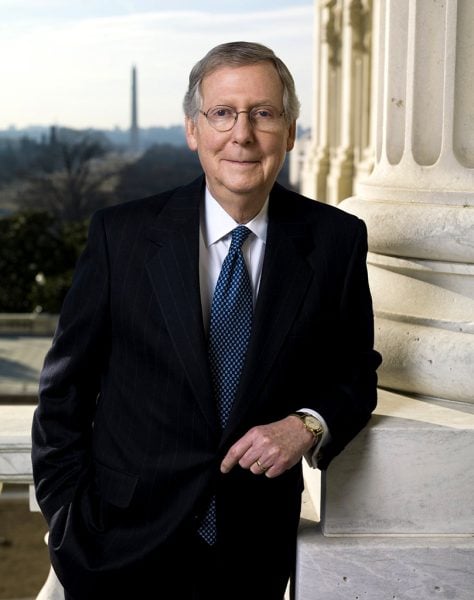
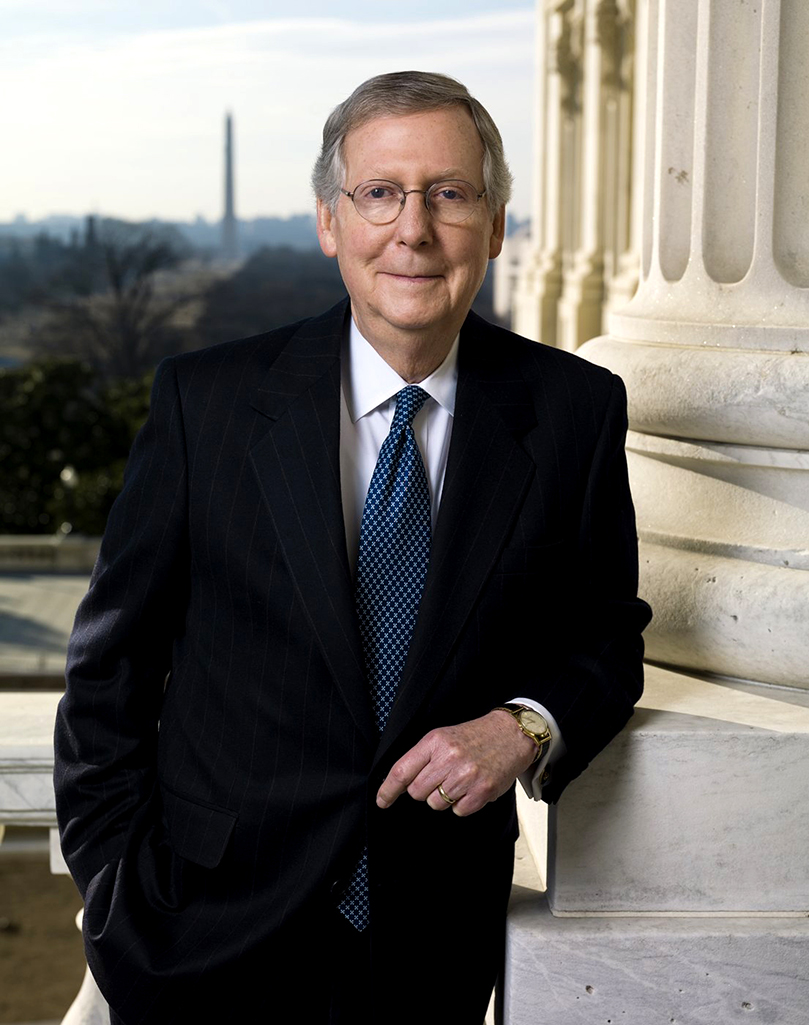
Colbert County native Mitch McConnell (1942- ) is a U.S. senator representing Kentucky. He has been elected to the U.S. Senate seven times, serving from January 3, 1985, to the present. He led Senate Republicans, both as minority leader and majority leader, from 2007 to 2025. McConnell is one of only 11 politicians to have served in the U.S. Senate for more than 40 years. A conservative Republican, he is known as a shrewd power broker.
McConnell was born Addison Mitchell McConnell III on February 20, 1942, to Addison Mitchell “A. M.” McConnell II and Julia Odene Shockley Mitchell. Although some sources claim he was born in Tuscumbia, he was born in nearby Sheffield, Colbert County. Despite its small population, three important U.S. senators were born in Sheffield: McConnell, Alabama senator Howell Heflin, and Tennessee senator Fred Thompson. McConnell spent several years of his childhood in Athens, Limestone County. At the age of two, he contracted polio, partially paralyzing his left leg. After extensive treatment and physical therapy, he regained regular mobility.
McConnell moved with his family to Augusta, Georgia, in 1950 and then to Louisville, Kentucky, in 1956. He studied political science at the University of Louisville, where was elected president of the Arts and Sciences Student Council; he graduated with honors in 1964. He subsequently attended the University of Kentucky College of Law, where he served as president of the Student Bar Association; he graduated in 1967. While studying law, McConnell interned for Kentucky congressman Gene Snyder. McConnell mentions in his autobiography, The Long Game, that he clashed with Snyder because he strongly supported civil rights for Black Americans whereas Snyder did not. In 1963, he attended the March on Washington, where he witnessed Martin Luther King Jr.’s “I Have a Dream” speech.
McConnell served in the U.S. Army Reserve for five weeks, beginning in July 1967. (The Army Reserve was a coveted spot because Pres. Lyndon Johnson was reluctant to send those forces to Vietnam.) After training at Fort Knox, McConnell received a medical discharge that August after being diagnosed with optic neuritis, an inflammation of the optic nerve, which transmits information from the eyes to the brain. Kentucky senator John Sherman Cooper, for whom McConnell worked as an intern, expedited McConnell’s release. In future elections, the brevity of McConnell’s service and the perception that he may have received preferential treatment became a campaign issue that opponents used against him.
After leaving the military, McConnell worked for an attorney’s office in Kentucky before working in Washington, D.C., for Republican Kentucky senator Marlow Cook from 1968-70. In 1968, McConnell married Sherrill Redmon; the couple had three daughters together before divorcing in 1980. In the 1970s, McConnell served in the Gerald Ford administration as Deputy Assistant Attorney General and then Acting Assistant Attorney General in the Office of Legislative Affairs. He then moved from Washington, D.C., to Louisville to work in a law firm and teach a night class in political science at the University of Louisville. In 1977, he was elected as a judge in Jefferson County, Kentucky; he continued in this role for the next seven years.
In 1984, McConnell was elected as a U.S. senator from Kentucky and has generally won subsequent reelection bids by comfortable margins. He has served as both the Senate majority leader, when Republicans held the most seats, and minority leader, when Democrats held the most seats. Like many of his contemporaries, McConnell has often voted along party lines.
McConnell married his second and current wife, Elaine Chao, in 1993, while serving his second senatorial term. Then the president of the United Way of America, Chao later served as Pres. George W. Bush’s Secretary of Labor and Secretary of Transportation in Pres. Donald Trump’s first term.
McConnell has served on numerous important committees in his four decades in the U.S. Senate. He has served as chair of the Rules and Administration Committee, vice chair of the Joint Committee on the Library, and chair of the Joint Committee on Printing and is a member of the powerful Committee on Appropriations (which included subcommittees dealing with funding for the Department of Defense, which he chaired, and Homeland Security). McConnell was active on the Agriculture, Nutrition, and Forestry Committee, the Select Committee on Intelligence, the Judiciary Committee, the Finance Committee, and the Foreign Relations Committee.
McConnell’s policies have typically been guided by a belief in limited government and fiscal conservatism. Throughout his years in office, Kentucky has benefited from receiving generous federal funding because of his efforts. He proved instrumental in guiding tax cuts through the Senate under Republican presidents. He advocates for strong enforcement of immigration policies and a secure and policed border. Despite his efforts to oppose Pres. Barack Obama’s signature legislation, the Affordable Care Act (commonly known as Obamacare), he failed to stop the act from becoming law. He has typically favored free trade policies and opposed tariffs, believing that protectionist policies and trade wars prove hurtful to consumers, small businesses, and large corporations. The senator aligns with his conservative colleagues’ philosophy of putting the needs of the United States before the needs of other countries but opposes the isolationist beliefs that some of his Republican colleagues harbor.
McConnell’s foreign policy views are nuanced, and he often relies on his ability to garner bipartisan support on these issues. He opposes liberal international policies, which, in his opinion, compromise too much and grant too many concessions to other countries, but he is also against conservative isolationism. McConnell supports active partnerships between the United States and other nations in foreign affairs but also supports diplomacy with the threat of military force if necessary. For instance, McConnell staunchly defended Pres. George W. Bush’s 2003 invasion of Iraq, known as Operation Iraqi Freedom, which aimed to uncover Iraqi president Saddam Hussein’s alleged stockpile of weapons of mass destruction. Decades later, he strongly supported Ukraine after the 2022 Russian invasion and advocated for the United States to send money and weapons to Ukraine for defense. McConnell supports the North Atlantic Treaty Organization (NATO) mutual defense alliance and its mission to protect member countries. Isolationism, McConnell believes, enables dangerous countries to become more powerful and pose larger threats to global stability. The senator has advocated for significant increases in defense spending to support a robust military and technological advances to protect the United States.
In the 2010s and 2020s, McConnell played a notable role in shaping the Supreme Court’s increasing conservatism. Most famously, he led a filibuster to block Pres. Obama’s selection of Merrick Garland for the vacant seat on the U.S. Supreme Court upon the death of Justice Antonin Scalia on February 13, 2016, nine months before the 2016 presidential election. By preventing Garland from receiving a hearing or being appointed, McConnell’s filibuster enabled Pres. Trump, who won the 2016 presidential election, to choose his own Supreme Court judge, Neil Gorsuch. Republicans lauded the senator’s shrewd maneuvering and party loyalty, but Democrats viewed his behavior as unethical. Although McConnell claimed that Supreme Court judges (such as Garland) should not be considered or appointed shortly before a presidential election, he later successfully advocated for the confirmation of Amy Coney Barrett, who replaced Supreme Court justice Ruth Bader Ginsburg eight days before the 2020 presidential election between Trump and Joe Biden. President Trump’s three appointees shifted the Supreme Court to the right, contributing to the 2022 reversal of Roe v. Wade and the 2024 granting of presidential immunity.
Although McConnell had established a solid working relationship with Pres. Trump during the latter’s first term, their bond turned into hostility when McConnell blamed him for the January 6, 2021, riot at the U.S. Capitol, accusing the outgoing president of inciting violence and an insurrection. The senator delayed the hearing and vote on impeachment until after Trump left office. McConnell then voted against impeachment, claiming that it was impossible to impeach Trump because he was no longer president and thus could not be removed from office.
Despite their mutual animosity, McConnell reluctantly endorsed Trump for president, stating that he would endorse the Republican nominee no matter who it was. In Pres. Trump’s second term, McConnell has frequently differed from the president on key issues, including tariffs, and has voted against the confirmation of several presidential appointees, including Director of National Intelligence Tulsi Gabbard, Secretary of Defense Pete Hegseth, and Secretary of Health and Human Services Robert F. Kennedy Jr., all of whom were approved by the Senate.
McConnell has suffered some serious health problems in recent years. For instance, the senator underwent a triple heart bypass surgery to clear blocked arteries in 2003 and has fallen five times in public. Furthermore, his face has frozen several times, sometimes even mid-sentence, which has caused concern for his safety and health. McConnell’s health concerns likely factored into his decision not to seek re-election.
McConnell has been an astute and influential politician for 40 years and served as Senate party leader longer than any politician in American history. He employs the filibuster as an effective weapon, claiming that using a filibuster can help muster bipartisan support for issues. Time magazine named McConnell one of its 100 Most Influential People in 2015. McConnell announced on February 20, 2025, that he would not seek an eighth term as senator and would retire when his current term expires in January 2027.
Additional Resources
- Dyche, John David. Republican Leader: A Political Biography of Senator Mitch McConnell. Wilmington, Del.: Intercollegiate Studies, Institute, 2009.
- MacGillis, Alec. The Cynic: The Political Education of Mitch McConnell. New York: Simon & Schuster, 2014.
- McConnell, Mitch. The Long Game Memoir: New York: Sentinel, 2019.