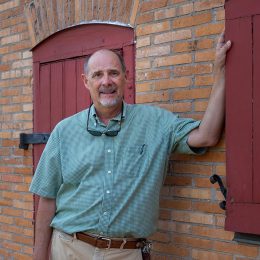
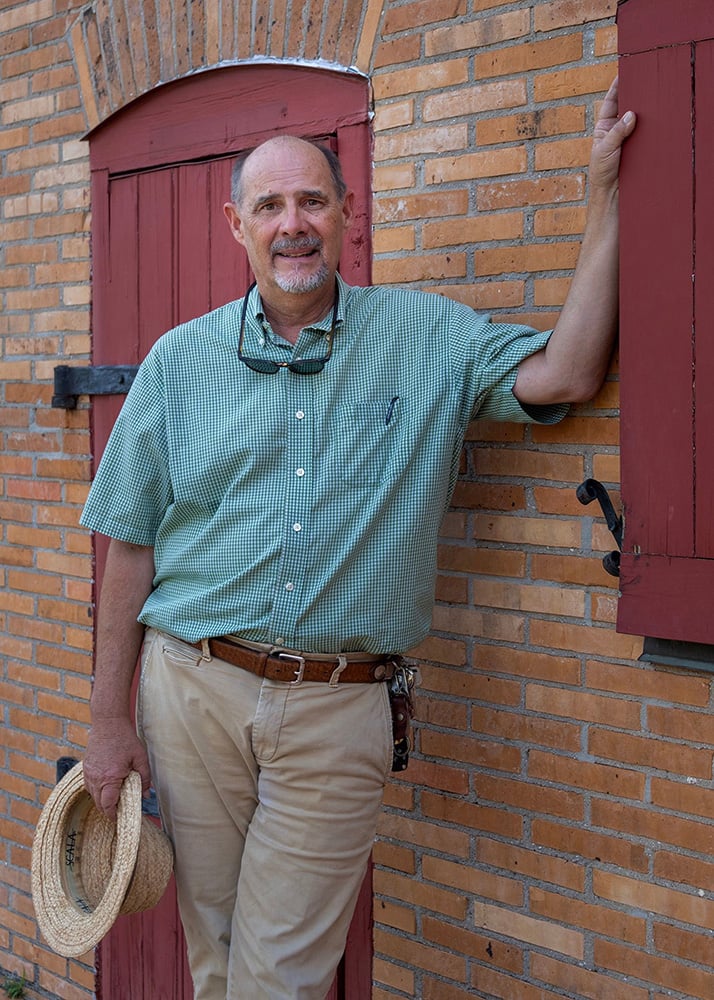
John S. Sledge
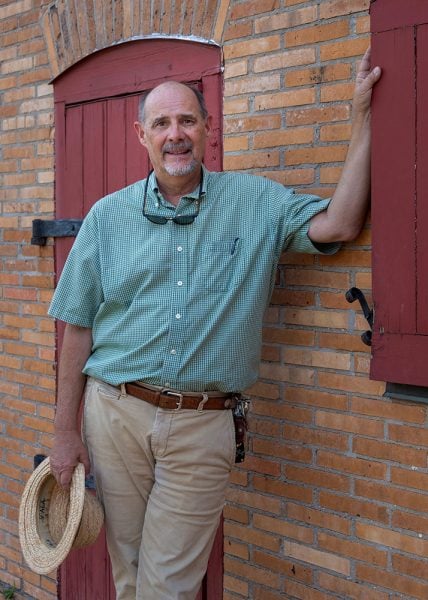
John S. Sledge (1957- ) is an award-winning historic preservationist, author, and critic whose nine books and dozens of articles have explored southern architectural heritage, maritime and military history, and many aspects of Alabama and Mobile, Mobile County, history. He is the recipient of several notable literary awards.
John Sturdivant Sledge was born September 22, 1957, in Gainesville, Florida, where his father, the later celebrated professor and author of With the Old Breed at Peleliu and Okinawa (1981) Eugene B. “E.B.” Sledge, was pursuing his doctoral studies in zoology at the University of Florida. His mother, Jeanne Arceneaux Sledge, spent part of her childhood living in one of the famed Pontalba Buildings on the historic Jackson Square in New Orleans. The couple married in 1952 and had two children. John’s younger brother, Henry, was born in 1965.
The family lived in Winter Haven, Florida, from 1960 through 1962, during which time Sledge’s father worked at a plant nursery. Sledge recalls weathering Hurricane Donna in 1960 with his family and watching the 1962 launch at Cape Canaveral of the Mercury spacecraft Friendship 7, piloted by John Glenn, from their porch. The family relocated to Montevallo, Shelby County, in 1962, where E. B. Sledge served as a professor of biology at Alabama College (present-day University of Montevallo), until his retirement in 1990.
Young Sledge spent many childhood holidays in the company of his paternal grandmother, Mary Frank Sturdivant Sledge, a founding member of the Historic Mobile Preservation Society, a volunteer organization John Sledge would lead for a two-year term in the mid-1990s. She lived in Georgia Cottage, an 1840 Greek Revival home once occupied by famed nineteenth-century novelist Augusta Jane Evans Wilson. It was here that Sledge’s fascination with the written word and storytelling developed.
Graduating from Shelby Academy in 1975, Sledge enrolled at Auburn University, where he studied history and Spanish. He spent the summer of 1979 in Madrid immersed in Spanish language and culture. After graduating from Auburn in 1980, he pursued a master’s degree in historic preservation from Middle Tennessee State University. He wrote his thesis on historic preservation efforts in Summerfield, Dallas County.
In 1985, after brief stints in preservation-related work in Ellaville, Georgia, and Pulaski, Tennessee, Sledge became an architectural historian for the city of Mobile’s Historic Development Commission. During his four-decade career there, he conducted extensive historic building surveys for Mobile and neighboring Baldwin County, oversaw the city’s endangered properties program, and placed dozens of structures on the National Register of Historic Places.
In 1988, Sledge married Lynn Marie Hulcher. The couple would have two children.
Sledge’s first three books were extensions of his preservation work in Mobile. Cities of Silence was an illustrated history of five of Mobile’s oldest cemeteries. An Ornament to the City explored the history of the ornate “iron lace” which graces the balconies of many Mobile buildings. Drawing deeply on available business records, it was praised for its rich storytelling and won the Alabama Library Association’s Award for Best Nonfiction Book of 2009. In The Pillared City, Sledge chronicled the architectural history of Mobile’s Greek Revival period (1825-70), which included some of the port city’s most iconic extant structures such as Christ Episcopal Church, Oakleigh, Barton Academy, and Georgia Cottage, where Sledge spent many of his youthful days. Richly illustrated and beautifully produced, these three books blend historical images and maps with contemporary black-and-white photography by artist Sheila Hagler.
His 2013 book Southern Bound was a compilation drawn from Sledge’s book review columns at the Mobile Press-Register. He served as editor of the paper’s book page from its inception in 1995 until its end in 2012, among the last book sections to be published in a southern newspaper. (Moving to a digital format, the Press-Register downsized and laid off several hundred employees from the paper and related publications that year.) During that time, he authored some 700 columns and he and Lynn Sledge edited and published reviews from dozens of contributors. Sledge is a member of the National Book Critics Circle.
Sledge turned next to an expansive narrative history of the Mobile River. The short, but important waterway, he contended, lacked the glamorous literary heritage of the larger Mississippi, but was fascinating in its own right. Blending chronological and thematic chapters with Sledge’s personal experiences on the river, the book was praised by Alabama author and literary critic Don Noble as a monumental and impressive historical narrative. A subsequent edition included a new preface in which Sledge addressed the 2018 discovery of the wreckage of the Clotilda, the last ship to bring enslaved Africans to American shores in 1860. The Mobile River received the Alabama Historical Association’s 2016 Clinton Jackson and Evelyn Coley Award for best book on local history.
Sledge applied the same narrative approach in These Rugged Days: Alabama in the Civil War, praised for its vivid storytelling by acclaimed documentarian Ken Burns, and a subsequent book on the Gulf of Mexico, The Gulf of Mexico: A Maritime History. Both subjects afforded Sledge the opportunity to draw deeply from the stories which filled his southern boyhood and had long held his interest as a historian and writer.
In 2024, Sledge teamed with celebrated Alabama photographer Chip Cooper, Cuban historian Alicia García-Santana, and Cuban photojournalist Julio A. Larramendi to produce Mobile and Havana: Sisters Across the Gulf. This dual, bilingual history of cities on opposite sides of the Gulf of Mexico represented the culmination of years of cultural exchange.
In addition to his books, Sledge has written a bevy of articles for both popular magazines and scholarly publications, including Old House Journal, Garden & Gun, Virginia Quarterly Review, Mobile Bay, Blue & Gray Magazine, Sea History, Alabama Review, Gulf Coast Historical Review, The Northern Mariner, French Quarter Journal, and Alabama Heritage.
Throughout his career, Sledge received numerous writing awards and honors. He is a three-time recipient of the Mobile Historic Development Commission’s Elizabeth B. Gould Research Award. In 2024, the organization bestowed upon Sledge its Eichold-Hamilton Award honoring his long career with the city of Mobile. The Alabama Historical Commission has twice honored his work with its Distinguished Service Award in 2002 and 2010. Sledge was the 2021 recipient of the University of Alabama’s prestigious Clarence E. Cason Award for Nonfiction Writing. Others honored with the award have included Albert Murray, Wayne Flynt, Winston Groom, Roy Hoffman, Cynthia Tucker, and Frye Gaillard.
Upon his retirement from the city of Mobile in 2024, Sledge became maritime historian-in-residence at the National Maritime Museum of the Gulf, where he assists in the development of exhibits and public programs. He continues to write and speak widely on the architectural, military, and cultural history of Mobile and the broader American South.
Works by John S. Sledge
Cities of Silence: A Guide to Mobile’s Historic Cemeteries (2002)
An Ornament to the City: Old Mobile Ironwork (2006)
The Pillared City: Greek Revival Mobile (2009)
Southern Bound: A Gulf Coast Journalist on Books, Writers, and Literary Pilgrimages of the Heart (2013)
The Mobile River (2015)
These Rugged Days: Alabama in the Civil War (2017)
The Gulf of Mexico: A Maritime History (2019)
Mobile and Havanna: Sisters Across the Gulf (2024)
Mobile in the Heart (forthcoming 2027)