Huntsville Jewish Heritage Center
Opened in 2017, the Huntsville Jewish Heritage Center (HJHC) is one of relatively few dedicated Jewish heritage museums in the Deep South, and the only one in Madison County. It is housed in Temple B’Nai Sholom, which was constructed in 1899 and is the oldest synagogue in Alabama in continuous use. The center’s intentional design, which takes visitors from new construction through to the historic sanctuary and into the HJHC, reflects its founding purpose to make almost 200 years of local Jewish history visible and accessible to congregants and outside visitors alike.
The HJHC is part exhibit space and part archival repository for showcasing Huntsville’s Jewish history. The collection contains items from early community members, as well as objects relating to the Holocaust, the state of Israel, holiday celebrations, and Jewish life cycle events. Located in what was the B’Nai Sholom’s original study for rabbis, it emphasizes the traditions of Judaism, while inviting visitors of all faiths and backgrounds to reflect on commonly shared beliefs.
Development
In 2015, Rabbi Elizabeth Bahar asked Margaret Anne Goldsmith, a historian of Huntsville’s Jewish community, to convert the rabbi’s original study into a museum. Goldsmith, HJHC’s recognized founder and first director, is a descendant of four of the founding families of B’Nai Sholom: the Bernsteins, Hersteins, Schiffmans, and Goldsmiths. Goldsmith assembled a committee including herself, Morty Banks, and Sara Crocker, all congregants of B’Nai Sholom, to contact synagogues with similar museums to inquire about their collections and management policies. This included temples in Savannah, Georgia, Manhattan, New York, and Newport, Rhode Island. The committee and B’Nai Sholom’s board named the museum “Huntsville Jewish Heritage Center” in order to embrace the wider history of the area, including the combined and diverse histories of Temple B’Nai Sholom (Reform), Etz Chayim Synagogue (Conservative), Chabad of Huntsville (Orthodox), the Jewish Federation of Huntsville and North Alabama, and other Jewish organizations.
A planning group known as the Heritage Center Committee (HCC) raised funds in increments of $5,000. Several families contributed to the campaign, raising a total of $35,000 to remodel and update the rabbi’s old study to house the museum, construct and install display furnishings, professionally film and edit a 10-minute video, and renovate other building components to support artifacts. HCC received some display and interpretive objects through donations and loans. Some objects already owned by B’Nai Sholom were relocated from other areas of the building. Renovations, exhibit design, and a partial installation of materials were largely accomplished by June 2016, and the HJHC was completed in December 2016.
The HJHC was dedicated and opened to the public for the first time on Sunday, April 2, 2017. The dedication included a 45-minute program, with remarks from Rabbi Elizabeth Bahar, Margaret Anne Goldsmith, B’Nai Sholom board president Pam Rhodes, and former University of Alabama in Huntsville faculty Daniel Schenker, who is also a Huntsville historian. The Temple choir provided music, and docents stationed throughout the building helped visitors and answered questions.
Overview of Exhibits
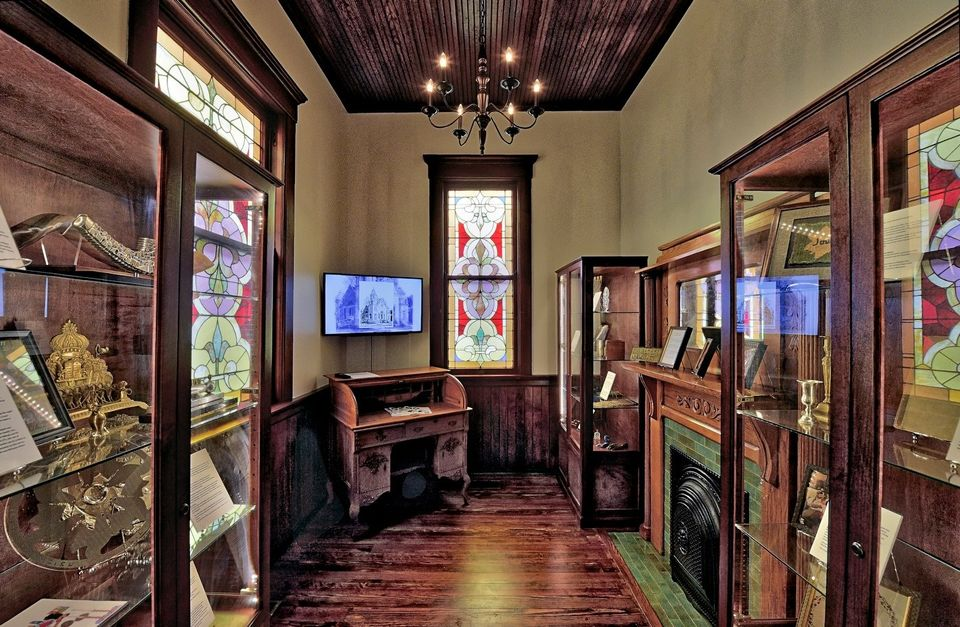
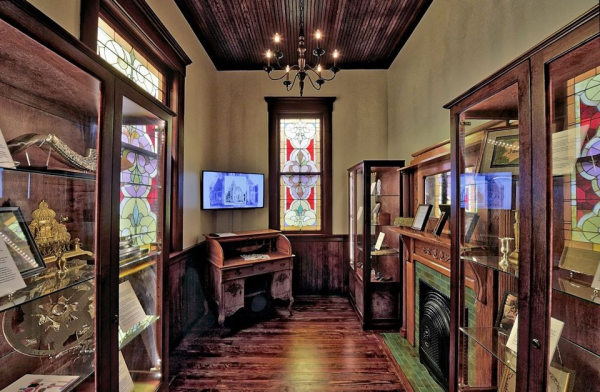
The HJHC pays tribute to the space’s original intent, retaining the rolltop desk used by rabbis since the temple’s construction in 1899, as well as the original oak mantelpiece, stained-glass windows, and wood floors and moldings. The remainder of the room is filled with exhibit cases holding religious artifacts and symbols. The room’s updated purpose maintains the expectation of introspection. Notably, Goldsmith has said that the Center is meant for education and reflection, not proselytizing.
Visitors to the HJHC typically enter B’Nai Sholom through its administrative and social gatherings building, which faces Lincoln Street. They are introduced to B’Nai Sholom and the history of Judaism in the area through a 10-minute introductory film, which covers 1832-2016 and includes Huntsville and neighboring communities. To develop the film, Daniel Schenker and Blake Hudson, a city of Huntsville videographer, interviewed 16 individuals from B’Nai Sholom, Etz Chayim, and other Jewish organizations. The interviewees were asked to recall more recent history, from the latter half of the twentieth century, after discovering that a consistent B’Nai Sholom organizational record did not exist after 1956. Schenker and Hudson edited the interviews with video and still images to create the final film, which, like all content generated during the project, is archived at B’Nai Sholom.
Tours are by appointment only. Temple members serve as docents, leading visitors down a hallway between the newer construction and the historic structure that is B’Nai Sholom’s sanctuary and other original rooms. The hallway, which is full of hanging photographs and documents from generations of congregants, acts as an intentional transitional space. Visitors enter the hallway from a newer building made to house administrative tasks, a reading library, and a social hall. They exit the hallway and step into the sanctuary, where information on Judaic customs and traditions begins. A tour of the sanctuary helps reinforce to visitors that Jewish practices are culturally alive, not just abstract concepts.
Before entering the HJHC, visitors are pointed to five Torah covers and two Torah rollers at the entrance of the room. The Torah, Judaism’s central text, conveys its foundational stories and laws, through the Five Books of Moses (Genesis through Deuteronomy in the Jewish Torah and Christian Bibles). The Torah is handwritten in Hebrew and rolled around two wooden shafts, typically ornately carved or decorated. As a sign of reverence, the Torah is covered with a mantle (cover). The covers at HJHC’s entrance are highly decorative, with gold embroidery and beading. The decoration of the Torah, or Hiddur Mitzvah (Beautifying the Commandment) in Hebrew, is a Jewish tradition that encourages reverence for God’s Word through enhancing ritual objects. By entering HJHC with the Torah covers as the “doorway,” visitors are physically and intellectually stepping into Judaic culture through its foundational text.
Exhibits are loosely arranged in five categories: the Sabbath, memorial and celebration events, life cycle events, holidays, and sacred objects and traditions. Sacred objects in particular are used in most of the exhibits to help visualize and support the importance of each event and tradition.
Artwork, photographs, historical documents, and other hanging artifacts are also used to visualize momentous occasions and concepts. Many of the sacred objects, photographs, and other adornments were donated or loaned by congregants of Temple B’Nai Sholom, Etz Chayim Synagogue, and Chabad of Huntsville. Others were gifts from the Ashalim Child Advocacy Center in Israel, the National Museum of American Jewish History in Philadelphia, Awareness Ministries, and other Jewish organizations.
Sacred objects in the collection include a tzedakah box, a traditional container used to collect money for charitable donations. There is a mezuzah, which is a small decorative case holding a handwritten parchment scroll with Torah verses Jewish people affix to the right doorpost of their homes. Another is a tallit, a traditional rectangular prayer shawl worn during morning prayers. And there are tefillin, a pair of small black leather boxes containing handwritten Torah scrolls that adults traditionally bind to the arm and head during morning prayers.
The HJHC's exhibits are open to anyone interested in learning about Jewish life in north Alabama. As the only dedicated Jewish heritage museum in Madison County, HJHC preserves a community record that might otherwise have remained scattered across individual families and organizations, and positions Temple B'Nai Sholom's historic sanctuary as a living site of both worship and public memory.