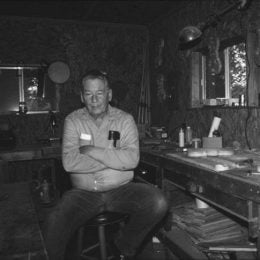
Gene Ivey
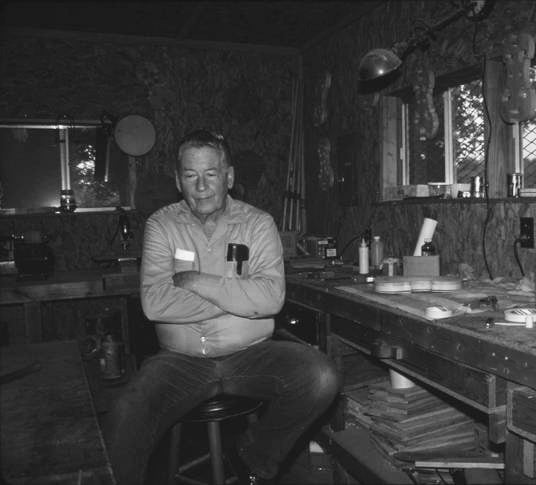
Jackson County native William Eugene “Gene” Ivey (1926-2014) was a renowned instrument maker and traditional fiddle player. He crafted almost 300 guitars, fiddles, and mandolins over his lifetime, taught the craft to others, and created a bluegrass gathering in Ider, DeKalb County, that continues today. In 2010, he was the first person to earn the Roland Walls Lifetime Achievement Award from the DeKalb County Fiddlers’ Convention and was awarded the designation of master folk artist from the Alabama State Council on the Arts.
Ivey was born on his family’s farm on February 25, 1926, in Paint Rock, Jackson County, to William Riley Ivey and Debbie Ann Evans Ivey. He was the youngest of six children. The family moved to DeKalb County and lived in various places around Sand Mountain during his childhood. His parents bought him his first fiddle at age nine, and he learned to play along with his father’s collection of bluegrass and gospel records. He recalled in a later interview that his community was steeped in live traditional music, and he played at his first square dance at the age of ten. He was working as a laborer by his late teens and married Mary Louise Shrader on November 7, 1943; they did not have any children.
Ivey registered for service in World War II in February 1944 and joined the U.S. Marines. In late March 1945, his unit, the First Marine Division (nicknamed “The Old Breed”), was sent to the Pacific theater as part of the Tenth Army, which combined U.S. Army troops with Marines from the Third Amphibious Unit to take the Japanese island of Okinawa. Ivey participated in the Battle of Okinawa, which raged from April 1 to June 22, and was wounded in action in the Battle of Itoman, the final conflict on Okinawa. Although the United States took the island, it would be the bloodiest battle of the war in the Pacific, with tens of thousands of casualties on both sides, including civilians. Fellow Alabamian Eugene Sledge also served in this conflict and wrote about it in his memoir, With the Old Breed: At Peleliu and Okinawa. Ivey was given a special commendation and coin from the commanding general of the Third Marine Expeditionary Force, stationed in Okinawa. While serving in the South Pacific, he was asked to repair a broken fiddle that a fellow soldier found. He salvaged the usable parts, made a body out of a metal can, and repurposed steel fishing line for string and a pole for the bow. That would mark the beginning of his instrument-making and repair career.
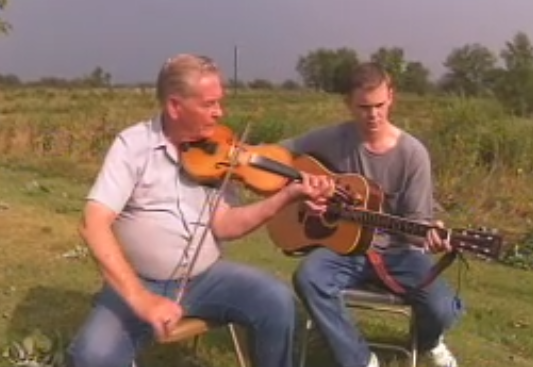
Ivey returned to Alabama after the war and opened Ivey's Service Station and Tire Center in Ider. He also was a member of the Ider Rescue Squad and a deacon at Five Points Baptist Church. According to his recollections, he built his first fiddle in 1967, and when he closed his tire business in 1993, he established an instrument shop in the building. In his years as a fiddler and instrument maker, he taught both crafts to others. Banjo maker Randy Arnold of Northport, Tuscaloosa County, studied with Ivey and noted that although Ivey honored tradition, he embraced modern technology, including synthetic glue and machine carving. By the time of his death in 2014, Ivey’s fiddles were selling for up to $2,500. His building became a focal point for bluegrass enthusiasts for the remainder of his life. In the 1980s, he and Mary Louise also founded an annual fiddlers gathering at Ider Town Park, held on the third Saturday in July. In April 2003, his workshop burned as the result of a lightning strike, and he lost all of his instruments. With the help of students and neighbors, he rebuilt the shop and continued making instruments.
In 1995, Ivey was awarded the first of what would be ten Folk Arts Apprenticeship grants from the Alabama Folklife Association. The program provides funds to master practitioners of various folk arts, including fiddle making, to pass on their techniques and knowledge to aspiring students. He has been recognized as a “Musical Achiever” by the Alabama Music Hall of Fame for his significant contributions to music in the state, and some of his instruments have been displayed at the Smithsonian Institution’s National Museum of American History.
After his death on March 16, 2014, his former students and friends continued to gather, as he requested late in his life, and play on the porch of the historic cabin that serves as the offices for Mentone Realty in Mentone. And each year since his death, his students and friends have hosted the Gene Ivey Fiddlers’ Picnic at Ider Town Park on the third Saturday in July.