Jothan McKinley Callins
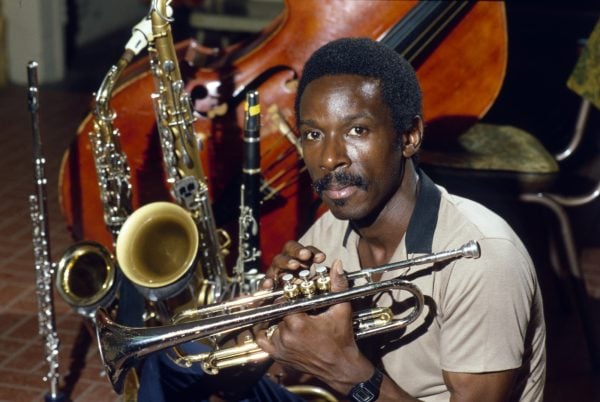
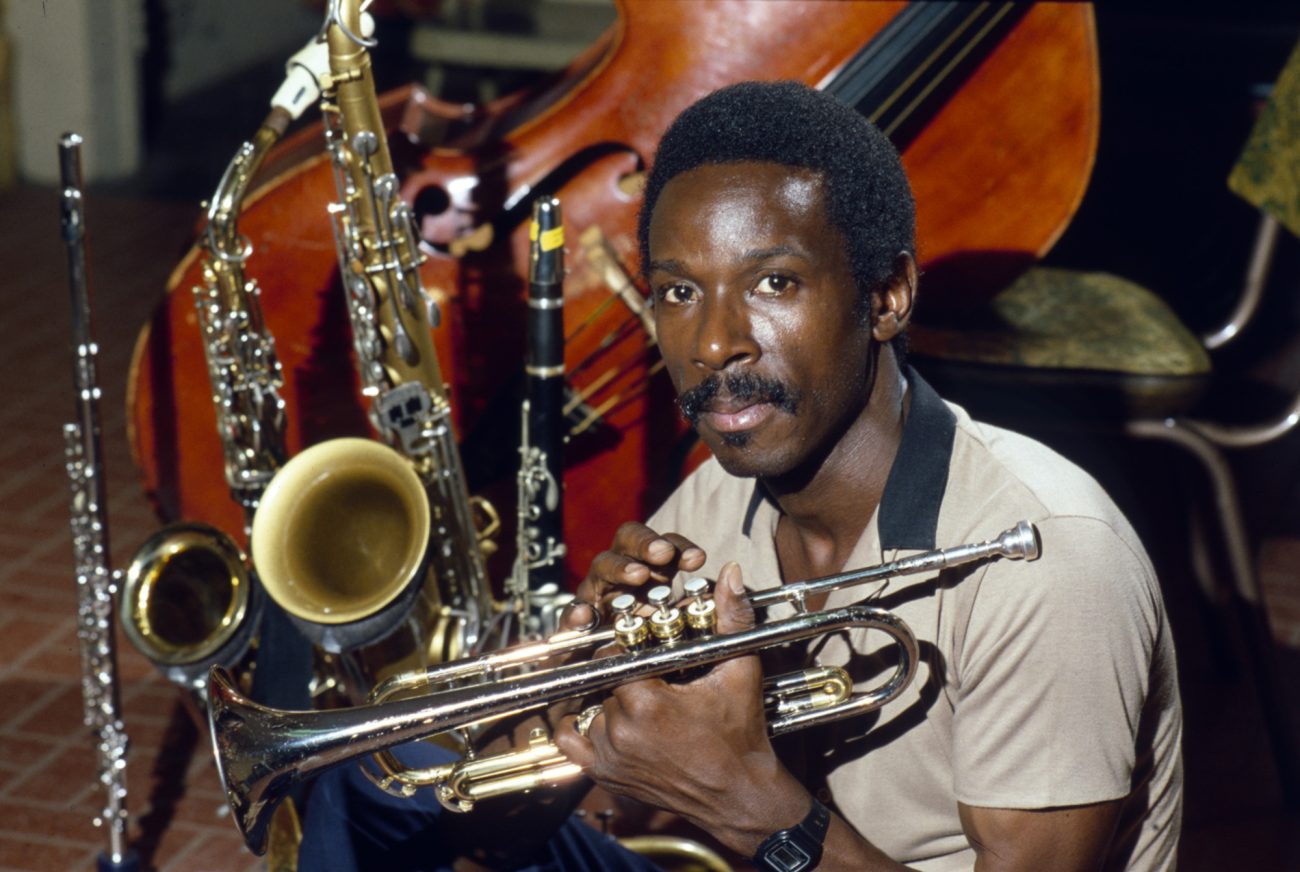
Jothan McKinley Callins (1942-2005), a native of the Birmingham suburb Ensley, was a notable jazz trumpeter, bassist, bandleader, composer, scholar, and educator. Both a product and a champion of Birmingham’s homegrown jazz tradition, Callins devoted much of his energy to preserving and perpetuating his city’s musical legacy. He was a key figure in the development of the Alabama Jazz Hall of Fame, a devoted chronicler of local jazz history, and founder of the influential Birmingham Youth Jazz Ensemble. A member of Sun Ra’s band, the Arkestra, he was a particularly close collaborator with Birmingham native Sun Ra (née Herman Blount) in that bandleader’s final years.
Callins was born on October 29, 1942, in Ensley, Jefferson County, the third of nine children born to Aldrich Callins Sr. and Odell Callins. Callins grew up a few blocks from Tuxedo Junction, an area once celebrated as a hub for Black musical and social life. He received his early training in music at William Hooper Councill Elementary and, under the direction of bandmaster Amos Gordon, at Western Olin High School (present-day Jackson-Olin High School). He attended Florida A&M University on a music scholarship and, upon graduation in 1964, moved to New York City, launching his professional career with a spot in the Lionel Hampton Orchestra.
In the late 1960s, Callins established himself as an active participant in New York’s Greenwich Village jazz scene and in the Black Arts Movement’s developing community of musicians, actors, writers, and dancers. During this period, he worked with Nigerian drummer, activist, and educator Babatunde Olatunji and, following an introduction by Birmingham musician Walter Miller, first performed with Sun Ra and his Arkestra. As a member of the New York-based Negro Ensemble Company, Callins played bass in the 1973 Broadway production The River Niger.
In 1968, Callins formed his own band, the Sounds of Togetherness, whose spiritually charged 1975 album Winds of Change explored themes of Black identity, freedom, peace, and transcendent consciousness. In the years since its release, the album has grown a reputation among collectors as an overlooked classic.
While performing and teaching in New York, Callins maintained close ties with Birmingham, Jefferson County. He was a passionate advocate for jazz in his home state, working both to document the music’s history and to pass the tradition to new generations. In the late 1970s, he returned to Birmingham, was appointed Jazz Artist in Residence for Birmingham City Schools. In 1977, he founded the National Black Cultural Society, a Birmingham-based nonprofit that served as parent organization to the Alabama Jazz Hall of Fame. (Callins was inducted into the Alabama Jazz Hall of Fame in 1979, along with Sun Ra and others.) He continued to pursue his own education, earning a master’s degree in ethnomusicology from the University of Pittsburgh in 1982. His thesis, “The Birmingham Jazz Community: The Role and Contributions of Afro-Americans (up to 1940),” was the first detailed history of what Callins persuasively argued was a distinctive and influential local music tradition, one largely rooted in the city’s historically segregated Black schools.
In 1989, Callins renewed his affiliation with the Sun Ra Arkestra. Sun Ra himself had grown up in Birmingham, though he consistently claimed to have come from outer space, and Callins’s and Sun Ra’s shared Alabama roots provided an important connection between the two musicians. Sun Ra had seldom returned to Birmingham since leaving the city in 1946, and Callins helped revive the relationship between the bandleader and his hometown. Callins became a close collaborator with Sun Ra, who incorporated the Callins composition, “Alabama,” into his repertoire. When Sun Ra’s failing health caused him to move back to Birmingham from his adopted Philadelphia, Callins assisted in the move. Following Sun Ra’s 1993 death, Callins coordinated a memorial service for the bandleader, complete with poetry, musical performances, and reminiscence from some of Sun Ra’s oldest friends. Callins remained devoted to Sun Ra’s legacy and over the next several years presided over several Birmingham celebrations in the musician’s honor.
Callins was also among the early organizers of Birmingham’s City Stages music festival, which brought major artists from a diversity of genres to the city. Sun Ra and his Arkestra appeared at the first two festivals, in 1989 and 1990. In the 1990s, Callins collaborated with jazz pianist Consuela Lee Moorehead in the group Quartet Alabama and other projects. (Educated at the Snow Hill Normal and Industrial Institute, which her father founded in Snow Hill, Wilcox County, Moorehead had returned to Snow Hill to develop and direct the Springtree/Snow Hill Center for the Performing Arts on the grounds of the former school.) Callins remained active as a composer, and some of his original pieces, such as “Councill” and “Family,” became standards at local jam sessions.
Callins’s most lasting legacy was likely his work as founding director of the Birmingham Youth Jazz Ensemble. Established in 1994, the nonprofit served as an important training ground for numerous developing middle- and high-school musicians, many of whom would go on to careers in a variety of arts fields. Callins continued to serve as the group’s director until his death in 2005. He is buried in Mount Hope Cemetery in Vance, Tuscaloosa County.
Additional Resources
- Callins, Jothan. The Birmingham Jazz Community: The Role and Contributions of Afro-Americans (up to 1940). Master’s thesis, University of Pittsburgh, 1982.
- Mathews, Burgin. Magic City: How the Birmingham Jazz Tradition Shaped the Sound of America. Chapel Hill: University of North Carolina Press, 2023.