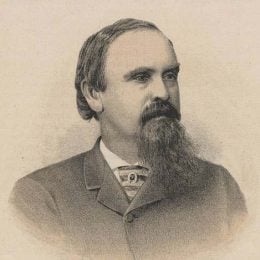
Arthur Keller
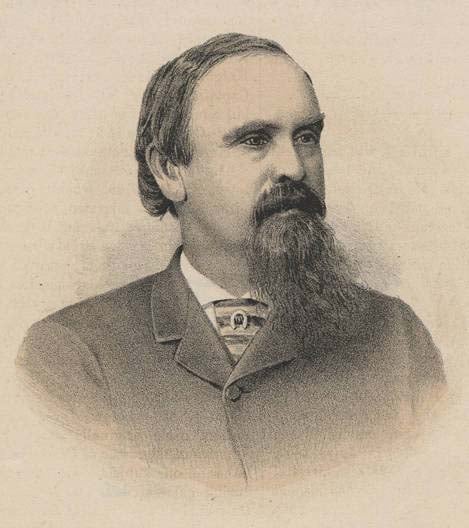
Arthur Henley Keller (1836-1896) is best known as disability advocate Helen Keller’s father but was well known in his lifetime as a lawyer, a newspaper editor, a Confederate officer, a real estate broker, a farmer, and a U.S. marshal for the Northern District of Alabama. In addition, he was an amateur historian and a delegate to five national Democratic conventions.
Keller was born on February 5, 1836, in Tuscumbia, Colbert County, to David and Mary Fairfax Moore Keller. His father had moved from Tennessee to north Alabama in 1820 and would serve as the president of the Tuscumbia and Decatur Railroad. He also owned extensive farmland, and according to the 1830 Census, nearly 50 enslaved individuals. There is no record that Arthur was a slaveholder. He studied under future Alabama governor Robert Burns Lindsay and attended the University of Virginia to study law, graduating in 1858. Keller first married Sarah E. Rosser, with whom he would have three children prior to her death in 1877. His second marriage was to Kate Adams, with whom he would also have three children, including author and activist Helen Keller, who became widely known for overcoming disabilities that left her unable to see, speak, or hear.
In 1862, Keller enlisted in the Confederate States Army’s 27th Alabama Infantry Regiment and served as captain and quartermaster. He was transferred to Philip D. Roddey’s command, a cavalry brigade, in August 1864 and held the position of paymaster. While this post was originally temporary, Roddey successfully requested Keller’s transfer to be made permanent. He was paroled in 1865 at the close of the war, at which time he engaged in the shipping and receiving business and returned to practicing law in north Alabama.
Keller appears to have amassed most of his wealth after the Civil War. In addition to representing clients in the local, state, and federal courts, Keller farmed crops such as potatoes, cotton, apples, and peaches, while also raising sheep, cattle, and hogs. For many years he was a real estate broker, at one point forming a partnership with fellow lawyer John D. Rather and W. A. Johnson. He endorsed a number of products in various newspapers and was a founding investor in the Sheffield and Atlantic Railroad and the Indiana, Alabama, and Texas Railroad. He was one of several men to form a partnership to build a cottonseed oil mill in Demopolis, Marengo County, of which he was listed as a director in 1882. Newspapers announced in 1884 that Keller had purchased a stone quarry located on the Tennessee River near Sheffield, Colbert County. He was a member of the board of directors for the Grangers Life and Insurance Company and the Tuscumbia Electric Light and Water Company. He served as the vice president for the Bank of Commerce in Sheffield. In his editorial writings, he supported the growth of railroads and opposed the spread of Mormonism in north Alabama. An eloquent and outspoken advocate for the Democratic Party, Keller served as a delegate at five Democratic national conventions as well as numerous other conventions around the state.

Throughout Keller’s many endeavors, he was best known for his ownership and editorial work with the North Alabamian in Tuscumbia. He purchased the paper around 1875 and continued the publication’s tradition of supporting the Democratic Party. In 1883, he purchased the Tuscumbia Democrat and absorbed it into the North Alabamian. From 1885 to 1890, Keller ran the paper sporadically, at times leasing it to others who would take temporary editorial control. In 1890, he purchased the Tuscumbia Dispatch and merged it with the North Alabamian; he continued operating the paper until his death in 1896. While he was encouraged to run for public office on several occasions, newspapers reported that he declined, preferring to continue operating his newspaper.
In 1882, state senator David Davie Shelby challenged Keller to a duel. Shelby was, at this time, interested in securing the open U.S. House of Representatives seat created by the death of Republican William M. Lowe. Keller’s Democratic paper had published a history of Shelby’s Republican political career that he deemed damaging to his campaign and him personally. Shelby sent a messenger to Keller, requesting that the two meet for a duel outside of the state in roughly two weeks, after he finished his political canvass of Alabama’s Eighth Congressional District. Keller publicly responded in newsprint that his comments had not been personal and maintained his right as a newspaper editor to discuss politicians and their political actions. He refused to consider a shootout but noted that another gentleman had previously challenged Shelby to a duel that he had yet to accept. Keller suggested that Shelby contact him instead.
A frequent seller of real estate, Keller entered into at least two land disputes which were decided by the courts. Keller successfully sued William H. Bullington, challenging his ownership of land located in the Huntsville district. Of more notoriety was Keller’s attempt to seize property belonging to fellow lawyer and politician Joshua Burns Moore. In 1869, Keller initiated a protracted legal battle regarding ownership of Moore’s home and attached land. Keller avowed that he had purchased a claim to Moore’s house and lot for $75, and sued Moore for ejectment. Although this claim had questionable legitimacy because the seller did not appear to have rights to the property, Moore offered to pay Keller up to $1,250 as a compromise to drop the matter. When Keller insisted upon $4,000 from Moore to drop the claim, Moore refused to pay, and Keller initiated the lawsuit. Lower courts ruled against Keller, who appealed the case to the Alabama State Supreme Court. In July 1874, the Supreme Court upheld the circuit court’s ruling against Keller and in favor of Moore.
Keller was appointed to the position of U.S. Marshal of the Northern District of Alabama by Pres. Grover Cleveland and served a four-year term in this office from 1885 to 1889. He continued the work of previous marshals, rounding up moonshiners across north Alabama. While there was a scandal involving excessive use of funds, the U.S. Department of Justice reportedly determined these allegations to be inaccurate.
Keller was a Presbyterian and a member of several fraternal organizations. He held the position of second vice president of the Editors and Publishers Association of Alabama (present-day Alabama Press Association). He served as an officer in the James Deshler chapter of the Sons of Confederate Veterans in Tuscumbia and as president of the North Alabama Sportsmen’s Association. He was an avid hunter and fisherman, making trips outside of the state to hunt ducks and deer. Keller was interested in local history and published a pamphlet in 1888 entitled, “History of Tuscumbia, Alabama” that recounted past events and construction in the town, along with sketches of prominent citizens.
Keller passed away from acute dysentery on August 29, 1896, at the age of 60. He is buried in Oakwood Cemetery in Tuscumbia.