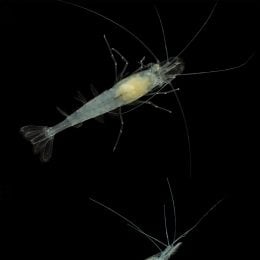
Alabama Cave Shrimp

The Alabama cave shrimp (Palaemonias alabamae) is a federally endangered crustacean currently found only in four cave systems in Madison and Jackson Counties. Its genus name derives from the ancient Greek mythological figure Palaemon, who became a sea deity, and its species name indicates that it is found only in Alabama. It was added to the U.S. Fish and Wildlife Service’s list of threatened and endangered species in 1988. In 2025, the cave shrimp (including all species of the animal) was named the “USA Cave Animal of the Year” by the National Speleological Society, headquartered in Huntsville, Madison County.
The Alabama cave shrimp was first discovered in Shelta Cave near Huntsville in 1958 by Thomas Poulson, a biologist on the faculty of the University of Illinois, and officially described as a new species by Tulane University biologist Alfred E. Smalley in 1961. The shrimp has not been found in Shelta Cave since 1973, but it is still home to many other unique species of cave-dwelling animals. The National Speleological Society established the Shelta Cave Nature Preserve in 1967 to protect all of them and restricts access through permitting.
The species Palaemonias alabamae belongs to the family Atyidae of freshwater shrimp and is one of nine known species of cave shrimp in the United States. They and other aquatic cave-dwelling creatures are known as stygobites or stygobionts, meaning that they spend their entire lives in subterranean water systems. They are closely related to the Kentucky cave shrimp (Palaemonias ganteri), found only in Mammoth Cave National Park in Kentucky.
Currently, the Alabama cave shrimp is found in four cave systems: Bobcat Cave, Muddy Cave, the Brazelton-Glover-Hering Cave System, and Fern Cave. Bobcat Cave is located in the northwest corner of the Redstone Arsenal campus in Madison County. Muddy Cave is owned by the Land Trust of North Alabama and is operated by the Southeastern Cave Conservancy; it is located outside the southeastern border of Redstone just north of Indian Creek. The Brazelton-Glover-Hering Cave System is located on privately owned land on Keel Mountain just to the northeast of Owens Cross Roads, Madison County, and all entrances are restricted to access by research scientists only. In Jackson County, a population of the Alabama cave shrimp was discovered in 2019 in Fern Cave, which is also home to the largest wintering colony of gray bats in the United States. Four entrances to the cave are located in the protected Fern Cave National Wildlife Refuge near the town of Paint Rock, and the other entrances are owned by the Southeastern Cave Conservancy. These shrimp share their habitats with other stygobiotic animals, including cavefish, cave salamanders, cave crayfish, and a variety of invertebrates.
Colorless and largely transparent, the Alabama cave shrimp has a total length of up to 1.2 inches (~ 30 millimeters), and females are generally larger than males. It and the closely related Kentucky cave shrimp are distinguished from other cave shrimps by the presence of small, undeveloped eye stalks. Like almost all fully cave-dwelling creatures, they evolved to lack functioning eyes and are generally without pigment; both of those traits require significant energy to maintain and serve no purpose in environments with no light. The Alabama cave shrimp prefers calm pools, so in caves that have seasonal underwater rivers and streams, they seek out chambers in the cave system outside of the flowing water. Based on estimates for similar cave shrimp species, scholars estimate that they may live up to 15 years, given their slow rate of growth and reproduction.
Researchers know very little about the life cycle and reproductive habits of cave shrimp because so few have been studied. They generally feed on aquatic microorganisms, plant matter washed in from the surface, and other invertebrates on the bottom of pools. In turn, they are likely preyed upon by cavefish and salamanders. Like other creatures in cave environments, they probably grow very slowly because of the general lack of nutrients and light. Alabama cave shrimp are egg-bearing, but little is known about how long eggs take to hatch or what stages the hatchlings proceed through before they reach their adult form. Similar shrimp species go through several larval stages prior to adulthood.
Like almost all aquatic freshwater species in the state, the Alabama cave shrimp faces significant threats. Runoff from deforestation, construction, and industry adds silt to the cave floors and may impede feeding and reproduction. Pollution and heavy metals from mining and industry poison the water that flows into the caves and kill off the living things in the cave systems. The shrimp are currently the subject of an ongoing recovery program by the U.S. Fish and Wildlife Service and are listed as S1 (Critically Imperiled) in the Alabama state listings of endangered species.
Additional Resources
- Niemiller, Matthew L., et al. "Discovery of a New Population of the Federally Endangered Alabama Cave Shrimp, Palaemonias alabamae Smalley, 1961, in Northern Alabama." Subterranean Biology 32 (September 2019): 43-59.