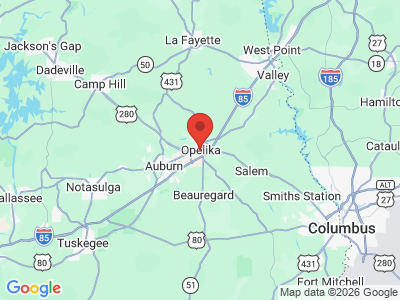
Lee County
 Lee County Courthouse
Located in east-central Alabama, Lee County was home to two Alabama governors: William J. Samford and Forrest "Fob" James. The county is also home to one of the two largest institutions of higher education in the state of Alabama: Auburn University. The county is governed by an elected six-member commission and includes eight incorporated communities, although only four lie entirely within the borders of Lee County.
Lee County Courthouse
Located in east-central Alabama, Lee County was home to two Alabama governors: William J. Samford and Forrest "Fob" James. The county is also home to one of the two largest institutions of higher education in the state of Alabama: Auburn University. The county is governed by an elected six-member commission and includes eight incorporated communities, although only four lie entirely within the borders of Lee County.
- Founding Date: December 5, 1866
- Area: 609 square miles
- Population: 163,461 (2020 Census estimate)
- Major Waterways: Chattahoochee River
- Major Highways: Interstate 85, U.S. 280, U.S. 431
- County Seat: Opelika
- Largest City: Auburn
History
 Prisoner Orchestra at Camp Opelika
Lee County was created by an act of the Alabama legislature on December 5, 1866. The land that would eventually become Lee County came from a land cession to the United States by the Creek Indians in the 1832 Treaty of Cusseta. Lee County was created from lands carved out from Macon, Russell, Chambers, and Tallapoosa Counties. Lee County was named in honor of Confederate general Robert E. Lee. The earliest settlers came to the area from Georgia, the Carolinas, and Virginia. Some of the first towns included Opelika, Auburn, Salem, and Loachapoka. During World War II, Camp Opelika in Lee County served as one of four major prisoner-of-war camps in Alabama that housed mostly German soldiers captured in Africa and Europe. The camp then served as temporary housing for returning servicemen before the area was converted to an industrial site in the 1950s.
Prisoner Orchestra at Camp Opelika
Lee County was created by an act of the Alabama legislature on December 5, 1866. The land that would eventually become Lee County came from a land cession to the United States by the Creek Indians in the 1832 Treaty of Cusseta. Lee County was created from lands carved out from Macon, Russell, Chambers, and Tallapoosa Counties. Lee County was named in honor of Confederate general Robert E. Lee. The earliest settlers came to the area from Georgia, the Carolinas, and Virginia. Some of the first towns included Opelika, Auburn, Salem, and Loachapoka. During World War II, Camp Opelika in Lee County served as one of four major prisoner-of-war camps in Alabama that housed mostly German soldiers captured in Africa and Europe. The camp then served as temporary housing for returning servicemen before the area was converted to an industrial site in the 1950s.
Opelika, originally located in Russell County, was named county seat of Lee County at its founding. The first courthouse was built there in 1867 by the formerly enslaved and renowned bridge builder Horace King. The two-story, brick building served as the county courthouse until a second courthouse was built in 1896 across the street from the original structure, which was eventually torn down. The 1896 courthouse has undergone a number of renovations since it was first built and continues to serve as the county courthouse for Lee County.
Major Cities and Demographics
 Downtown Auburn
According to 2020 Census estimates, the population of Lee County was 163,461. Of that total, 69.7 percent of respondents identified themselves as white, 22.7 percent as African American, 4.4 percent as Asian, 3.7 percent as Hispanic, 2.3 percent as two or more races, 0.2 percent as American Indian. The largest city in Lee County is Auburn, with an estimated population of 65,508. Other significant population centers include Phenix City (partially located in Lee County), Smiths Station, and Opelika. The median household income was $52,930, compared with $52,035 for the state as a whole, and the per capita income was $28,804, compared with $28,934 for the state as a whole.
Downtown Auburn
According to 2020 Census estimates, the population of Lee County was 163,461. Of that total, 69.7 percent of respondents identified themselves as white, 22.7 percent as African American, 4.4 percent as Asian, 3.7 percent as Hispanic, 2.3 percent as two or more races, 0.2 percent as American Indian. The largest city in Lee County is Auburn, with an estimated population of 65,508. Other significant population centers include Phenix City (partially located in Lee County), Smiths Station, and Opelika. The median household income was $52,930, compared with $52,035 for the state as a whole, and the per capita income was $28,804, compared with $28,934 for the state as a whole.
Economy
 Pepperell Mills
Like most of Alabama's counties, farming was the prevailing occupation of Lee County until well into the twentieth century. Cotton, corn, and cattle served as the county's main agricultural products. With its proximity to the Chattahoochee River and Georgia markets, however, shipping and other forms of transportation were also important parts of Lee County's economy in the nineteenth and twentieth centuries. The first major industry in Lee County was the Opelika Cotton Mill, which opened in 1900. Industrial development increased during the 1940s after the construction of dams on the Chattahoochee and Tallapoosa rivers provided hydroelectric power to the area. In recent decades, the economy has shifted to service and industry. As the home of Auburn University, Lee County is also recognized as a center of education in the state of Alabama.
Pepperell Mills
Like most of Alabama's counties, farming was the prevailing occupation of Lee County until well into the twentieth century. Cotton, corn, and cattle served as the county's main agricultural products. With its proximity to the Chattahoochee River and Georgia markets, however, shipping and other forms of transportation were also important parts of Lee County's economy in the nineteenth and twentieth centuries. The first major industry in Lee County was the Opelika Cotton Mill, which opened in 1900. Industrial development increased during the 1940s after the construction of dams on the Chattahoochee and Tallapoosa rivers provided hydroelectric power to the area. In recent decades, the economy has shifted to service and industry. As the home of Auburn University, Lee County is also recognized as a center of education in the state of Alabama.
Employment
According to 2020 Census estimates, the workforce in Lee County was divided among the following industrial categories:
- Educational services, and health care and social assistance (31.3 percent)
- Manufacturing (12.9 percent)
- Retail trade (10.2 percent)
- Professional, scientific, management, and administrative and waste management services (9.4 percent)
- Arts, entertainment, recreation, and accommodation and food services (9.0 percent)
- Finance and insurance, and real estate, rental, and leasing (6.8 percent)
- Construction (5.3 percent)
- Other services, except public administration (4.3 percent)
- Public administration (3.9 percent)
- Transportation and warehousing, and utilities (3.7 percent)
- Wholesale trade (1.4 percent)
- Information (1.2 percent)
- Agriculture, forestry, fishing and hunting, and extractive (0.6 percent)
Education
 Auburn University
The Lee County School District has 14 primary and secondary schools. Auburn City Schools has 13 primary and secondary schools, and Opelika City Schools has eight primary and secondary schools. Located in Auburn, Auburn University is one of the largest institutions of higher education in the state. A land-grant institution, the university offers both undergraduate and graduate degrees. Southern Union State Community College has campuses in both Opelika and Valley and offers two-year programs in the arts and sciences as well as technical and vocational degrees.
Auburn University
The Lee County School District has 14 primary and secondary schools. Auburn City Schools has 13 primary and secondary schools, and Opelika City Schools has eight primary and secondary schools. Located in Auburn, Auburn University is one of the largest institutions of higher education in the state. A land-grant institution, the university offers both undergraduate and graduate degrees. Southern Union State Community College has campuses in both Opelika and Valley and offers two-year programs in the arts and sciences as well as technical and vocational degrees.
Geography
 Lee County Map
Comprising just over 600 square miles, Lee County is located in east-central Alabama along the Alabama-Georgia border. The northern half of the county is part of the Piedmont physiographic section, whereas the county's southern portion is part of the Coastal Plain physiographic section. Some sources place the county in the eastern part of Alabama's Black Belt, but others do not. Loblolly and shortleaf pine forests dot the county's landscape. The county is bordered by Chambers County to the north, the state of Georgia to the east, Russell County to the south, and Macon and Tallapoosa Counties to the west.
Lee County Map
Comprising just over 600 square miles, Lee County is located in east-central Alabama along the Alabama-Georgia border. The northern half of the county is part of the Piedmont physiographic section, whereas the county's southern portion is part of the Coastal Plain physiographic section. Some sources place the county in the eastern part of Alabama's Black Belt, but others do not. Loblolly and shortleaf pine forests dot the county's landscape. The county is bordered by Chambers County to the north, the state of Georgia to the east, Russell County to the south, and Macon and Tallapoosa Counties to the west.
The Chattahoochee River and its tributaries flow throughout the eastern half of the county, and the Tallapoosa River and its tributaries flow throughout the western half. Together, the rivers provide a number of scenic views as well as recreational and economic opportunities for visitors to and citizens of Lee County.
Interstate 85 is one of Lee County's main transportation routes, running southwest-northeast. U.S. 280 and U.S. 431 run southeast-northwest through most of the county and split at Opelika, where 431 continues north and 280 continues northwest. The Auburn University Regional Airport is Lee County's only public airport.
Events and Places of Interest
 Chewacla State Park
There a number of recreational opportunities for visitors to Lee County. Chewacla State Park in Auburn offers 696 acres of hiking and biking trails as well as overnight camping facilities and rental cabins built by the Civilian Conservation Corps in the 1930s. The park also boasts a 26-acre lake for swimming, fishing, and boating as well as tennis courts, a playground, and picnic areas. Located on the campus of Auburn University, the Donald E. Davis Arboretum is home to 150 different tree species native to Alabama and the Southeast. The arboretum features a walking trail through the trees as well as a guide to help identify the different species. The Louise Kreher Forest Ecology Preserve, run by the Auburn University School of Forestry and Wildlife Sciences, is located just north of campus. The 110-acre preserve includes a number of walking trails as well as a wetland and butterfly garden. Other outdoor recreational opportunities in Lee County include Kiesel Park, the Lee County Public Fishing Lake, and Saugahatchee Lake in Opelika.
Chewacla State Park
There a number of recreational opportunities for visitors to Lee County. Chewacla State Park in Auburn offers 696 acres of hiking and biking trails as well as overnight camping facilities and rental cabins built by the Civilian Conservation Corps in the 1930s. The park also boasts a 26-acre lake for swimming, fishing, and boating as well as tennis courts, a playground, and picnic areas. Located on the campus of Auburn University, the Donald E. Davis Arboretum is home to 150 different tree species native to Alabama and the Southeast. The arboretum features a walking trail through the trees as well as a guide to help identify the different species. The Louise Kreher Forest Ecology Preserve, run by the Auburn University School of Forestry and Wildlife Sciences, is located just north of campus. The 110-acre preserve includes a number of walking trails as well as a wetland and butterfly garden. Other outdoor recreational opportunities in Lee County include Kiesel Park, the Lee County Public Fishing Lake, and Saugahatchee Lake in Opelika.
 Jule Collins Smith Museum Entrance
The Jule Collins Smith Museum of Fine Art at Auburn University houses a permanent collection of American and European art in eight galleries and includes a gift shop, restaurant, auditorium, and formal gardens. The museum offers a number of educational programs throughout the year for people of all ages. The Pioneer Park in Loachapoka features numerous historic structures that display artifacts and memorabilia related to the history and culture of Lee County in the nineteenth century. The grounds are the site of the annual Lee County Historical Fair held each October. The Museum of East Alabama in Opelika houses over 5,000 artifacts from the nineteenth and twentieth centuries. Pebble Hill (1846), also known as the Scott-Yarbrough House, is a historic home listed on the National Register of Historic Places; it and its modern outbuilding are home to Auburn University's Caroline Marshall Draughon Center for the Arts and Humanities. Other cultural attractions in Lee County include the Jonathan B. Lovelace Hall of Honor in Auburn and the Opelika Performing Arts Series, which hosts events such as Broadway tours and international and national symphony orchestras and opera companies.
Jule Collins Smith Museum Entrance
The Jule Collins Smith Museum of Fine Art at Auburn University houses a permanent collection of American and European art in eight galleries and includes a gift shop, restaurant, auditorium, and formal gardens. The museum offers a number of educational programs throughout the year for people of all ages. The Pioneer Park in Loachapoka features numerous historic structures that display artifacts and memorabilia related to the history and culture of Lee County in the nineteenth century. The grounds are the site of the annual Lee County Historical Fair held each October. The Museum of East Alabama in Opelika houses over 5,000 artifacts from the nineteenth and twentieth centuries. Pebble Hill (1846), also known as the Scott-Yarbrough House, is a historic home listed on the National Register of Historic Places; it and its modern outbuilding are home to Auburn University's Caroline Marshall Draughon Center for the Arts and Humanities. Other cultural attractions in Lee County include the Jonathan B. Lovelace Hall of Honor in Auburn and the Opelika Performing Arts Series, which hosts events such as Broadway tours and international and national symphony orchestras and opera companies.
 Pine Hill Haints in Waverly
There are a number of historical attractions throughout Lee County. The Loachapoka Historic District and the Northside Historic District of Opelika each contain a number of homes and buildings listed on the National Register of Historic Places. During mid-December, visitors can take self-driving and walking tours of historic Opelika, where more than 45 homes serve as backdrops for the unique holiday decorations of the town's Victorian Porch Tour. Other historic attractions in Lee County include the turn-of-the-century Salem-Shotwell Covered Bridge, the 1896 Lee County Courthouse, and the Tiger Trail of Auburn, which honors Auburn University's greatest athletes and coaches. Grand National golf complex on Lake Saugahatchee in Opelika is part of the Robert Trent Jones Golf Trail. The town of Waverly, also located partially in Chambers and Tallapoosa Counties, is home to the regionally popular Old 280 Boogie music and arts festival, which takes place each fall and spring. It is hosted by local printing business Standard Deluxe Inc., which also sponsors smaller music events throughout the year at its venue in Waverly.
Pine Hill Haints in Waverly
There are a number of historical attractions throughout Lee County. The Loachapoka Historic District and the Northside Historic District of Opelika each contain a number of homes and buildings listed on the National Register of Historic Places. During mid-December, visitors can take self-driving and walking tours of historic Opelika, where more than 45 homes serve as backdrops for the unique holiday decorations of the town's Victorian Porch Tour. Other historic attractions in Lee County include the turn-of-the-century Salem-Shotwell Covered Bridge, the 1896 Lee County Courthouse, and the Tiger Trail of Auburn, which honors Auburn University's greatest athletes and coaches. Grand National golf complex on Lake Saugahatchee in Opelika is part of the Robert Trent Jones Golf Trail. The town of Waverly, also located partially in Chambers and Tallapoosa Counties, is home to the regionally popular Old 280 Boogie music and arts festival, which takes place each fall and spring. It is hosted by local printing business Standard Deluxe Inc., which also sponsors smaller music events throughout the year at its venue in Waverly.
Additional Resources
- The Heritage of Lee County, Alabama. Clanton, Ala.: Heritage Publishing Consultants, 2000.
External Links
- Lee County
- Lee County Schools
- City of Auburn
- City of Opelika
- City of Phenix City
- City of Smiths Station
- Auburn Chamber of Commerce
- Opelika Chamber of Commerce
- East Alabama Chamber of Commerce
- National Register of Historic Places: Lee County
- Auburn University
- Southern Union State Community College
- Jule Collins Smith Museum of Fine Art
- Donald E. Davis Arboretum
- Museum of East Alabama
- Pioneer Park
- Chewacla State Park
- Robert Trent Jones Golf Trail: Grand National
- Auburn Arts Association
- Pebble Hill
- East Alabama Arts