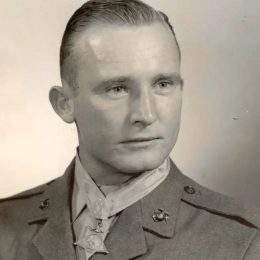
Harold Wilson
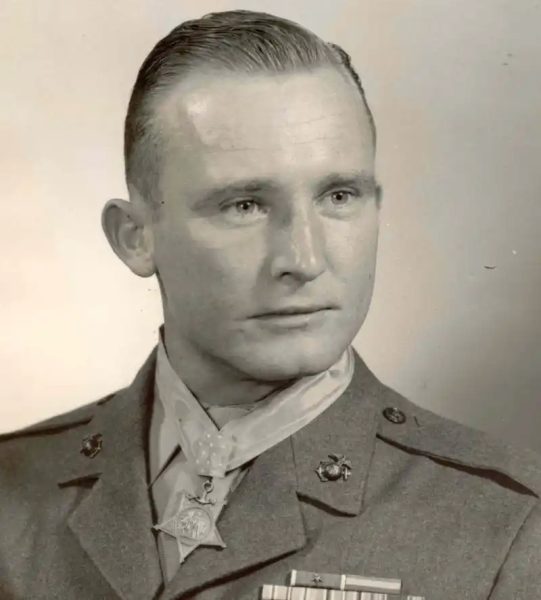
Birmingham native Harold Edward Wilson (1921-1998) was awarded the Medal of Honor in 1952 for his heroic actions in 1951 during the Korean War. A U.S. Marine, Wilson also received a Bronze Star, among many other citations, for his service. He had previously served in the Pacific theater during World War II and later in the Vietnam War, following which he worked on behalf of fellow veterans.
Wilson was born in Birmingham, Jefferson County, on December 5, 1921, to James Estes Wilson and Leila Beatrice Riley Wilson and was the middle sibling of five brothers; at least one brother would also serve in the Marine Corps during World War II. During his youth, he earned the nickname “Speedy” after acquiring a bike to replace his wagon for delivering groceries; the nickname stayed with him into adulthood. His father was a machinist and veteran of World War I. Wilson attended Central Park Elementary and Ensley High School. In early adulthood, he and one or two of his brothers worked for Tennessee Coal, Iron and Railroad Company. In February 1942, about two months after the United States declared war on the Axis powers and entered World War II, Wilson registered for the draft.
After enlisting in the U.S. Marine Corps Reserve at Fort McClellan, Calhoun County, Wilson was assigned to active duty in April 1942, serving in the Pacific theater for more than two years on Midway Atoll. He does not appear to have taken part in the pivotal June 1942 battle around the islands, however. He was later stationed at various military bases in the United States and was honorably discharged on October 20, 1945, having attained the rank of sergeant.
In 1947, Wilson re-entered military service, joining the Birmingham unit of the Organized Marine Corps Reserve. (He would remain in the Marines until 1972.) According to the 1950 U.S. Census, he was employed in the steel industry. Also that year, Wilson wed Julia McKenzie Sawls; they had at least two children.
Wilson was recalled to active duty in August 1950 following the June outbreak of the Korean War, which began when North Korea suddenly invaded South Korea. The invasion was condemned by the United Nations (UN), which then authorized the use of force by member nations under UN command to defend South Korea. That October, the People’s Republic of China unexpectedly joined the conflict, sending in thousands of troops to assist North Korea. Soon afterward, the Soviet Union’s air forces lent their support to the North Korean effort, threatening to overwhelm the UN troops defending South Korea. Wilson was assigned to Company G, Third Battalion, First Marine Regiment, First Marine Division, the same division in which Alabama native and renowned war memoirist Eugene Sledge had previously served during World War II.
Wilson arrived in Korea in November 1950 and served as a technical sergeant in a rifle platoon. In December 1950, he participated in the Battle of Chosin Reservoir, located in North Korea, in an area known for its steep hilly terrain. The battle became known for its high casualty rates in heavy snow and sub-zero temperatures and the eventual retreat by heavily outnumbered UN troops. Wilson was seriously wounded that month and in March 1951 was awarded a Bronze Star for his actions under fire. In late April, the Chinese launched a very large offensive with many thousands of troops. During the Battle of Hwacheon in South Korea on the night of April 23-24, while under mortar, grenade, and machine gun fire from advancing Chinese soldiers, Wilson was again wounded, this time in his shoulder, right arm, and left leg. Rather than accept medical aid, and unable to hold a weapon because of the severity of his wounds, he instead encouraged his men, helped the wounded, and distributed ammunition. At one point, a mortar round blew him off his feet, leaving him dazed from a concussion; nonetheless, he continued to assist his men in repulsing repeated enemy attacks with encouragement and supplying them with arms and ammunition. Wilson was evacuated to U.S. Naval Hospital, Yokosuka in Japan and, five months later, he returned to the United States. The Chinese offensive was over by the end of April. (An armistice was signed on July 27, 1953, ending hostilities.)
Wilson, then a master sergeant, was presented the Medal of Honor by Pres. Harry S. Truman at a White House ceremony in the Rose Garden on April 11, 1952, along with two other recipients. His parents and three brothers were also present. Among many other medals, Wilson had also been awarded a Purple Heart, which is given for being killed or wounded in action, along with four gold stars, indicating he earned four additional Purple Heart awards.
In August 1952, Wilson was commissioned as a warrant officer and continued to work his way up the ranks. He became adjutant of the Marine Corps Engineer School at Camp Lejeune, North Carolina, in December 1962. A year later, he served in a similar role for the Second Tank Battalion. Later, Wilson served in the Vietnam War with Marine Aircraft Group 13 before being stationed at Parris Island, South Carolina, where he was assigned as the Sixth Marine Corps district personnel officer in November 1968. Also during this decade, Wilson served as adjutant at Marine Corps Supply Center, in Albany, Georgia, present-day Marine Corps Logistics Base Albany.
Wilson retired from the Marines in 1972 and then worked as a benefits counselor with the U.S. Veterans’ Administration (present-day Department of Veterans Affairs) in South Carolina, where he had moved in 1974. He died on March 29, 1998, in Lexington, South Carolina, and was buried in the city’s Woodridge Memorial Park alongside his wife, who had died in 1984. His death was noted in a New York Times obituary. In August 2017, a weapons storage and training facility at Marine Corps Logistics Base Albany, Georgia, was named in his honor and a plaque placed there.