James Asbury Tait

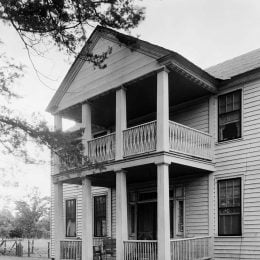
James Asbury Tait (1791-1855) served in the War of 1812 with the Georgia militia before settling in Wilcox County, where he became one of the largest landholders and enslavers in Alabama. His estate, known as the Dry Fork/Forks Plantation, was built between 1832 and 1834 by Tait and his enslaved laborers. The house still stands and is owned by the Tait family. It was listed on the National Register of Historic Places in 1999.
Tait was born in Baltimore, Maryland, on September 8, 1791, to Charles Tait, a judge, and Anne Simpson. James had one brother who died in infancy. After James’s birth, Charles moved the family to Georgia, where he served as a justice of the western Circuit of Georgia from 1803-09. In 1809, Charles won the election for one of Georgia's U.S. Senate seats, serving until 1819. While in the Senate, he was a proponent of dividing the Mississippi Territory in half, leading to the creation of the Alabama Territory. Charles and Anne moved to Alabama after James moved there. Charles was appointed the first federal district judge in Alabama and would become a key force in Alabama's quest for statehood in 1819.
In his early youth, Tait spent time on his paternal grandfather's very large plantations, on which many enslaved individuals grew cotton, staple crops, and tobacco. He received some education in a local academy in Wilkes County. When the War of 1812 broke out, he enlisted in the Georgia militia and spent the war embroiled in the associated Creek War of 1813-14. Although a smaller conflict within the broader war, both had links beyond simultaneous chronology. The Creek War began as a civil war among the Creek, or Muscogee, people in Alabama. The Creek National Council's accommodation policy towards the U.S. government and White settlers caused significant rifts within the Creek nation and led to the formation of a splinter group known as the Red Sticks, who violently opposed the accommodationist Creeks.
Tait and his unit served at Fort Claiborne in present-day Monroe County under Gen. Ferdinand L. Claiborne. He had raised his forces in the wake of the Red Sticks' August 1813 attack and victory at Fort Mims in present-day Baldwin County. Claiborne ordered the construction of a fort along the Alabama River, which was completed around mid-November. Tait spent much of his service in and around the fort as he rose to the rank of captain. His service with Claiborne’s unit in this area made an impression on Tait, who bought land in Alabama after the war. In 1819, Tait and his father purchased 10,200 acres of public land at a sale held in St. Stephens, Washington County. Tait’s fortunes expanded quickly, and, by 1820, he owned as many as 69 enslaved individuals. Over time, his holdings grew to approximately 20,000 acres, including lands inherited from his father and through buying foreclosed properties at public auctions. He also owned 800 acres in Kemper County, Mississippi.
During these post-war years, Tait married Virginia native Elizabeth C. Goode. Her father, William Goode, had served as a private with the Patriot forces during the Revolutionary War siege of Yorktown, Virginia. Tait and Goode would be married for around 40 years, during which time they had at least seven children.

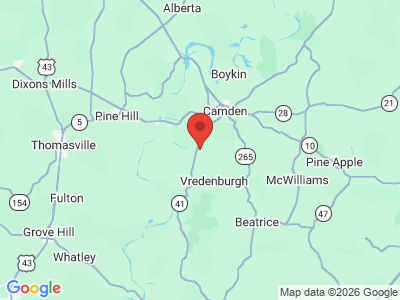
As Tait’s family grew, so did his wealth and status. Around 1832, Tait began construction of a two-and-a-half-story, five-bay, double-pile (two rows of rooms within the house), side-gabled frame house with some Federal and Neoclassical details located just south of Camden, Wilcox County. Built in large part by two enslaved individuals, Hezekiah and Elijah, and completed around 1835, the house is the oldest documented house in Wilcox County and one of the few houses in the county firmly documented and attributed to enslaved labor. Hezekiah and Elijah included some African artistic elements in the construction, particularly in the textile-like patterns of the mantle in the southeast upstairs room. Grandiose for its time, the house set the standard for contemporary planters in the county. By 1850, Tait’s success growing cotton led him to accumulate real estate holdings valued at $40,000, which were worked by 316 enslaved Black individuals, making him one of the largest enslavers in the state at the time.
Throughout his time in Alabama, Tait was a loyal Democrat. He and his family helped found and attended the Black’s Bend Methodist Church in Wilcox County. For Tait’s efforts, the church was later known as “Tait’s Chapel.”
During his later life, Tait donated money to the American Colonization Society of Liberia. Founded in 1816 by Robert Finley, the society aimed to encourage and support the resettlement of free and formerly enslaved Black people to the African continent. The organization garnered a significant amount of controversy, with enslavers largely supporting because they believed that free Black people could not integrate into American society and posed a threat to the institution of slavery. Many abolitionists and the Black community overwhelmingly opposed the project, arguing that many free and formerly enslaved Blacks had lived in the United States for generations and that many of those who did emigrate back to Africa did so under pressure. Ultimately, the society would assist only a few thousand Black Americans in emigrating to what would become Liberia.
Tait died on February 10, 1855, and was buried in Dry Forks Cemetery in Wilcox County. Two of his sons, Felix and Robert, would later serve in the Confederate Army during the American Civil War. Felix served in the Mexican War as well. Before the Civil War, he was a trustee for the University of Alabama and served in the Alabama House of Representatives. After the war, he served in the Alabama Senate. Son Robert established his own plantation, Countryside Plantation, in Wilcox County. And another, James Goode Tait, graduated from Harvard University and inherited the Dry Forks plantation. Charles fled to Texas after being accused of murder in Alabama. Despite financial hardships in the years following the Civil War, the Tait family continued to maintain ownership of Dry Forks Plantation and his descendants still own the house today. It was documented by the Historical American Buildings Survey in 1936.