Waldo Semon
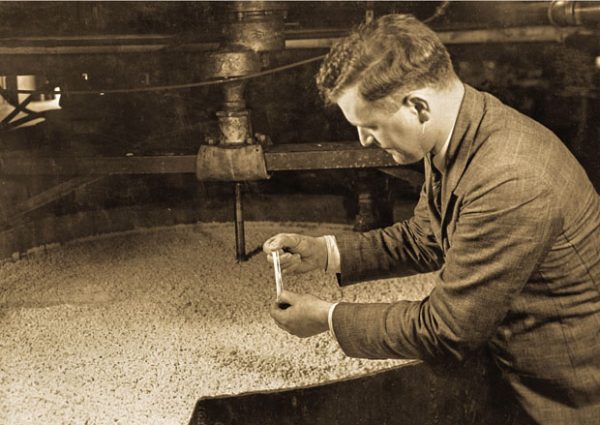
Marengo County native Waldo Lonsbury Semon (1898-1999) was the chemist who converted polyvinyl chloride (PVC) from a hard, unworkable substance into a pliable compound known as plasticized PVC. Created in the late 1920s, plasticized PVC is now widely used in countless products, including tubing, flooring, electrical wire insulation, vinyl records, and vinyl-coated cloth products, giving rise to a $32.66-billion-a-year industry as of 2024. Semon also developed synthetic rubber, thereby permanently shifting the rubber industry away from its reliance on limited natural rubber resources.
Semon was born on September 10, 1898, in Demopolis, Marengo County, to Frank Emerson Semon and Blanche Lonsdorf Semon; he had one sibling. His father’s work as a civil engineer building electrical plants required frequent relocations. He moved the family to the Pacific Northwest when Waldo was seven years old, and they would live in Washington and Oregon, respectively. In 1916, Semon entered the University of Washington (UW) in Seattle in the hopes of becoming a chemist. Dissatisfied with theoretical science as an undergraduate, Semon studied the practical application of chemical engineering, earning a bachelor of science in general chemistry, graduating cum laude in 1920. On September 20, 1920, he married Marjorie Gunn, in Tacoma, Washington. The couple would have three children. He continued his studies at UW, and, in 1923, he became one of the first individuals in the United States to earn a doctorate in chemical engineering, as the university was one of the first to offer an advanced degree in the field. In 1946, Semon received alumnus summa laude dignatus, UW’s highest honor.
Semon taught as an instructor at UW for a few years but found it difficult to support a family of four on an instructor’s salary of $1,800 a year. He became a part-time consultant for chemical companies in Seattle to supplement his income, ultimately earning as much as $3,000 for his consulting work. In 1926, the allure of a much-improved income and his reacquaintance with mentor and former UW faculty Harry Trumbull led Semon to a job with the BF Goodrich tire company in Akron, Ohio. Trumbull, head of chemical research at BF Goodrich, recruited Semon to lead a company effort to coat metal with rubber to create durable products such as gaskets for engines, transmissions, and other machinery. Trumbull believed the process could be best achieved using synthetic rather than natural rubber and hired Semon to solve the problem.
Having settled in Akron, Semon set to work and soon exhausted all his rubber supplies after numerous failures. He began experimenting with synthetic organic polymers, including polyvinyl chloride (PVC). Although more durable than crude rubber, PVC is extremely rigid at room temperature, limiting its commercial use prior to 1926. Semon worked to dissolve the unusable material into an adhesive to bond rubber to metal. Although the process was not successful, Semon accidentally discovered that heating PVC to a high boiling point created a flexible and elastic substance now called plasticized PVC. Semon made two breakthroughs using this specific process, he made PVC elastic as well as resilient, and he made the compound moldable into any shape required. For example, today this type of PVC is commonly used to make piping. Initially, BF Goodrich did not know how to use this discovery and shelved it. By the early 1930s, Semon finally convinced his employers of the compound’s usability, and the company later began marketing plasticized PVC as the brand Koroseal, advertising its wide versatility, resistance to dust and water, and ease of cleaning. The product was used in a wide range of products, including clothing and furniture. Today, Koroseal is an independent brand company that focuses on vinyl wallcoverings.
By 1934, Semon had become director of research at B. F. Goodrich in part due to his accomplishment of creating plasticized PVC and inventing 100 methods of affixing vinyl to metal. In 1940, Semon made another pioneering contribution to polymer science with the development of styrene-butadiene rubber, a synthetic substitute for natural rubber. The high demand for rubber, particularly for tires, during World War II fostered the demand for a synthetic version because natural rubber was scarce and difficult to harvest. In fact, Semon coordinated research and development (R&D) between BF Goodrich and the federal government’s synthetic rubber development program to speed up the process. The resulting product, Ameripol (a merger of the words “American” and “polymer”), played an essential role in securing the Allied victory against the Axis powers.
A more modest achievement by Semon is the invention of a synthetic bubble gum with high elasticity during the 1920s. In his pitch to the company, Semon stated that it acted just like regular bubble gum (derived from tree extracts and other natural sources historically), except the consumer could blow very large bubbles. Executives at BF Goodrich believed nobody would buy it and refused to develop it commercially. Indeed, Semon is sometimes mistaken as the inventor of commercialized bubble gum, but that recognition belongs to Walter Diemer, an accountant at the Fleer Chewing Company in Philadelphia, who debuted his creation in 1928.
Semon retired from BF Goodrich in 1963, ending a 37-year career. As a professional chemist, he created more than 5,000 synthetic rubber compounds and held 116 U.S. patents and 100 foreign patents. In retirement, Semon continued as a consultant for Goodrich and joined Kent State University as a research professor. He received numerous awards throughout his career, including the Charles Goodyear Medal from the American Chemical Society in 1944, the Elliot Cresson Medal from the Franklin Institute in 1964, the Golden Plate Award of the American Academy of Achievement in 1965. He was inducted into the National Inventors Hall of Fame in 1995. Throughout his life and career, Semon gained a reputation for a devotion to education and a fervent supporter of science education in the Akron and the surrounding area. In 1974, Semon donated 100 acres of land to Metro Parks in Summit County, Ohio, named the Waldo Semon Woods Conservation Area in his honor. He died on May 26, 1999, at the age of 100. Today, plasticized PVC or vinyl is the world’s second-best selling plastic after polyethylene, constituting a $32.66-billion-dollar industry worldwide as of 2024 and producing nearly 50 million tons annually. Vinyl coated products include umbrellas, raincoats, shower curtains, garden hoses, bags, and phonograph records, sometimes referred to as “vinyls.”