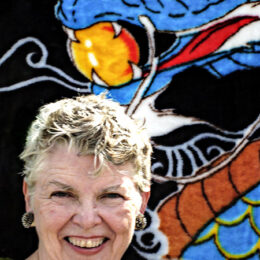
Mab Segrest

Mab Segrest (1949- ) is an activist, educator, and writer who has devoted her life to challenging the racism she first became aware of growing up in Tuskegee, Macon County. As a White person in a majority-Black part of the segregated South, Segrest writes about the ways that racism is linked to classism, sexism, and homophobia. She has researched the historical roots of racism in the United States through her personal experiences of oppression, and her books and political activism have advanced the understanding of how to make positive change.
Mabelle Massey Segrest, named after her grandmother and always known as Mab, was born on February 20, 1949, in Birmingham, Jefferson County, to Frances Hunter Cobb Segrest, a homemaker and language teacher, and John Fletcher Segrest Jr. Fletcher Segrest was a navigator in World War II who was shot down over Germany and spent two years in a prisoner of war camp. He served as postmaster in Tuskegee for 29 years and was an active segregationist.
Segrest grew up in Tuskegee, where she and her two siblings attended Tuskegee High School until 1963, when it was racially integrated along with all other Alabama public schools after the Lee v Macon County Board of Education decision. Gov. George Wallace responded to the case by postponing classes and sending state troopers to surround Tuskegee High. Segrest watched as Black children braved the troopers and entered her school. Their courage led her to begin to question the system in which she was raised. Thereafter, Segrest and her siblings began attending Macon Academy, an all-White private school that her parents helped establish. In 1966, her father helped organize the Alabama Private School Association (now the Alabama Independent School Association), consisting entirely of all-White schools until 2008.
Other experiences during the civil rights movement also helped shape her adult life. Local members of the Student Nonviolent Coordinating Committee (SNCC) attempted to integrate Segrest’s Methodist Church and other all-White churches along Main Street. On the evening of January 3, 1966, gas-station attendant and distant cousin Marvin Segrest killed SNCC demonstrator Sammy Younge after he refused to use the segregated bathroom at the gas station. The killing sparked marches and protests in Tuskegee; Segrest was later acquitted of the murder by an all-white jury.
Segrest attended Huntingdon College, in Montgomery, Montgomery County, and graduated with a bachelor of arts in English and history in 1971. She left Alabama in 1971 for graduate school at Duke University in Durham, North Carolina, hoping to become a college professor. While in the more liberal environment of Durham, Segrest discovered that she was a lesbian. She found self-acceptance and freedom by joining a local and national lesbian and feminist community that also fought for economic fairness and racial equality. These experiences shaped her writing, teaching, organizing to counter racism, and building gay and lesbian (and queer and transgender) feminist culture and politics. In 1979, she earned her Ph.D. in English from Duke University.

Soon realizing how discrimination against gay people hindered access to academic teaching jobs, Segrest turned her energy and creativity elsewhere. Her activism began with lesbian writer and artist friends who formed the Feminary collective and published Feminary: A Feminist Journal for the South (1977-82). Fellow Alabamian Minnie Bruce Pratt would join in 1978. Feminary soon became an influential vehicle for southern lesbian feminist work. Segrest’s book, My Mama’s Dead Squirrel: Lesbian Essays on Southern Culture (1985), is a collection of her early essays from her Feminary years. Feminary women also helped to found Womonwrites: The Southeast Lesbian Writers Conference, which lasted from 1979 to 2019. These and similar institutions nurtured a creative and intellectual surge of southern “queer” culture through the creation of feminist publishers, booksellers, and book distributors. Such collective efforts would challenge the laws, theologies, and medical diagnoses that had shaped gay lives so painfully for decades and centuries.
By 1983, Feminary collective women had moved on to other interests. She volunteered with other Carolinians to found North Carolinians Against Racist and Religious Violence (NCARRV) to counter the significant Klan and neo-Nazi activity in the state. She served as coordinator (1985-88) and then director of research and publications (1989-90). As she traveled across the state to help people and communities targeted by Klan violence, she often remembered both Sammy Younge and Marvin Segrest, whom she recognized as different parts of herself. Her second book, Memoir of a Race Traitor (1994), brought together her Alabama childhood experiences with an account of her recent work against Ku Klux Klan and neo-Nazi movements. Race Traitor became an early classic in White anti-racist writing. In 1993, Segrest helped found Southerners on New Ground (or SONG) with five other lesbian activists. Still active today, SONG built up community among marginalized parts of the queer South, uplifting Black and Brown leadership and helping transform progressive southern movements.
From 1992 to 2000, Segrest was coordinator of the United States Urban-Rural Mission (URM) of the World Council of Churches (WCC), based in Geneva, Switzerland. In 1995, she spoke in Beijing at the Fourth U.N. World Conference on Women about the relationship between homophobia and the rise of conservatism globally. She attended the General Assembly of the WCC in Zimbabwe in 1999 and continued to travel internationally. She wrote about these experiences in Born to Belonging: Writings on Spirit and Justice (2002), shifting her feminist focus from national to global institutions that dramatically improved the economic fortunes of the working class and poor.
Segrest realized her early dream of being a college professor when she joined the faculty at Connecticut College in 2002 as interim chair of the Gender and Women’s Studies Department (now the Gender, Sexuality and Intersectionality Studies Department). There, she earned tenure, taught core classes in transnational feminism, and worked extensively with students to counter sexual assault on campus. She began archival research on Georgia’s Central State Hospital, founded in 1842 in Milledgeville and by the twentieth century the largest state mental hospital in the world. During these years, Segrest received fellowships at Tulane University, Emory University, Georgia College and State University, and the National Humanities Center in Research Triangle Park, North Carolina.
Segrest’s archival research led to her monumental history, Administrations of Lunacy: Racism and the Haunting of American Psychiatry at the Milledgeville Asylum (2020). In the book, she built upon her prior work in joining the “intimate” with the “historic” to tell the story of the South through the story of a “lunatic asylum.” Her narrative demonstrates how structural racism at state hospitals played a significant role in shaping or “haunting” modern psychiatry.
In 1986, Segrest and her partner, Barbara Culbertson, had a daughter and co-parented together with the father and his male partner (and later husband). From New London, Connecticut, and a sojourn in Brooklyn, Segrest moved back to Durham in 2017, where she is now director of the Anti-Racist Research Program for Blueprint NC, a nonprofit consortium of civic engagement groups working towards multiracial democracy. In that position, she has tracked extremist “insurgencies” in North Carolina since the January 6, 2021, attack on the U.S. Capitol.
Works by Mab Segrest
Living in a House I Do Not Own (1982)
My Mama’s Dead Squirrel: Lesbian Essays on Southern Culture (1985)
Quarantines and Death: The Far Right’s Homophobic Agenda (with Lenny Zeskind, 1989)
Memoir of a Race Traitor: Fighting Racism in the American South (1994)
Born to Belonging: Writings on Spirit and Justice (2002)
Sing, Shout, Whisper, Pray: Feminist Visions for a Just World (co-edited with Jacqui Alexander, Lisa Albrecht, and Sharon Day, 2003).
Administrations of Lunacy: Racism and the Haunting of American Psychiatry at the Milledgeville Asylum (2020)
Additional Resources
- Enszer, Julie R. “The Lesbian Literary Luminaries of the South.” The Bitter Southerner, September 1, 2022, https://bittersoutherner.com/features/2022/the-lesbian-literary-luminaries-of-the-south.
- Mixon, Amanda. "Not in my name": The Anti-Racist Praxis of Mab Segrest & Minnie Bruce Pratt.” Journal of Lesbian Studies 24.3 (2020): 199-213.
- Powell, Tamara M. “Look What Happened Here: North Carolina's Feminary Collective.” North Carolina Literary Review 9 (2000): 91-102.