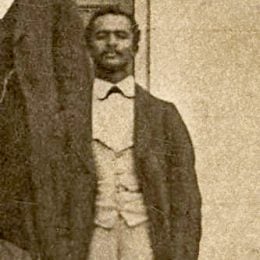
Benjamin F. Royal
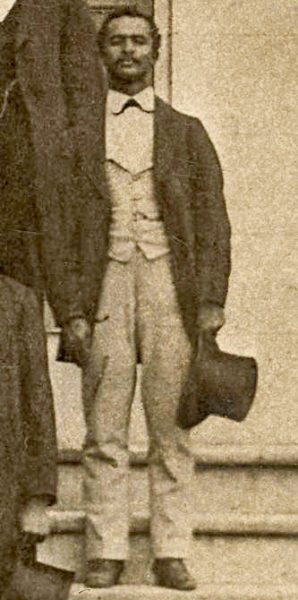
Born into slavery, Benjamin F. Royal was the first Black person elected to the Alabama Senate, in 1868 during the Reconstruction era, and was reelected to three additional terms. Royal also served as a representative to the 1867 Alabama Constitutional Convention and was a founding member of the Union League in Alabama. Overall, Royal was a loyal Republican who fought to maintain civil rights for Black Americans as the White elites once again rose to power and brought Reconstruction to a close.
Thus far, no documentation regarding the date and location of Royal's birth has been found in historical records, and little is known of his early life. His mother was enslaved by his father, John Hunter Royal. And although the nature of the relationship between Royal's mother and father is unknown, Royal's mother was likely the victim of sexual abuse. John Hunter Royal was living in Warren County, Mississippi, when he died in 1837, and so Benjamin Royal probably grew up near that location. Despite prohibitions on education for the enslaved, Royal managed to learn to read and write a little. Eventually, he spent time working as a plantation overseer. When the Civil War ended, Royal was living in Union Springs, Bullock County.
As the citizens of Alabama worked to rejoin the United States and rebuild in the wake of the Civil War, Royal became heavily involved in Alabama state politics and served in several political capacities. In 1867, residents of Bullock County elected Royal to serve as their representative to the state's Constitutional Convention. Ratified in 1868, the constitution guaranteed the rights of all citizens, protected the property rights of married women, enshrined Black suffrage, broadened the voting rights of poor Whites, and created a bureau to promote industrial development. It also provided financial support for public education and established a centralized board of education.
During Congressional Reconstruction, the U.S. military governed Alabama, and military officials appointed Royal to one of the many Boards of Registration that existed throughout the state, each consisting of two White members and one Black member. These boards controlled the registration of voters and managed elections and were responsible for sending election returns to the military governor. During this time, Royal also played a role in creating the Union League in Alabama, which worked as an auxiliary organization to the Republican Party. It registered Blacks for the Republican Party, educated them about their political rights, and protected Blacks who exercised those rights. Lastly, in 1868, Royal was the first and only Black man elected to the Alabama Senate. Also that year, Royal married a woman named Harriet on February 9 in Bullock County. The couple had one daughter. Royal was reelected to the Senate in 1870, 1872, and 1874. In 1872, four more Blacks were elected to the Senate: A. H. Curtis of Perry County, Jeremiah Haralson of Dallas County, John W. Jones of Lowndes County, and Lloyd Leftwich of Greene County. In 1874, with the election of James K. Greene of Hale County, the number rose to six.
During the latter part of the 1870s, Reconstruction efforts across the South began to wane. White Southerners used political violence, with help from the Ku Klux Klan, and accusations of corruption by carpetbaggers (northern Republicans who migrated to the South) and Black Republicans to reassert their political power. Northern Republicans then became disillusioned with the persistence of continued political instability and violence in the South and lost interest in the issue. In particular, the White planter elites who had dominated politics in the state and the South prior to the Civil War used this instability to return to power. They then worked to erode the political power of Blacks. Evidence of this is seen in the 1875 Constitution, by which White political leaders overturned much of the progressive elements of the 1868 document and also instituted a poll tax, segregated education, and centralized power in the state government. Under the administration of ex-Confederate governor George S. Houston (1874-78), Alabama Democrats successfully overturned voting rights for Blacks. Thus, White Democrats, sometimes known as “Bourbons,” regained control of the state, virtually ending Reconstruction.
In 1876, Royal and the other five Black members lost their seats. No Black person served in the state Senate that term. This sharp decline mirrored a broader backlash against Black political activism and power across the South and brought death threats against Royal and many other Black politicians. As White elites regained political power in Alabama, Royal attempted to lead an exodus movement out of Alabama and into Kansas. The effort had some success, though exactly how many joined Royal and his family is unknown. It is possible that Royal died in Kansas, but no historical documentation of a date and location exists.
It was not until 1992, when Sundra Escott-Russell of Birmingham, Jefferson County, was elected, that another Black politician served in the state senate; she remained in office until 2006.