Roy Hoffman
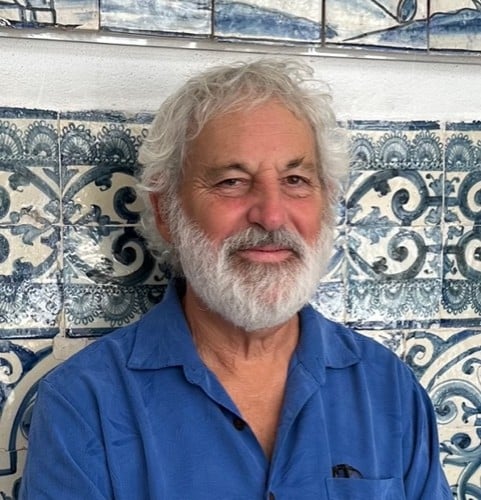
Novelist, journalist, and essayist Roy Hoffman (1953- ) is a Mobile native known for writings that draw on family, personal and communal histories, and cultural experiences to convey a sense of place and tell a larger story. He has authored four novels, exploring aspects of the southern experience, often from the viewpoint of a newcomer or outsider caught between two places and struggling to make a home in the global American South. His essays are frequently reflections on current and past events as seen through the eyes of a writer comfortably planted in both his home state and his adoptive New York City, where he worked for 21 years. In addition to his Alabama roots, Hoffman’s Judaism engages and inspires his work. His fiction and personal essays often reflect the intersection of the southern and Jewish literary traditions.
Hoffman was born in Mobile, Mobile County, on June 23, 1953, to Evelyn Robinton Hoffman and Charles Hoffman. His father, a lawyer who worked until the age of 97, became Alabama’s oldest practicing attorney at the time. Hoffman paid homage to him in his 2000 Fortune magazine essay, “Working Past 90.” The youngest of four children and the only son, Hoffman grew up in midtown Mobile where he played baseball, learned blues and pop piano, and was active in his lifelong Jewish congregation, Springhill Avenue Temple. He graduated from Mobile’s University Military School (UMS) in 1971. As a student, he was inspired by such novels as Don Quixote, Crime and Punishment, The Heart is a Lonely Hunter, Manchild in the Promised Land, and his teen favorite, Look Homeward, Angel. In 1970, he published his own literary magazine, which sold for 10 cents, and reviewed Hair, the then scandalous counterculture musical he had seen on Broadway. That same year, at a Springhill Avenue Temple event, visiting author and renowned Holocaust-survivor Elie Wiesel advised the teenage Hoffman, who worried he had not suffered enough to be a writer, that a good writer can watch humanity on the street corners and find stories to tell.
Hoffman began to actively watch and listen for literary material. His voice as a writer emerged at Tulane University, where he developed a lasting habit of jotting observations and musings in pocket notebooks. He majored in English, enthralled by the Romantic poets, and wrote for the college newspaper, New Orleans Magazine, and the Vieux Carré Courier.
After graduating from Tulane in 1975, Hoffman headed to New York City, encouraged by his eldest sister, Sherrell, a New York television director. He left his resume with New York Magazine, saying he would take any position. A low-level job quickly opened and Hoffman filled it, operating a photostat machine in the art department. He moved up to the newsroom as a fact checker and editorial assistant. Enlivened by New York’s literary riches, he was excited to meet celebrity writers in the office, including the iconic Tom Wolfe whose work, The Electric Kool-Aid Acid Test, Hoffman admired. He was energized by a poetry workshop with the acclaimed Muriel Rukeyser and with his peers formed a writing group that met for more than a decade, dubbing themselves, in hopeful self-prophecy, “The Famous Writers Group.”
In 1983, Hoffman published his first novel, Almost Family, written in his New York studio apartment. Set in fictional Madoc, Alabama, and inspired by his own upbringing, the story explores the relationship between a Black housekeeper and her White, Jewish employer as they navigate their intertwining worlds in civil rights-era Alabama. His debut novel won the Southern Regional Council’s 1983 Lillian Smith Book Award, and the 1984 Alabama Library Association Author Award. While traveling home for an event at Books & Co., a Mobile bookstore, Hoffman met schoolteacher Nancy Mosteller. They married in 1985 and returned to New York City to start their family life. The couple has one daughter.
That same year, Hoffman signed on as a speechwriter for New York University’s chancellor L. Jay Oliva, scripting hundreds of events. He continued working on fiction and writing freelance features, like his profile for the Atlanta Journal-Constitution of Southern Jewish author Eli N. Evans, who became a friend and mentor. In 1992, he joined New York governor Mario Cuomo’s speechwriting staff, based in the governor’s Manhattan headquarters on the 57th floor of 2 World Trade Center. He was in his office on February 26, 1993, during the first terrorist bombing of the World Trade Center. He would later recount the experience in essays for New York Newsday and the Wall Street Journal.
In 1996, after 21 years in New York, Mobile Press-Register associate editor Bailey Thomson urged Hoffman to return home and be the Press-Register’s writer-in-residence, and, later, a staff writer. Soon living in Point Clear and Fairhope, Baldwin County, he worked full-time for the paper until 2012. That year, he was part of a 600-person regional layoff at the Press-Register and affiliated publications as they began to move to a digital format. During his tenure, inspired by diverse cultures of the Gulf Coast, Hoffman interviewed subjects far and wide, from migrant workers to longshoremen, crab pickers to bar pilots who navigate ships to port, to an Auschwitz survivor, Alma Fisher, who had been a childhood classmate of Eva Braun, Adolf Hitler’s short-lived wife. As stories developed, he deepened his sense of place. As a frequent contributor to the New York Times, he brought attention to his corner of the South with op-ed pieces such as “How to be Liberal in Lower Alabama,” “Hurricane People,” and “Harper Lee, My Daughter and Me.”
In 2001 Hoffman met Sena Jeter Naslund, who had recently published her best-selling novel, Ahab’s Wife. Naslund invited him to teach a workshop and mentor in her new, brief residency MFA (Master of Fine Arts) in Writing Program at Spalding University in Louisville, Kentucky, now the Naslund-Mann Graduate School of Writing. Hoffman became a faculty member, continuing to teach fiction and creative nonfiction in the program for more than two decades.
Hoffman’s collection of essays and narrative nonfiction, Back Home: Journeys Through Mobile, was published in 2001. The book reflects Hoffman’s bond to home as shaped by his childhood and the many individuals he met during his journalism career, including Mobile area native and Harlem author Albert Murray. The University of Alabama awarded Hoffman the Clarence E. Cason Award in Nonfiction Writing in 2009 for his contribution to journalism and literature in the South. Later broadening his scope to encompass more of the state, his 2011 book Alabama Afternoons: Profiles and Conversations includes extended visits with World War II veteran and author Eugene B. Sledge, authors Howell Raines and Diane McWhorter, civil rights photographer Charles Moore, and artist William Christenberry.
Hoffman’s fictional works draw on his vast storytelling experience to probe the human condition, with his characters, often from different places in their lives, yearning to connect. His 2004 novel Chicken Dreaming Corn, endorsed by Harper Lee, explores the immigrant experience of the early twentieth century as it unfolded in the American South. In setting the book on Dauphin Street in downtown Mobile, Hoffman draws inspiration from tales of his Romanian Jewish grandparents who landed as shopkeepers in south Alabama and learned to blend the ways of the old world with the new. Modeled on the real-life Hoffman Furniture in Mobile, he reflected on the liquidation and closing of the century-old store in a 2025 Washington Post personal essay, “Saying Goodbye to a Store that Felt Like My Family’s Ancestral Home.”
His 2014 novel Come Landfall extends this theme to include refugees from Southeast Asia who settled on the Mississippi coast in the aftermath of the Vietnam War. Like his other works, in Come Landfall, Hoffman’s fictional characters draw on his personal family history. This time building on the story of his uncle, a U.S. Marine who was taken prisoner in the Pacific during World War II and never returned, and the lingering pain of the unknown.
In his most recent novel, The Promise of the Pelican (2022), set in Fairhope, Hoffman’s central characters are a young, undocumented Honduran accused of murder and the retired criminal attorney who returns to the courtroom to defend him. The attorney, who once fled Amsterdam as a child Holocaust refugee, and the young man from Honduras form a bond across generations, languages, and cultures. In this literary crime novel, themes develop in new ways for Hoffman, withcharacters making their way in a multicultural South, coming to terms with those whom they view as foreign or “the other,” and the powerful bonds of family and home.
Works by Roy Hoffman
Almost Family (1983)
Back Home: Journeys Through Mobile (2001)
Chicken Dreaming Corn (2004)
Alabama Afternoons: Profiles and Conversations (2011)
Come Landfall: A Novel (2014)
The Promise of the Pelican (2022)