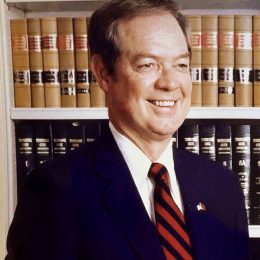
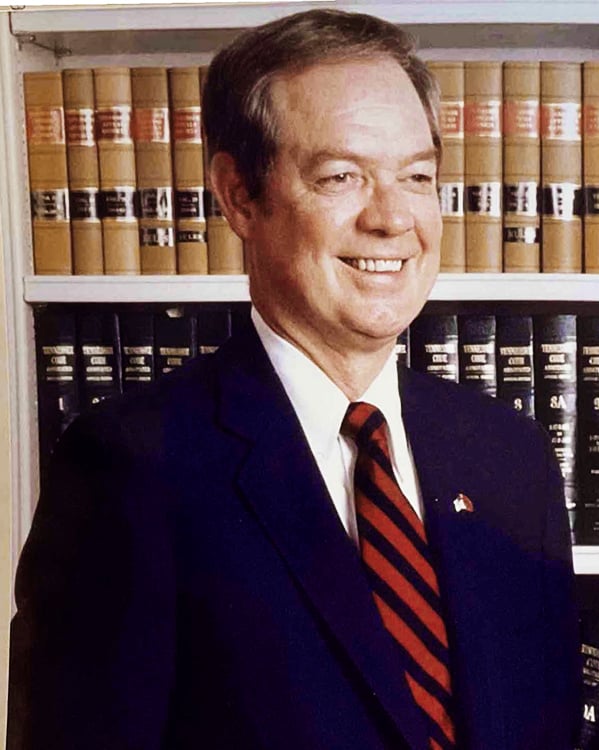
Harlan Mathews
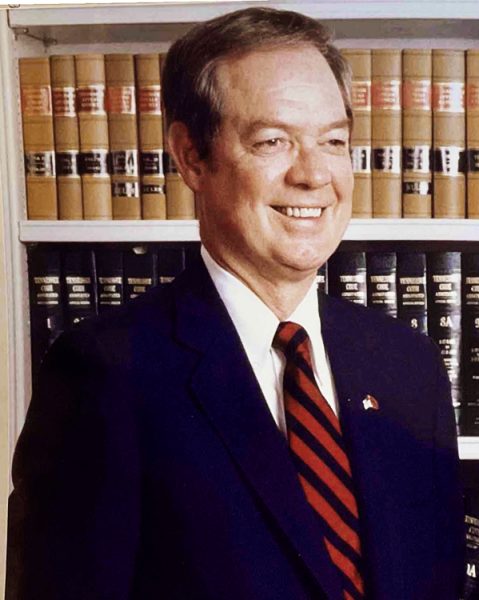
Walker County native Albert Harlan Mathews (1927-2014) was a long-time Democratic public servant whose career spanned more than four decades in Tennessee state government, culminating in an appointment to the U.S. Senate in 1993. Although brief, his Senate tenure was marked by several important votes on high-profile legislation. Over the course of his career, he served under three Tennessee governors in both executive and legislative capacities and built a reputation as a budget and finance expert.
Mathews was born on January 17, 1927, in Sumiton, Walker County, to John Williams Mathews and Lilie M. Mathews; he was an only child. After finishing high school in 1944, he enlisted in the U.S. Navy and served through the final months of World War II, until 1946. One of his posts was aboard the aircraft carrier USS Badoeng Strait (CVE-116), which was commissioned after the war had ended. In 1947, he married Betty Amelia Cox; the couple would have three children and later divorce. Following his military service, Mathews returned to Alabama and took advantage of the G.I. Bill to attend Jacksonville State College (present-day Jacksonville State University) in Jacksonville, Calhoun County, earning a bachelor’s degree in 1949. He then relocated to Tennessee to study public administration at Vanderbilt University, completing a master’s degree in 1950.
Mathews began his tenure in public service after graduating from Vanderbilt. His initial government post came in the Tennessee State Planning Office, where he began work in 1950 on the planning committee of Democratic governor Gordon Browning. In 1954, he transitioned to the budget staff under Gov. Frank G. Clement, reflecting his evolving role in fiscal management during Tennessee’s transformation from an agricultural to a more industrial economy. In 1961, Mathews was appointed commissioner of the Department of Finance and Administration and served in that role through 1971. In that capacity, he navigated the state’s economic growth, coordinated budgetary matters, and developed expertise in Tennessee’s fiscal infrastructure.
During his tenure as commissioner, Mathews combined public service with legal training, completing his law degree from the YMCA Night Law School (present-day Nashville School of Law) in 1962, and working in government affairs. After leaving the commissioner position in 1971, he spent a brief period in the private sector as senior vice president of AMCON International, Inc. in Memphis before returning to government in 1973 as a legislative assistant to Comptroller of the Treasury William Snodgrass.
In 1974, Mathews was elected by the Tennessee General Assembly to serve as State Treasurer, a post he held until January 17, 1987. In this role he led the effort for significant institutional reforms and the creation of modern investment strategies for state funds. He helped to establish the State Pool Investment Fund (1974) and the Local Government Investment Pool (1980), which aim to provide a safe way for the state and local governments to invest, and the State Trust (1979). To support retirement efforts of state employees, he implemented 457 and 401(k) deferred-compensation plans in the early 1980s. He also oversaw the development of the Unclaimed Property program, the Criminal Injuries Compensation Fund, and the State Victims of Drunk Drivers Compensation Fund. Mathews was an active member of the National Association of State Treasurers and served as president of the organization in 1977–78.
Mathews’s stewardship of the Treasury coincided with a period of state fiscal modernization during which Tennessee expanded its revenue sources, streamlined financial operations, and sought to protect taxpayer investments during a period of high inflation and stagnant economic growth. His quiet administrative style and conservative fiscal approach earned him praise from across the political spectrum and allowed him to build long-term working relationships with both political leaders and civil servants, including Ned McWherter, who held a 14-year run as Speaker of the Tennessee House of Representatives.
When McWherter decided to run for the Tennessee governorship in 1986, Mathews joined the campaign as chief fundraiser. After McWherter won the election, he appointed Mathews as his deputy governor in 1987. In this post, Mathews operated behind the scenes in Tennessee’s executive branch, helping coordinate state policy, interagency cooperation, and long-term planning.
The November 1992 election of U.S. senator Al Gore as Vice President of the United States left Gore’s Senate seat open. After his initial choice, U.S. representative John Tanner, took himself out of the running for the vacancy, McWherter appointed Mathews to fill the seat beginning in January 1993. McWherter intended Mathews’s appointment to be a temporary arrangement to give candidates time to prepare for the upcoming election, rather than giving an incumbent advantage.
During his Senate tenure, from January 3, 1993, to December 1, 1994, Mathews served on committees related to government operations and finance. Serving in the 103rd Congress, he voted in favor of several pieces of notable legislation: the Family Medical Leave Act, the National Voter Registration Act, implementation of the North American Free Trade Act (NAFTA), the Brady Handgun Violence Prevention Act (known as the “Brady Bill”), the Omnibus Budget Reconciliation Act of 1993 (an economic stimulus plan), and the 1994 Violent Crime Control and Law Enforcement Act (the “Crime Bill.”) His votes for the latter two were praised by ex-president Bill Clinton after his death; the Omnibus bill passed by one vote.
Although he briefly considered it, Mathews chose not to run in the 1994 special election, clearing the way for U.S. representative Jim Cooper to become the Democratic nominee. After Cooper lost the election to Fred Thompson, also an Alabama native, both Tennessee Senate seats flipped to Republicans with Bill Frist’s election that year, marking a significant realignment towards the Republican Party in Tennessee’s partisan politics and in the nation.
After leaving the Senate, Mathews returned to Nashville and resumed his legal practice, joining the law firm of Farris, Mathews, Bobango, PLC. Although he did not formally return to state politics, he remained active as a lobbyist and informal advisor; notable among his clients and associations was his advisory role with Democratic governor Phil Bredesen after the governor’s election in 2002.
Mathews remained widely respected in Tennessee for his low-key but effective leadership style, his mastery of state fiscal matters, and his commitment to public service rather than personal political advancement. In 1999, Mathews received the Lucille Maurer Award (formerly the Treasurer Emeritus Award) for exemplary service in the position.
On May 9, 2014, Mathews died of a brain tumor at a hospice in Nashville at the age of 87. His passing prompted tributes across the state recognizing his decades of service.