Little River Canyon Onion
The Little River Canyon onion (Allium speculae) is a perennial flowering plant found only in Georgia and Alabama and is especially prolific around Little River Canyon National Preserve in Cherokee and DeKalb Counties. It is listed as threatened by the U.S. Fish and Wildlife Service because of its limited range and specialized habitat. The species is in the order Asparagales, a large and diverse group that includes all of the plants in the onion family as well as orchids, daffodils, and agaves, among others. The genus name Allium comes from the Latin word for garlic, and the species name speculae comes from the Latin word for a watchtower, likely for its habitat in rocky outcrops. The Little River Canyon onion is a member of the large genus Allium, which includes six species native to Alabama.
The plant was collected by botanist Carroll E. Wood Jr., of the Arnold Arboretum at Harvard University, in 1955 and described by Washington State University botanists Marion Ownbey and Hannah C. Aase in 1959. It is currently known from about 22 locations in Alabama and eight in Georgia. This onion grows in shallow depressions on stone outcrops in places where water seeps from underground sources. In Alabama, it generally grows on sandstone, and in Georgia, it is confined to the Lithonia Gneiss outcrops in the central part of the state. It grows in association with other types of geographically restricted and habitat-specific plants that include Nuttall’s rayless goldenrod (Bigelowia nuttallii), Lookout Mountain tickseed (Coreopsis pulchra), small head blazing star (Liatris microcephala), and Harper’s dodder (Cuscuta harperi).
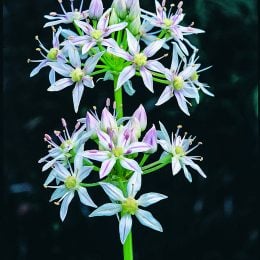
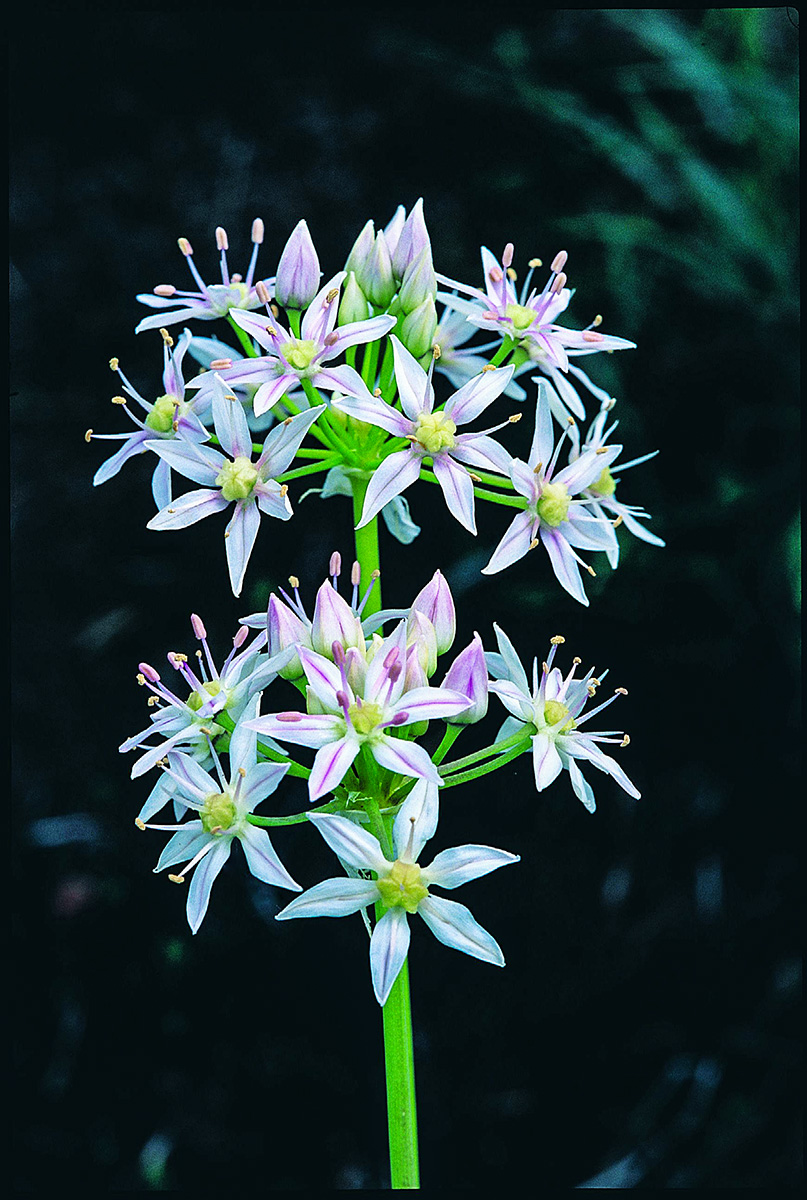
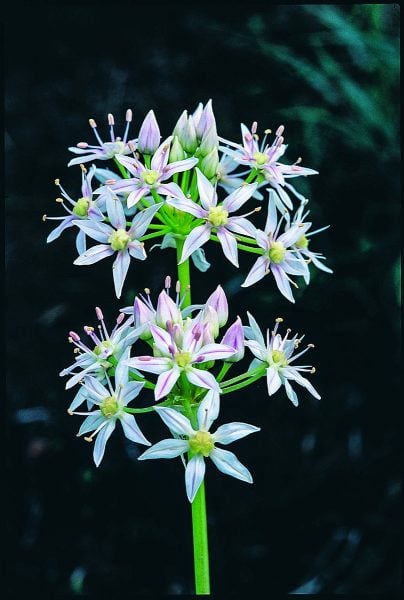
The Little River Canyon onion produces four to five flattened grasslike leaves that can reach approximately 10 inches (~25 centimeters) in length. Each leaf has a deep groove that runs its length. The plant grows from bulbs that form clumps in the moist seepages that the plant prefers. Flowers are produced in late May and June at the top of a stalk and are encased in a papery sheath that opens to reveal clusters of 10 to 15 blooms that are white with green centers and a pink hue at the base. The flowers are about a half inch (~1.3 centimeters) across and are what scientists call tepals (3 petals and 3 sepals). After the flowers fade, the plant produces fruits with three lobes that mature to a three-part capsule with seeds in each section. The seeds fall to the ground near the parent plants and increase the area of the clumps.
The Little River Canyon onion is pollinated by a variety of flying insects, including bees and butterflies. Threats to this imperiled plant include quarries and mining, trash dumping, off-road vehicles, development, and climate change. The threat assessments for this plant are limited and need further study.