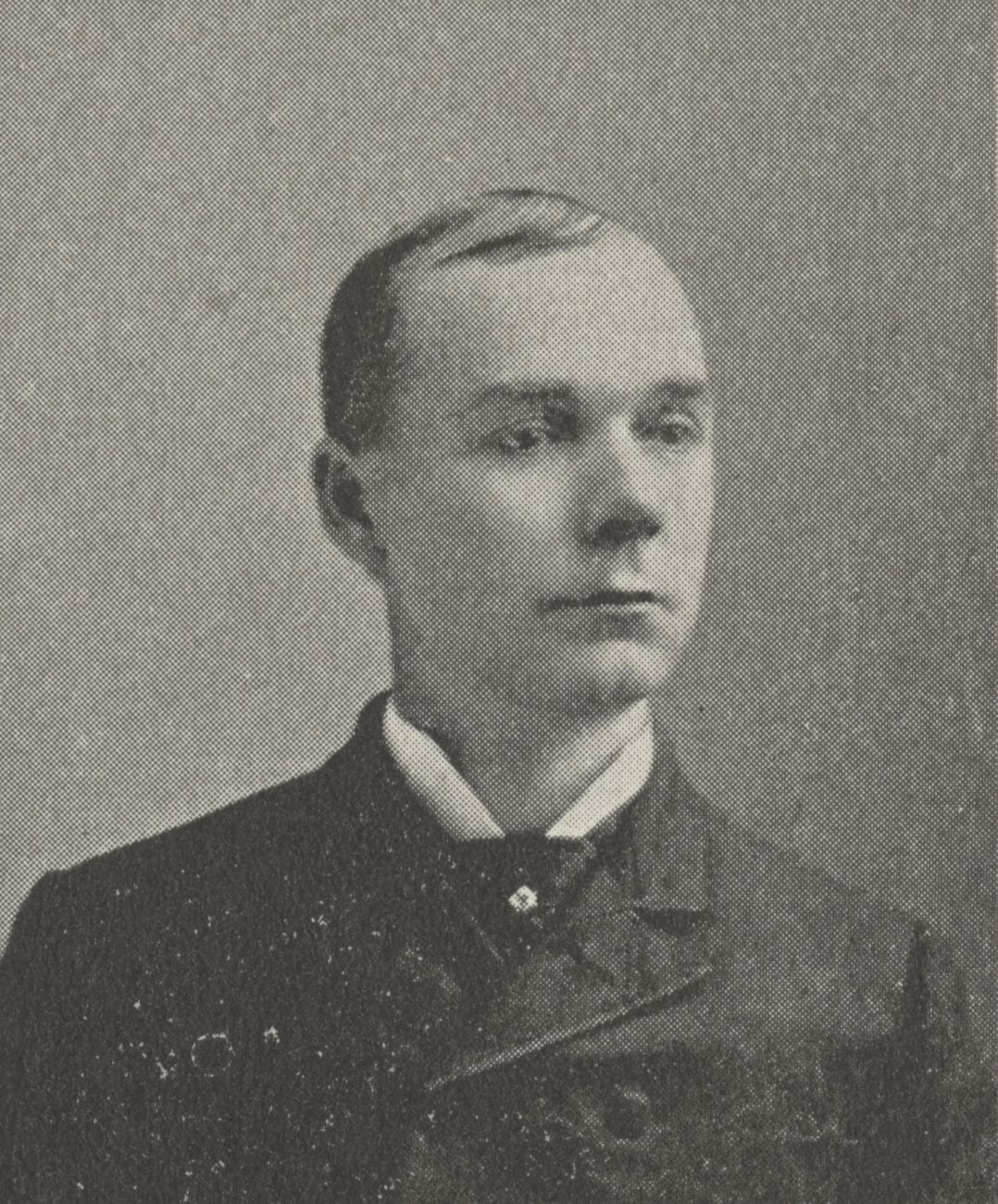
Jesse Francis Stallings
Lawyer and Democratic politician Jesse Francis Stallings (1856-1928) represented Alabama’s Second Congressional District for four terms in the U.S. House of Representatives, from 1893 to 1901. He opposed the state’s 1901 Constitution because he feared it would disenfranchise some White voters. After leaving Congress, he practiced law in Birmingham, Jefferson County, and served as president of the Lincoln Reserve Life Insurance Company.
Stallings was born on April 4, 1856, near Manningham, Butler County, to Reuben Stallings and Lucinda Ferguson Stallings. He was one of three siblings. His father farmed for a living and served in the Confederate Army during the American Civil War.
Stallings attended the University of Kentucky and later studied law at University of Alabama, graduating in 1877. He practiced law in Greenville, Butler County, after being admitted to the bar in April 1880. He became an active member of the Democratic Party in Butler County and the state, attending local and state conventions. In November 1886, the Alabama Legislature elected Stallings to the Office of Solicitor for the Second District, where he provided legal advice and prepared legal documentation outside the court room. Stallings also served as a delegate to the 1888 Democratic National Convention to elect the Democrat’s presidential nominee, former president Grover Cleveland in an unsuccessful bid.
Stallings married three times. In 1883, he married Ella McAllister, with whom he had a son. She died shortly after in 1885. Then he married Ella’s sister, Belle McAllister, in 1887. They had a son who died at a very young age. They later divorced. Twelve years later, Stallings married Marie Hudmon, with whom he had three children.
After his term as solicitor expired in 1892, Stallings won the Congressional seat held by the retiring Hilary Abner Herbert to represent Alabama’s Second Congressional District, which then consisted of Baldwin, Butler, Conecuh, Covington, Crenshaw, Escambia, Montgomery, Pike, and Wilcox Counties. One of the candidates that year, and in 1894, was Alabama state senator Ariosto Appling Wiley, who would win the seat in 1900. Stallings did not introduce any meaningful legislation and was frequently absent from Congress to campaign in his district. He rarely spoke in Congress but was considered a fine orator.
Stalling identified with the Populist wing of the Democratic Party actively showing a concern for the farmers’ wellbeing in his campaigns and congressional votes. Originally a grassroots movement that started among farmers in the Midwest and South in the early 1890s, Populism evolved into a national movement that significantly influenced reform efforts among members of the Democratic Party. At the time, farmers felt actively abused by big business and monopolies, and the Democratic Party worried about losing their voting base to the Populist movement, which had evolved into a third party. Stallings, like other members of his party, worked to reaffirm farmer loyalty. Relatedly, Stallings over the course of his political career and public life supported a graduated income tax and unlimited coinage of silver, known as “free silver.” He favored reducing tariffs, limiting immigration, and regulating railroad rates.
In the 53rd and 54th Congresses, Stallings served on the Committee on Education and the Committee on Election of the President and Vice-President and Representatives. While on the latter committee in 1894, Stallings argued for the election of Democrat Oscar W. Underwood to Alabama’s Ninth Congressional District seat, which was contested by Republican opponent Truman Aldrich. (Stallings was put in this position due to the absences of more senior Democratic members of the committee.) During the spirited debate, he also condemned southern Republicans for disloyalty to the South and disputed Republican claims of election fraud in Alabama and the South, such as Democrats stuffing ballot boxes. (Alabama would enact a new constitution in 1901 on Democrats' mantra of “honest elections and White supremacy,” openly acknowledging that fraud existed.) Stallings more generally defended the Confederacy and denounced Reconstruction and related military occupation and disenfranchisement of former Confederates, and he added a veiled attack on newly enfranchised voters during that era. Aldrich was eventually declared the winner.
In the 55th and 56th Congresses, he served on the Committee on Banking and Currency and Committee on Pensions, from which he reported on veterans and veterans’ widows seeking pensions and increased pensions. He favored reform to tighten qualifications and create more consistency but did introduce a bill to increase payments to survivors of the Mexican and Indian Wars from $8.00 a month to $12.00.
Declining to run for renomination in 1900 (Ariosto Appling Wiley won the open seat), Stallings instead ran in the 1900 gubernatorial election, opposing the conservative effort to rewrite the state’s 1875 Constitution, fearing that poor and illiterate Whites would be disenfranchised. Stallings had considerable support in early ballots, but William J. Samford won the governor’s race and, the following year, the state enacted the 1901 Constitution, which is noted for disenfranchising most Black voters as well as some poor Whites, through various means, to ensure White supremacy. Stallings was selected to represent Butler County at the constitutional convention but did not serve and spoke out often against its ratification. After he left Congress in 1901, he resumed practicing law in Birmingham.
In 1906, Stallings unsuccessfully ran in the Democratic primary for “alternate senator.” Since the current senators, John Tyler Morgan and Edmund Pettus, were aging, alternate senators were elected to serve in case of a vacancy prior to the next meeting of the legislature. (Until passage of the Seventeenth Amendment in 1913, state legislatures appointed senators.) John Hollis Bankhead received the most votes and Joseph F. Johnston, the second most. Bankhead was appointed to the seat left open by the death of Morgan in 1907 and remained in the Senate until his death in 1920. Johnston took the seat held by Pettus after his 1907 death and remained in the Senate until his death in 1913. Stallings chaired the Alabama state Democratic Party campaign committee, successfully managing Emmet O’Neal’s gubernatorial campaign in 1910. During this time, he also opposed a prohibition amendment to the state constitution, which was supported by Gov. Braxton Bragg Comer, and was defeated.
From 1912 until his death, Stallings served as president of Lincoln Reserve Life Insurance Company (present-day Lincoln National Life Insurance Company). He also served briefly as secretary-treasurer for the Alabama Coke and Coal Company. Stallings died on March 18, 1928, and was interred at Elmwood Cemetery located in Birmingham.