Jean Woodham
Alabama-born sculptor Mildred Jean Woodham (1925-2021) was one of the earliest American artists to take up welding as a fine-art technique and to fabricate monumental outdoor sculpture. During her career of more than 50 years, she completed more than 150 public and private commissions across the United States, several of them in her home state, and helped establish welded metal as a serious medium for large-scale abstract sculpture.
Woodham was born on August 16, 1925, in Midland City, Dale County, to Marcus Morton Woodham and Alma Clements Woodham. She had three siblings. Her father was an agriculture and science teacher, principal, and later an agricultural agent, for which he received the National County Agent Service Award in 1950. Her mother also taught school and was an artist. She grew up in the rural southeast Alabama town of Geneva, Geneva County. By her own account, she resolved to become a sculptor while still in grade school, although the public art she encountered as a child was largely limited to courthouse fountains and Confederate memorials. She received no formal art instruction prior to attending college. Woodham enrolled at Alabama Polytechnic Institute (API, present-day Auburn University), where she completed a bachelor’s degree in applied art in three years, graduating in 1946. She was awarded the Burton Prize (by Lucille Burton) for the highest scholastic achievement by an art major.
Woodham arrived in New York City on July 4, 1946, and joined the Clay Club (the present-day SculptureCenter) in Greenwich Village, then a center of the American avant-garde movement. Her studio neighbors and exhibiting peers during these years included Louise Nevelson and Isamu Noguchi, among other figures central to mid-century American sculpture. Nevelson became an early supporter and later sponsored Woodham’s membership in the Sculptors Guild. Within a year, Woodham was exhibiting professionally and had recorded her first museum sale, and her work was reproduced in Jacques Schnier’s survey Sculpture in Modern America (1948).
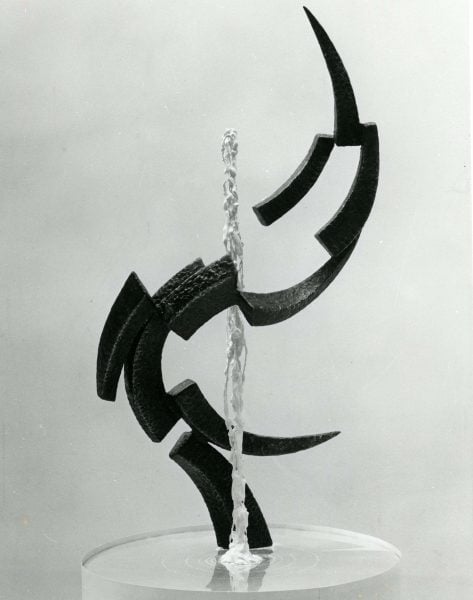
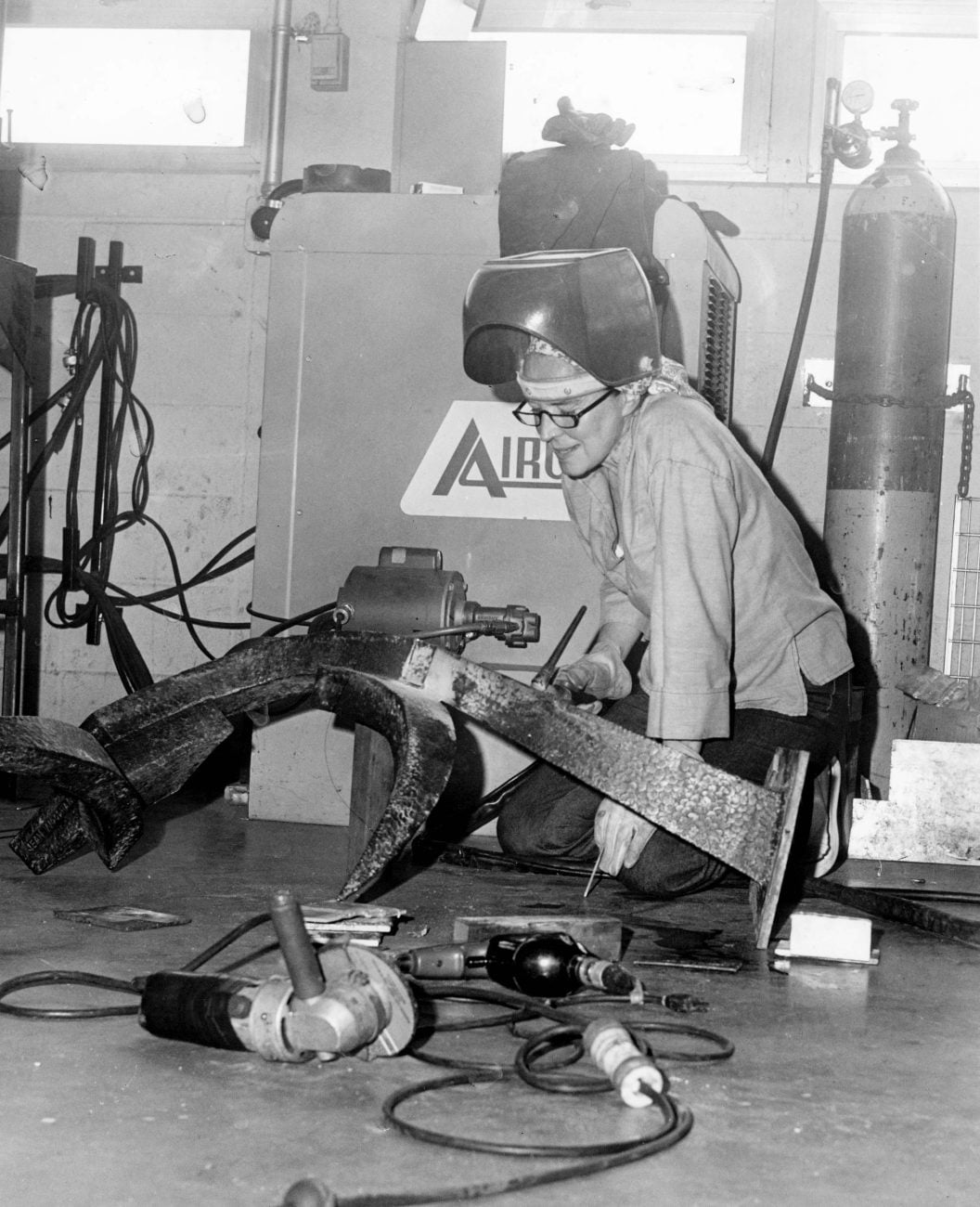
In New York, Woodham enrolled in what has been described as the first American class devoted to welding as an art technique, organized by the sculptor Sahl Swarz and informed by the work of David Smith. She was one of only a handful of students. Welding shaped the rest of her career, allowing her to build open, cantilevered forms in steel and, in time, to construct large works herself rather than contracting them to industrial fabricators. In 1949, she received the Kate Neal Kinley Memorial Fellowship from the University of Illinois. That November, Woodham married James Caraway Jr. (A native of Cordova, Walker County, he also had graduated from Auburn University, in 1940. He served in the U.S. Navy during World War II and become an illustrator.) The couple had two daughters.
In 1955, Woodham and her family moved to Connecticut, where she became head of the sculpture program at the Silvermine Guild of Artists, one of the largest artist cooperatives in the country. She continued to exhibit widely and to accumulate honors, and in 1960 she was commissioned to create a sculpture, Progression, for the NS Savannah, the first nuclear-powered merchant ship. Her marriage ended in 1968, a turning point that led Woodham to reorient her practice toward large-scale commissioned public sculpture. In 1970, she bought a house in Westport, Connecticut, and converted its garage into a studio, later adding a large addition to accommodate monumental works.
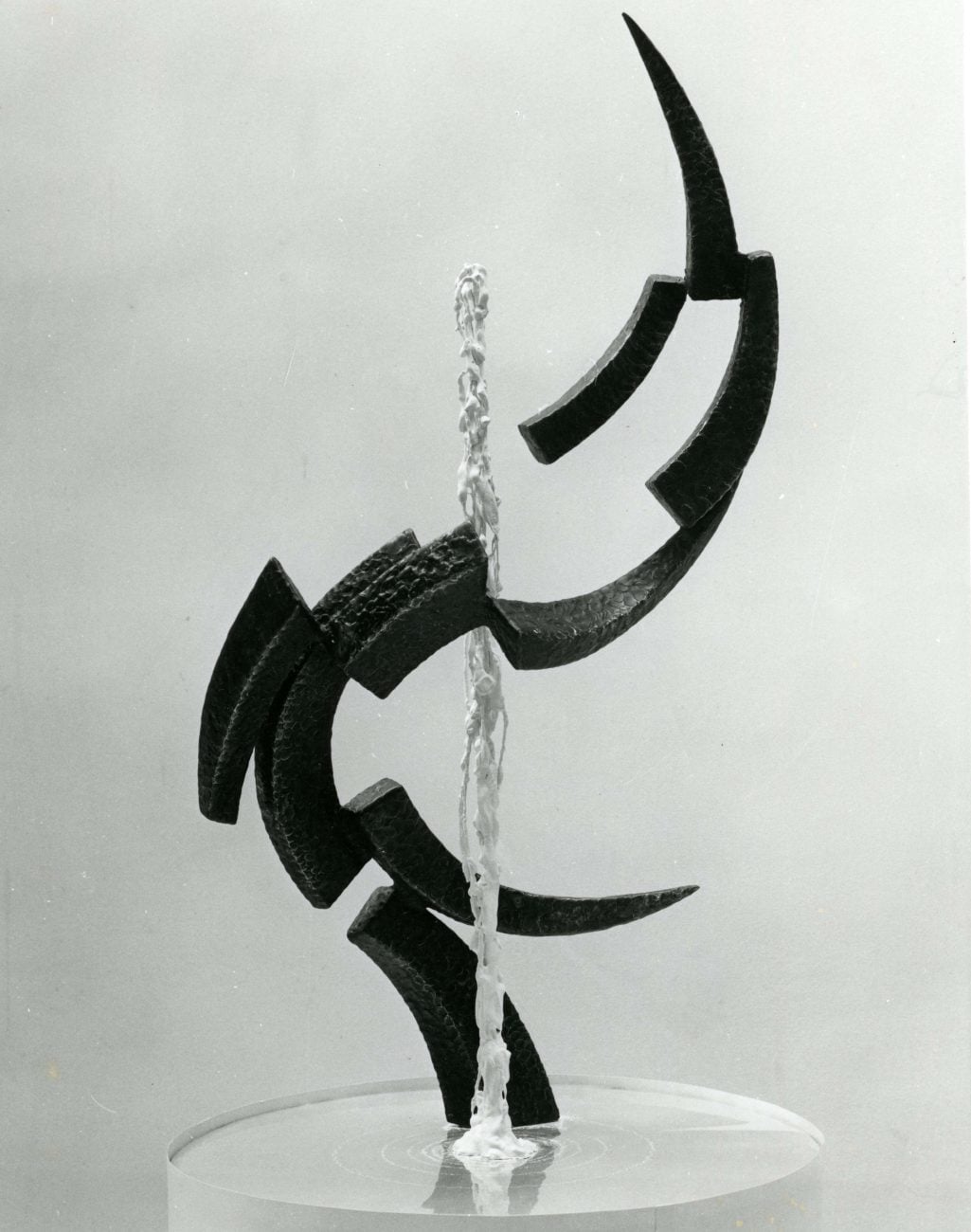
Working primarily in welded steel, bronze, and brass, Woodham’s sculptures are abstract rather than representational. She returned repeatedly to the relationship of form to space and time, naming continuity, momentum, and balance as central concerns, and she resisted narrative or literal readings of her work. Critics later placed her within the lineage of modernist abstraction associated with sculptors such as Henry Moore and Jean Arp.
In the following decades, she completed commissions for corporate, civic, and educational clients across the country. Among the largest was Scholars’ Sphere (1975-1978), a roughly 28-foot welded work created for Harry S. Truman High School in the Bronx under what was then the largest sculpture commission awarded by the New York City Board of Education. Other commissions included works for the General Electric Credit Corporation, Texas Eastern Transmission, and the World Bank in Washington, D.C. By the later years of her career, her sculptures numbered more than 150 in public and private collections. She served as president of the Sculptors Guild from 1990 to 1993.
Woodham maintained ties to Alabama throughout her life, and several of her sculptures are installed in the state. In 1970, she returned to Auburn University as a visiting professor of art at various times in the early 1970s. In the late 1970s, she completed Monody, a welded steel sculpture roughly 19 feet tall, conceived as an elegy for Pres. John F. Kennedy and installed outside of Goodwin Hall at Auburn. Her sculpture Spinoff is held by Auburn University’s Jule Collins Smith Museum of Fine Art, of which she was a founding member.
In Opelika, Lee County, Woodham’s sculpture Whirlwind was commissioned by the Azalea Garden Club and installed when the city’s Lewis Cooper Jr. Memorial Library opened in the mid-1970s. A 1977 letter of thanks from Woodham to the garden club is preserved with the work, which remains in the collection of the Opelika Public Library. Woodham remarried in 1986, to Leon Friedman, who produced television commercials. He died in 1995
In 1996, Auburn University presented a 50-year retrospective of her work in conjunction with its Franklin Lecture series. Woodham died on October 28, 2021, in Westport at the age of 96. In October 2025, her sculpture Time/Spike was installed at the Dothan Area Botanical Gardens, near where she grew up.
Additional Resources
- The Sculpture of Jean Woodham: A Fifty Year Retrospective. Exhibition catalogue. Auburn, Ala.: Auburn University, 1996.