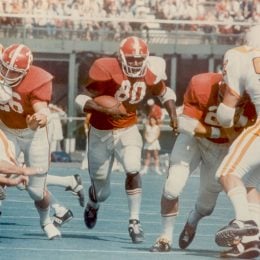
Wilbur Jackson

Dale County native Wilbur Jackson (1951- ) was the first Black athlete to receive a college football scholarship from the University of Alabama, where he was a star halfback for the Crimson Tide football team. He subsequently played running back for the San Francisco 49ers and the Washington Redskins (present-day Washington Commanders).
Wilbur Jackson was born in Ozark, Dale County, on November 19, 1951. His father worked a railroad job for decades. Jackson attended the segregated D. A. Smith High School (originally Ozark Negro High School) in Ozark. He initially played basketball and baseball, but he stopped playing baseball after he broke his leg. During his junior year at Smith, he began playing football; although he was primarily a running back, he occasionally played split end (also called wide receiver or flanker). After D. A. Smith High School closed in 1969, he continued to play football at Ozark’s newly integrated Carroll High School until he graduated in 1970; he played both running back and wide receiver. Caroll High School’s head football coach Tom McLendon became Jackson’s mentor.
Pat Dye (later head coach at Auburn University) was then serving as football recruiter for the University of Alabama in the Wiregrass region. After watching a video of his performance in a 1969 football jamboree (a preseason scrimmage-type practice), Dye recommended Jackson to Alabama coach Paul “Bear” Bryant, even though Jackson had played only 14 high school football games. That year, Jackson became the first Black player to receive a football scholarship from the University of Alabama. He was soon followed by Mobile native John Mitchell, and Mitchell would become the first Black athlete to appear in a varsity game in 1971.

Bryant recruited Jackson as a split end but soon moved him to the position of running back, which he would go on to play for his entire college and professional career. Because freshman players were not eligible to appear in varsity football games at that time, Jackson did not play until his sophomore year in 1971. That year, Alabama finished 11-1, missing out on the national championship title after losing to Nebraska in the Orange Bowl. Alabama was 10-2 during Jackson’s junior year.
Jackson was an integral part of the Alabama football team that split the 1973 national championship title with the University of Notre Dame. In that era, the nation’s top-ranked teams were assigned to bowl games; due to contractual agreements, the number one and number two ranked teams did not always play against each other, and the outcome of the bowl game did not always determine the national championship title. In 1973, an unprecedented six undefeated teams competed for the national title. In that year’s Sugar Bowl, which pitted number one Alabama against number four ranked Notre Dame, Jackson rushed 11 times for 62 yards, caught 2 passes for 22 yards, and scored a touchdown on a 5-yard run. Notre Dame defeated Alabama 24-23. The national championship title was officially determined by two polls; the United Press International poll, which was taken before the bowl game, declared Alabama the winner, but the Associated Press poll, taken after the bowl game, declared Notre Dame the winner. That season, Jackson was named to the All-American team and to the First-Team All-SEC team, where he was chosen as the top running back in the Southeastern Conference.
Wilbur Jackson still holds the Crimson Tide record for most yards per carry at 7.2 yards per carry. During his collegiate football career (1971-73), he ran for 1,529 yards on 212 attempts. He played his best game against Virginia Tech in 1973 when he ran for 138 yards on only 5 carries, averaging 27.6 yards each time he touched the football.
In 1974, the San Francisco 49ers chose Jackson in the first round of the National Football League (NFL) draft; he was the ninth pick overall. After Jackson’s first season with San Francisco, the Pro Football Writers of America (PFWA) voted him onto their All-Rookie Team, naming Jackson (along with the San Diego Chargers’ running back Don Woods) the top NFL rookie running back for 1974. Jackson’s two best years in the NFL were in 1976 and 1977, when he rushed for 792 yards and 780 yards, respectively. In 1977, he averaged 4.4 yards per carry, scored seven touchdowns, and had an 80-yard run, by far his longest run from the line of scrimmage, his second longest being 64 yards.
In 1980, Jackson married Martha Ann Jackson; the couple would have one daughter. Later that year, the 49ers traded him to the Washington Redskins, with whom he would play his final years in the NFL. His first season in Washington was his most productive, when he ran for 708 yards and scored three touchdowns. Jackson played sparingly in the 1982-83 season, in the opener against Philadelphia and in Washington’s wins over Minnesota and Detroit in the playoffs. In Super Bowl XVII on January 30, 1983, Jackson injured his hamstring while trying to tackle Miami Dolphins kickoff returner Fulton Walker, who scored on the play. The Redskins prevailed over the Dolphins, 27-17. (The game featured five other Alabamians: Andra Franklin, Don McNeal, and Tony Nathan of the Dolphins and Dave Butz and Mike Williams of the Redskins.) Jackson announced his retirement in July of that year, at age 32. In his nine-year NFL career, Jackson rushed 971 times for 3,852 for 13 touchdowns. His 4.0-yard average per carry is impressive but not close to his college average.
After his retirement, Jackson moved back to Ozark, where he owned a cleaning business for 30 years. Jackson also has frequently given inspirational talks to audiences throughout the state. Jackson appears in the 2013 documentary film Three Days at Foster, which concerns the effort to integrate collegiate sports in Alabama in the 1950s and 1960s.
Jackson was inducted into the Alabama Sports Hall of Fame in 2007. Ozark commissioned a colorful mural, 26 feet tall and 86 feet wide, in his honor in the downtown part of the city; the mural, painted by artist Wes Hardin, was dedicated and unveiled on August 16, 2021.