O. V. Hunt
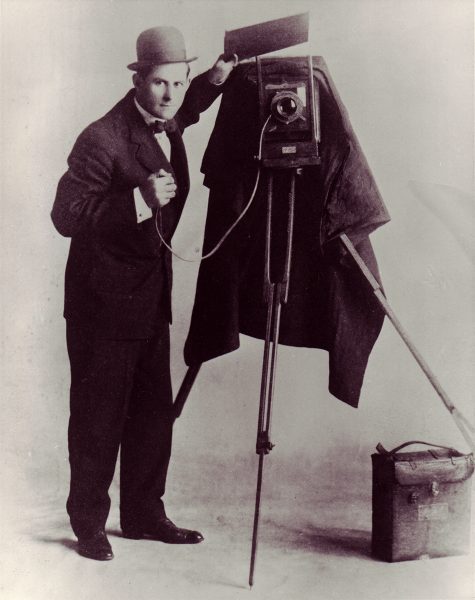
Oscar Virgil Hunt (1881-1962) was one of Birmingham’s most prolific and adventurous twentieth-century commercial photographers. Even many years after his death, his work continues to be shown in exhibitions and reproduced in books, periodicals, and other media. He is typically remembered as “O.V. Hunt.”
Hunt was born in Bowden, Georgia, in 1881, to John J. Hunt, a harness maker, and Carrie C. Hunt, a homemaker and seamstress. He was the oldest of four siblings. By 1897, the family had moved to Birmingham. In 1898, after a brief period as a streetcar motorman for the Birmingham Railway, Light and Power Company, Hunt began working in the studios of two of Birmingham’s early professional photographers, Bert Covell and R. T. Boyett. In 1913, Hunt married Eleanor Lucile Nix; the couple had two children. By the late 1910s or early 1920s, Hunt was operating his own photographic studios in downtown Birmingham. In addition to maintaining his studios, as many as a dozen at different locations at some point, Hunt also worked as a photographer for the Birmingham Ledger newspaper and for the Tennessee Coal, Iron, and Railroad Company, the U.S. Steel affiliate in Birmingham, Jefferson County.

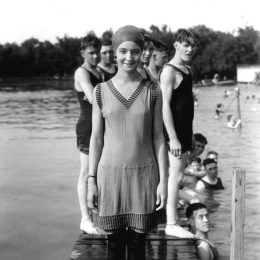
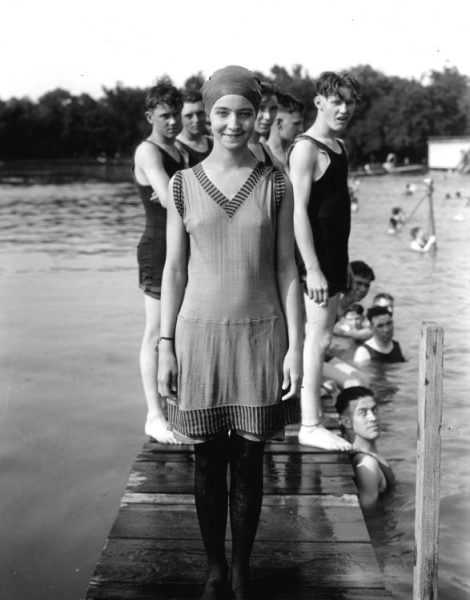
Birmingham was still young when Hunt entered photography, and he documented the city’s growth. He photographed residents at work and play, capturing such moments as a police officer directing traffic on a downtown street or a teenage girl in a bathing suit at East Lake Park, smiling confidently into the camera while ignoring the group of boys admiring her from behind. Hunt’s street scenes can be striking, sometimes shot from several stories above the street. He photographed elaborate promotional displays at downtown movie theaters and in department store windows, motorcycle and bicycle races at the fairgrounds, and firefighters battling a massive blaze. In 1947, the Birmingham Chamber of Commerce selected several Hunt photos to use in promotional material for the city.
Hunt retired in 1952 but kept a studio, which became a hangout where young photographers and photo collectors gathered to drink, discuss old photos, and listen to Hunt tell stories. In addition to his own work, Hunt’s collection included photos from early Birmingham that he purchased when older photographers went out of business. Hunt died on December 29, 1962, at the age of 81. He is buried at Birmingham’s Elmwood Cemetery.
Apparently fearless in his pursuit of a memorable image, Hunt took the first aerial photo of Birmingham in 1911 while sitting in the passenger seat of a biplane flying more than 5,000 feet above the city. On another occasion, he took his cumbersome tripod camera onto a hanging steel beam several stories above the ground to photograph downtown Birmingham.
In his lifetime, Hunt’s photos were exhibited on at least two occasions: first in 1921, as part of an exhibit at Birmingham’s Little Art Gallery that included local and national photographers, and again in 1928, in an exhibit at the Birmingham Public Library sponsored by the Birmingham Photographers Club. After Hunt’s death, his photos were featured in two solo exhibits, a 1993 exhibit at the Birmingham Public Library entitled Downtown: Photographs from the Archives’ Collection and a 2007 exhibit at Vulcan Park and Museum entitled O. V. Hunt, Commercial Photographer: Images of Life and Work in the Magic City.

Hunt’s surviving photographs number more than 1,300 images. This figure includes 8 x 10 glass-plate negatives, which provide high-quality photos, and are preserved in the Birmingham Public Library Archives. Many negatives were salvaged from his studios after his death, and other images came out over the years from various sources. But an unknown number of images were lost. Some images show the mundane work required of professional photographers, such as weddings and school groups, images from factories showing new pieces of manufacturing equipment, and photos of new delivery trucks for local businesses. When photographing workplaces, Hunt often placed working people at the center of his images, as when he photographed a streetcar conductor standing amid bags of mail and two Black miners posing on either side of the entrance to a mine.
According to photo historian Frances Osborn Robb, O.V. Hunt was the state’s first long-term commercial photographer. His images remain popular today and are reproduced in books and magazines, sold as postcards, used in documentary films and museum exhibitions, and displayed in Birmingham area bars and restaurants and in offices and homes.
Additional Resources
- Robb, Frances Osborn. Shot in Alabama: A History of Photography, 1839-1941, and a List of Photographs. Tuscaloosa: University of Alabama Press, 2016.