Heinie Manush
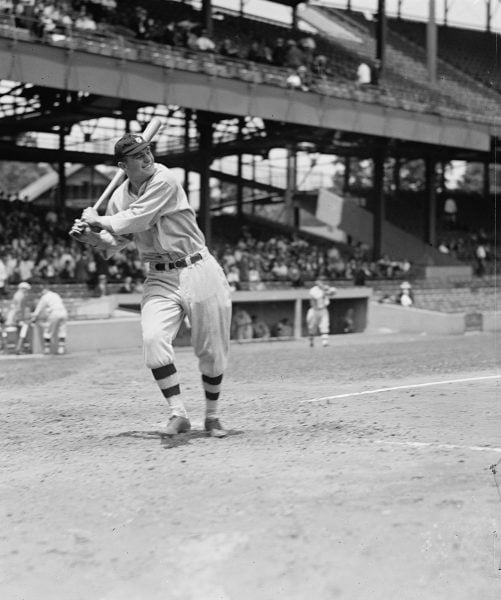
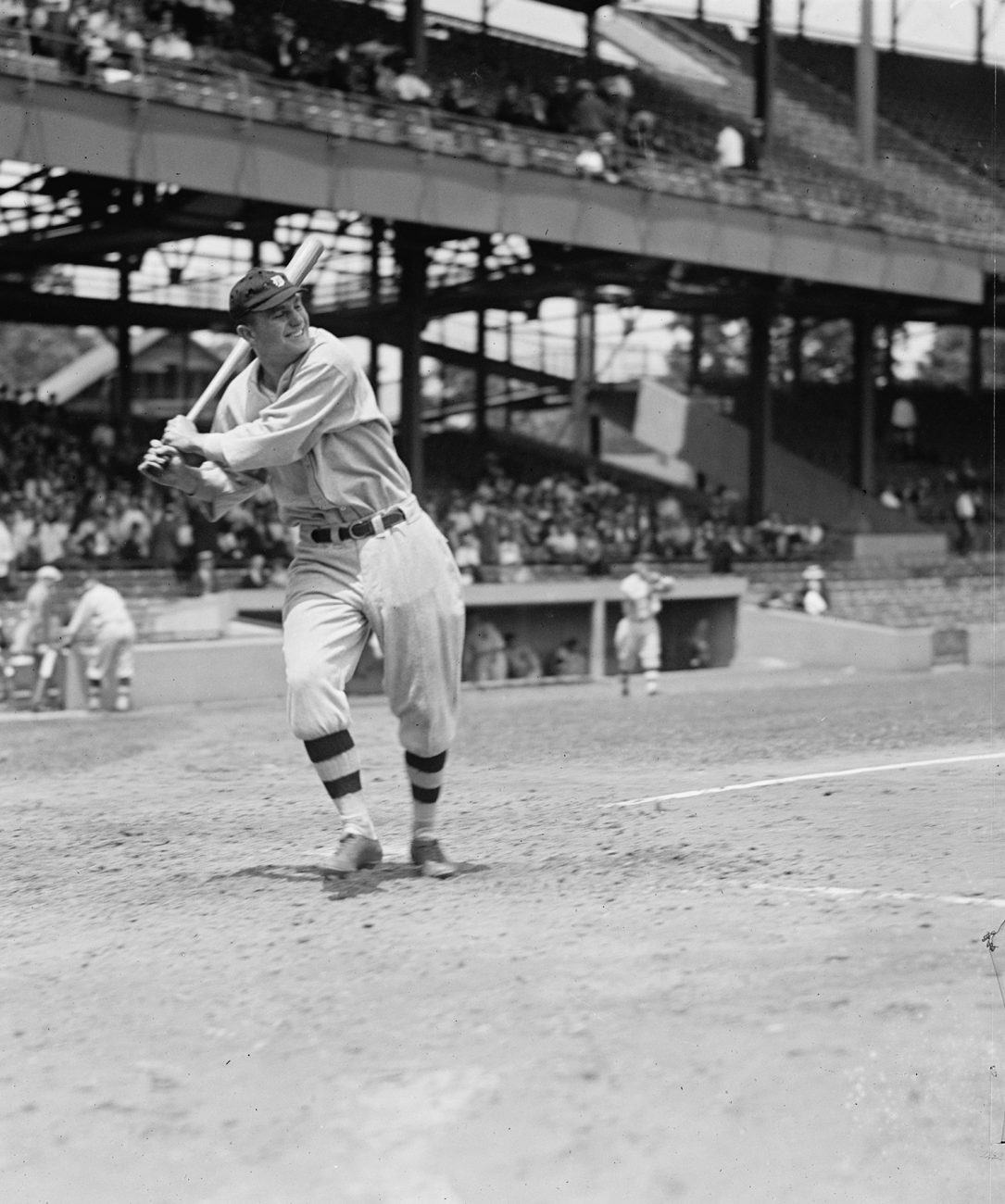
Alabama native Henry Emmett “Heinie” Manush (1901-1971) was a Major League Baseball (MLB) player known for being an excellent hitter and superb outfielder, primarily for the Detroit Tigers and the Washington Senators. He was inducted into the National Baseball Hall of Fame in 1964, the Alabama Sports Hall of Fame in 1972, and the Washington Nationals Ring of Honor in 2010. He was known also for his hot temper, which got him in trouble during the 1933 World Series.
Manush, commonly known by his nickname “Heinie,” was born in Tuscumbia, Colbert County, on July 20, 1901. (“Heinie” is a common German nickname for “Heinrich,” or “Henry.”) His father, George Manush, a carpenter and cabinet maker, immigrated to Alabama from Germany, and his mother, Catherine Rita Carls Manush, was from Wisconsin and the daughter of German immigrants. George and Catherine had eight children: seven sons and a daughter. Six of the seven sons played professional baseball, with Heinie, the youngest child, being the most successful.
In 1908, Heinie’s brother Frank, who was 18 years older than him, visited the Manush family home after he had been drafted by the Philadelphia Athletics. Heinie was enthralled with Frank’s baseball equipment and decided then that he also wanted to play professional baseball. Unfortunately, Frank performed poorly and never played in the major leagues again after 1908.
Manush attended Tuscumbia High School until his senior year, when he transferred to Massey Military Academy in Cornersville, Tennessee. After graduation in 1918, he moved to Iowa to help a brother with his plumbing company before moving to Los Angeles to play semiprofessional baseball. Manush then played minor league baseball for the Portland (Oregon) Beavers in 1920, the Edmonton (Canada) Eskimos in 1921, and the Omaha (Nebraska) Buffaloes in 1922.
Manush played for the Detroit Tigers from 1923-27. He played both left and center field, helping to establish one of the greatest outfields in major league history, with two other future Hall of Famers, Ty Cobb in center field and Harry Heilmann in right. Manush batted .334 as a rookie in 1923. He then slumped to .289 in 1924, primarily because Cobb tried to improve Manush’s hitting by urging him to bat scientifically, like he did, using kinetic force (such as shifting body weight towards the pitcher as the pitch comes), pitch recognition (such as watching the ball’s spin to determine whether it is a fast ball or curve), and studying pitchers’ tendencies (such as whether they usually throw a fastball or curve on the first pitch to a batter). Cobb then realized that Manush was a natural hitter who performed best when he did not think much about hitting and instead relied on his instincts and natural reactions. Manush’s best year was in 1926, when he won the batting title on the last day of the season, narrowly besting Babe Ruth by hitting .378. Manush was proud that he prevented Ruth from winning the “triple crown,” the coveted title when a batter has the highest batting average in the league, the most home runs, and the most runs batted in (RBIs). As Cobb grew older, Manush played more center field than left field. Manush married Elizabeth “Betty” Lloyd in 1928. They had three daughters.
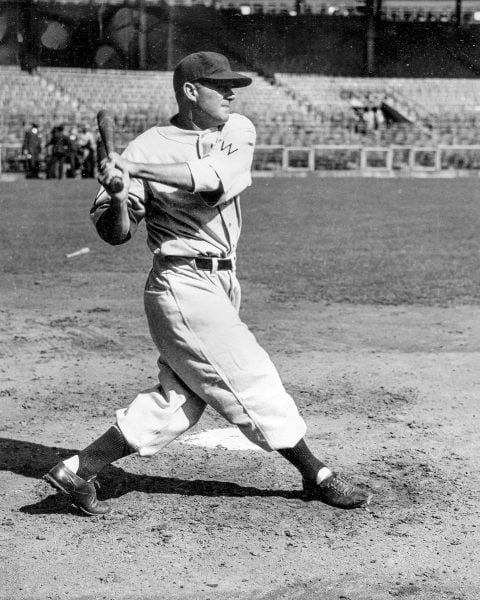
From 1928-30, Manush played for the St. Louis Browns, moving back to left field. He played for the Washington Senators from 1930-35 at a time when the team was a frequent contender for the American League pennant. In 1933, Manush batted .336 and led the Senators to the World Series against the New York Giants. Manush batted only .111 in the World Series and became frustrated with his poor performance. In game four, umpire Charley Moran called Manush out on a close play at first base. Manush became so irate that he not only yelled at Moran but grabbed the umpire’s elastic bowtie, pulled it away from Moran as far as he could, and then let go, causing the bowtie to snap back hard onto the umpire’s neck. Manush was ejected from the game and had to be physically restrained by his manager, Joe Cronin. The Senators lost to the Giants, four games to one. Manush was named to the All-Star team in 1934, his only appearance. Manush played for the Boston Red Sox in 1936, the Brooklyn Dodgers from 1937-38, and the Pittsburgh Pirates from 1938-39
Manush’s .330 lifetime batting average places him in the top 50 throughout all 150 years of MLB history. He had 2,524 hits (in the top 100) and 1,183 RBIs. He struck out only 345 times in 17 seasons (in the top 100). After Manush retired from the major leagues, he was a manager from 1940-44 in the Red Sox organization before managing in the minors for Virginia's Martinsville Athletics of the Carolina League in 1945. After giving up managing in the minor leagues, Manush worked as a scout for the Pittsburgh Pirates and the Washington Senators throughout the second half of the 1940s and during the 1950s. During this period, Manush also turned to golf as a hobby and won several city golf championships in Sarasota, Florida.
Heinie Manush was inducted into the National Baseball Hall of Fame in 1964, having been voted in by the Veterans Committee, 25 years after he retired. The Veterans Committee votes on baseball players who might have deserved to be selected for the Hall of Fame decades earlier but were overlooked. Manush was the first Alabamian to receive this prestigious honor and is the only player from Tuscumbia inducted thus far. Manush felt greatly honored by his inclusion and returned to Cooperstown, New York, for the next several years to honor the annual new inductees while his health permitted it. He also attended many Old-Timers’ Day games, when retired players play three innings of an exhibition game to entertain fans, because of his love for the game.
Manush died on May 12, 1971, in Sarasota after a bout with throat cancer, which left him unable to speak and able to communicate only by writing. Manush was buried in Sarasota Memorial Park. He did not live to see his induction into the Alabama Sports Hall of Fame in 1972, one year after his death. The Washington Nationals, Washington D.C.’s current MLB team, honored Manush in 2010 for his play with Washington Senators. One of the American League’s charter franchises, the Senators played in the city from 1901 to 1960.
The Tuscumbia community has frequently recognized Manush. The town’s high school baseball field was renamed Heinie Manush Field in 2002 and was rededicated in his honor in 2011. When the city held Heinie Manush Day festivities on April 18, 2021, the field was home to a baseball game played in his honor. Other Heinie Manush Day events included a memorial dinner and a tour of the 1885 historic house Manush's father built in Tuscumbia.