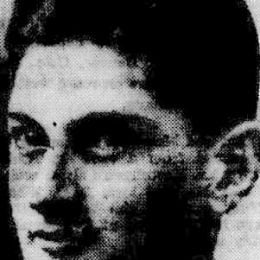
Joseph Gelders

Joseph Sidney Gelders (1898-1950) was a civil rights activist, labor organizer, and communist from Birmingham, Jefferson County. A member of one of Birmingham’s prominent Jewish families, Gelders was a U.S. Army veteran and University of Alabama physics professor. During the 1930s, he joined the Alabama Communist Party (ACP). He became the representative for the National Committee for the Defense of Political Prisoners (NCDPP), founded the National Committee for People’s Rights (NCPR), and co-founded the Southern Conference for Human Welfare (SCHW) and National Committee to Abolish the Poll Tax (NCAPT).
Gelders was born November 20, 1898, to Louis Gelders Sr. and Blanche Loeb in Birmingham, as the second of three children. Gelders’s father was a restaurateur and hotelier, and his mother was a community leader at Temple Emanu-El. Gelders’s brother, Louis Gelders Jr., was an architect, and his sister, Emma Gelders Sterne, was a noted author of children’s books. Gelders graduated from Birmingham’s Central High School in 1916 and then briefly attended the University of Alabama and the Massachusetts Institute of Technology. He left college to join the U.S. Army during World War I, enlisting on July 2, 1918, and serving as a corporal in its Coast Artillery Corps in Mobile, Mobile County, and Hampton, Virginia, until his honorable discharge on November 25, 1918.
Gelders married Esther Frank on November 19, 1918; the couple would have two daughters. The eldest, Margaret, would become a noted progressive activist and also work for a branch of the SCHW. By 1920, Gelders was working for his father at St. Clair Springs Hotel and serving as a scoutmaster for Birmingham’s Troop 15 of the Boy Scouts of America. Throughout the 1920s, he worked in a series of occupations, including as a steelworker at Tennessee Coal, Iron and Railroad Company (TCI). In 1926, he became Franklin Motor Car Company’s sales manager in Birmingham. After his father died on July 6, 1927, Gelders inherited a portion of the estate and purchased majority ownership of the car company’s Birmingham dealership. In August, Gelders was named the new general manager, but the business had failed by 1928.
In 1929, Joseph and Esther enrolled at the University of Alabama. Esther earned bachelor’s and master’s degrees in literature and became an instructor in the English department, and Gelders earned a master’s degree in physics and was appointed to a faculty position in 1931. By 1934, Gelders had incidentally discovered Soviet leader Joseph Stalin’s Foundations of Leninism in the university library and began widely reading Marxist literature. Stricken with stomach ulcers in 1934, Gelders sought treatment in a hospital in New Orleans. A nurse noticed his books and introduced him to communist William G. Binkley, who encouraged him to go to New York to meet CP officials. Rebuffed for being a middle class, or bourgeois, professor by CP leadership, Gelders returned to Birmingham and joined the Alabama Communist Party and was later accepted by the Communist Party of the United States of America (CPUSA). During this time, he wrote a folk song, “The Ballad of John Catchings,” which told the story of a Birmingham steelworker falsely imprisoned during a 1934 strike. The Great Depression had inspired a renewed wave of American labor radicalism. Though the ACP was always on the political fringe, the organization boasted around 1,000 dues-paying members at its peak.
In 1935, the Gelders family moved to New York. Esther financially supported the family as a real estate leasing agent, and Gelders became a secretary for the NCDPP, a CP organization founded along with the International Labor Defense (IDF) to provide legal assistance to the Scottsboro defendants. Gelders returned to Birmingham in 1936 to assist incarcerated communists.
Gelders’ advocacy did not go unnoticed by TCI officials and segregationists, much to his detriment. On September 23, 1936, Gelders received a letter from Jack Barton, whom Gelders was working to get released from the Bessemer City Jail for possession of communist pamphlets, warning him of an impending attack. That night, as Gelders was returning home from a CP meeting, he exited a bus at Phelan Park and was struck in the back of the head with a type of club known as a “blackjack.” He resisted but was overwhelmed by three men and forced to lay on the floor of a car with a straw hat covering his face. The car made another stop, adding an additional passenger who took leadership of the group. Stopping east of Maplesville, Chilton County, on State Route 22, the men forced Gelders out of the car. They then stripped Gelders to his underwear and beat him with a leather strap. Following the beating, Gelders was threatened with murder if he did not leave Alabama. The next morning, Gelders was discovered by a passer-by, who took him to the Central Alabama Hospital in Clanton, Chilton County. Gov. Bibb Graves announced a reward for the capture of the assailants and ordered a special investigation by the Alabama Highway Patrol. This investigation implicated Alabama National Guard officer Walter J. Hanna as the leader of the abductors, with evidence he worked as a secret anti-labor investigator for TCI. National Guardsman Dent Williams and White Citizens’ Council member James Leslie were also named as suspects. When the state failed to file charges, an investigator explained that TCI wielded too much power for the case to proceed.
Following his recovery, Gelders continued his political activism. In 1937, he merged the NCDPP with the dormant Southern Committee for People’s Rights to create the Birmingham-based National Committee for People’s Rights (NCPR). Although this organization continued to support the Scottsboro defendants and other incarcerated people, its rebranding limited direct association to the CP and its negative reputation. In 1938, Gelders was a founding member of the Southern Conference for Human Welfare (SCHW), an organization that advocated for New Deal liberalism to modernize the South. Gelders served as the chairman of the SCHW’s Civil Liberties Committee, which challenged disenfranchisement of poor White and Black voters. In 1941, Gelders and notable SCHW-activist Virginia Foster Durr created the National Committee to Abolish the Poll Tax (NCAPT), which pursued federal legislation against poll taxes. These organizations predated significant legislative reforms during the 1960s.
Gelders reenlisted in the U.S. Army on March 30, 1942, as a technical sergeant in the Western Signal Corps stationed in Sacramento, California. He served until his honorable discharge on July 24, 1944. After the war, Gelders became an engineering doctoral student at the Agricultural Experiment Station on the University of California, Davis campus.
Gelders continued to suffer from chronic injuries sustained during his 1936 abduction and died of a heart attack at the San Francisco Veterans Affairs Medical Center on March 1, 1950. Being a veteran, he was buried at Golden Gate National Cemetery in San Bruno, California.
Additional Resources
- Cauthen, Joyce. “Hearts of Steel: The Story of John Catchings, Joe Gelders, and a Ballad.” Tributaries: Journal of the Alabama Folklife Association, no. 4 (2001): 31–55. Montgomery, AL: NewSouth Books.