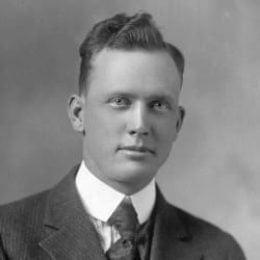
Frank Lawrence Owsley
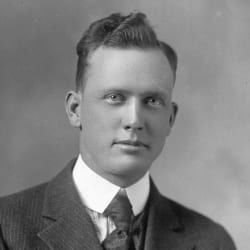
Alabama native Frank Lawrence Owsley (1890-1956) was a noted historian and professor in and of the American South. His prolific writings focused especially on the pre-Civil War and Civil War eras and included multiple works in which he defended southern politics, culture, and society, including a social history of the South that concentrated on the rural, middle-class yeoman farmers. His professorial career included time at Vanderbilt University and the University of Alabama, where he helped establish the graduate history departments and trained a number of future academics.
Owsley was born on a rural farm near Montgomery, Montgomery County, on January 20, 1890, to Lawrence Monroe Owsley and Annie Scott McGehee. He was the middle child of seven siblings. Owsley spent much of his early life on the large farm that his father owned and rented to Black sharecroppers. In the aftermath of the Civil War, sharecropping became a common practice throughout the South as White landowners with large land holdings rented out sections of their property to farm, initially primarily to Black men and women.
After attending local schools in Wetumpka, Elmore County, Owsley enrolled at Alabama Polytechnic Institute (API, present-day Auburn University). He graduated with a bachelor's degree in 1911 and then a master's degree in 1912. Aside from a short stint of military service, Owsley spent much of the next seven years teaching in public schools and at API. As the United States prepared to join World War I, Owsley attended officer training at Fort Oglethorpe in Georgia in 1917. However, his military career was cut short when he resigned due to a disability.
Owsley moved into higher education in 1919, when he worked at Birmingham-Southern College in Birmingham, Jefferson County, for a year. During that year, Owsley met his future wife, Harriett Chappell. The two were married on July 24, 1920, in Birmingham. The couple would have three children, though one died in infancy.
Following his brief stay in Birmingham, Owsley procured a job at Vanderbilt University in Tennessee, where he would work for the next 29 years. During his time, he founded the graduate history program and directed almost 40 dissertations. He also published multiple historical works centered on the American South and the Civil War, including States’ Rights in the Confederacy (1925), Defeatism in the Confederacy (1926), King Cotton Diplomacy (1931), and Plain Folks of the Old South (1949). His early books pushed back on many of the prevailing narratives of the time that the Confederacy had lost due to the United States’ technological and numerical superiority. Rather, Owsley argued that the Confederacy lost the war due to the selfish actions of individual Confederate states that undermined the broader military efforts. In King Cotton Diplomacy, Owsley examined Confederate diplomacy in France and England during the war and argued that, despite their reliance on southern cotton, neither country wanted to risk backlash from the United States for supporting the Confederacy. In researching the book, Owsley traveled to England and France on several occasions to look at archival material. His last work, Plain Folks of the Old South, explored the rural middle class of the pre-Civil War South, arguing that this group constituted the majority of southerners and that the Old South was a democracy supported by small farmers, as opposed to the more common narrative by historians that wealthy enslavers dominated political power in the Old South. In researching this early social history, Owsley pioneered the use of U.S. Census records as a historical resource.
While groundbreaking in many respects, Owsley’s book faced criticism for presenting an idealized vision of the antebellum South and defending the Confederacy. Owsley had faced similar criticism for an early collaboration he participated in with a group of 12 other southerners connected to Vanderbilt; the group was known variously as the Agrarians, Southern Agrarians, and the Nashville Agrarians for their connection to that city. Their collection of essays was published as I’ll Take My Stand: The South and the Agrarian Tradition. The work was dedicated to another Alabamian, Walter Lynwood Fleming, and included work by Andrew Lytle, who had connections to Alabama. It defended the “Old South” and the southern way of life. Owsley’s essay, “The Irrepressible Conflict,” in one instance described Black people as half-savages and criticized the northern states for trying to impose their culture upon an agrarian South. Other historians at the time criticized the work for downplaying the violence of slavery, over-idealizing the antebellum South, and contributing to the Lost Cause narrative of the Civil War, which romanticized the Confederacy and ignored the role of slavery in the Civil War.
Owsley included many of these same themes in a fourth-grade textbook he co-authored with John Craig Stewart and Gordon T. Chappell in the early 1950s titled Know Alabama. The textbook portrayed plantation life as a joyous time and enslaved individuals as generally happy. It also portrayed the Confederacy as a crusade for states’ rights, saw Confederate soldiers as brave heroes, glorified early Ku Klux Klan members as defenders of the South, and portrayed Reconstruction as a terrible time when northerners, Republicans, and Black people corrupted the state. This textbook would serve as the primary history text for fourth graders, White and Black, across the state from the mid-1950s into the 1970s. It has since been denounced by contemporary Alabama historians.
After leaving Vanderbilt in 1949, Owsley began working at the University of Alabama, where he established the university’s graduate history program. While in England as the Fulbright Exchange Professor at Cambridge University, Owsley suffered a heart attack and died on October 21, 1956, at the age of 66. His remains were transported back to Alabama, where he is now buried in Tuscaloosa, Tuscaloosa County.
After his death, his wife wrote a memoir of his life, Frank Lawrence Owsley: Historian of the Old South. A Memoir with Letters and Writings of Frank Owsley, published in 1990. Their son Frank Lawrence Owsley Jr. followed in his father’s footsteps, although becoming a scholar of War of 1812 and the Creek War of 1813-14. He would teach at Auburn University for many years, retiring in 1995. He died in 2013.
The Southern Historical Association gives out the “Frank L. and Harriet C. Owsley Award” for a distinguished book on southern history every even numbered year. The University of Alabama College of Arts and Sciences awards the “Frank Owsley Memorial Scholarship for Superior Competency in American History” to a graduate student on a yearly basis.
Works by Owsley
States’ Rights in the Confederacy (1925)
Defeatism in the Confederacy (1926)
King Cotton Diplomacy (1931)
Plain Folks of the Old South (1949)
The South, Old and New Frontiers (1949)