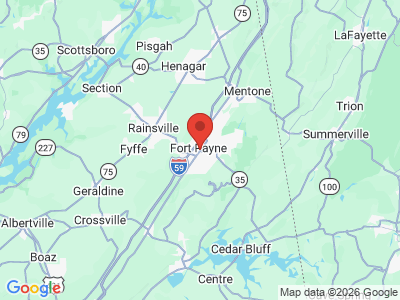
Fort Payne Opera House

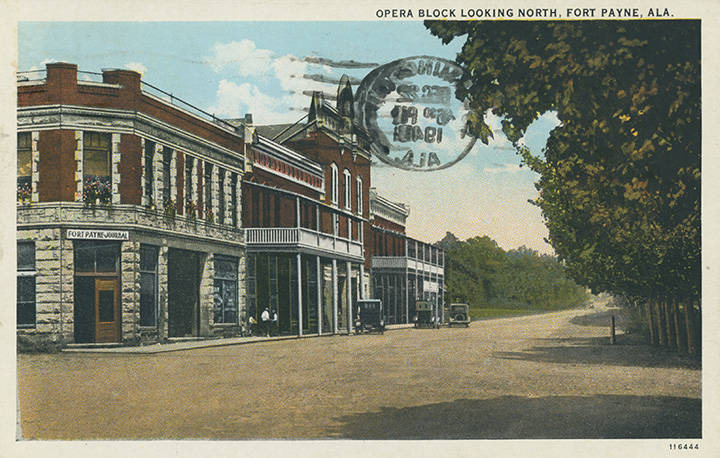
The Fort Payne Opera House is the oldest in-use theater in the state. Built during the city’s height in the late nineteenth century, it has since served a wide range of functions. During the 1960s, when the building was falling into disrepair, it was restored by a local nonprofit, Landmarks of DeKalb County, Inc. The Opera House is open for tours and hosts a diverse range of entertainment to honor its history.
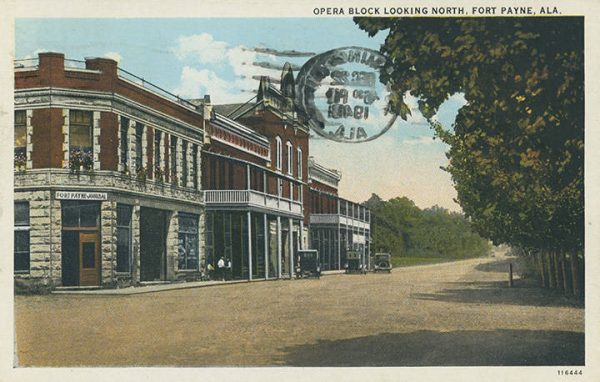
The Opera House no longer boasts the frescoes that once decorated the outer walls and the notable central arch atop it seen in old photos. Its Victorian influence though, is still visible today in the building’s interior, with its high ceiling, first floor and two-tiered balcony (able to seat 448 people), and its decorated lobby. It was constructed in 1889, the same year that Fort Payne was officially incorporated as a city and was undergoing an economic expansion, or “boom.” The Fort Payne Coal & Iron Company, composed widely of New England “boomers” (a term used to describe investors who contributed to the rapid growth of cities), had conceived of the building as one of many selling points for future investors. It was promoted in advertisements alongside other new amenities, such as electrical and water systems, with the intention of portraying Fort Payne as an ideal New England city in the South.
Wendell P. Rice, who served on the board of directors for the Coal & Iron Company, is credited with building the iconic Opera House. In an 1890 edition of the Fort Payne Herald, the new building is referred to as the “Rice Opera House,” and his name was featured within the building’s original arch. The new theater was seen regularly in early advertisements, where it was proclaimed to be the future home of the nation’s most talented actors, as well as a host to lectures for intellectual improvement during the winter months.
The official grand opening of the Opera House was held on September 16, 1890, with a performance of playwright Charles Hoyt’s comedic play A Tin Soldier. Following this performance, it would go on to host many shows during the short-lived boom (1889-92). These performances included Herminie, featuring playwright and actor William Redmund, operas performed by Clara Louise Kellogg, the leading prima donna soprano of the grand opera houses in Europe, and performances by Milton Nobles, who was then considered the greatest actor on the American stage.
Despite its popularity, the economic collapse of 1892 saw the city suffer and brought a temporary end to these grand performances. The Opera House would, however, go on to play many different roles in the city. It temporarily hosted students from North Alabama College when its school building burned down in 1904. (Formerly the Fort Payne Academy for Young Ladies, it opened in 1889 and closed in 1907). It housed various businesses on its first floor and would even briefly have a return to live performances in the early 1900s when S. T. Kimble, a showman from Chicago, used it as a rehearsal space for traveling theatrical troupes. Kimble made alterations to the building, installing its first electric curtain, but would only entertain one group of performers before abandoning his plans.
Following Kimble, the Opera House did not see a return to entertainment until 1914, when it was purchased by Leona Davis, one of the county’s first businesswomen, who converted the first floor into a movie theater. In 1918, she installed a gasoline-powered electrical generator, and performances aired once more in the form of silent films. In 1928, the theater showed the first film with sound, but not audible dialogue, The Jazz Singer. The next year, both Ukelele Ike and Mexicali Rose became the first two films shown that offered both recorded dialogue and sound.
During the Great Depression, Davis leased the Opera House to two different men. The first was the owner of the Gadsden Theatre, a man named Sansom, who filled every seat during his first showing but was unable to keep the theater going through the heights of the Depression. His projectionist, Garnett Stancil, assumed his lease in 1932 and would spend the next three years keeping the theater afloat, even consigning himself to living temporarily in the building with F.L. Griffin, a former showman who helped Griffin promote the events. During this period, performances were kept affordable for the public, who could scarcely afford the 5 and 10 cent admission, through the introduction of special potato days, egg days, and even bottlecap days, when the entry fee was waived for these selected items.
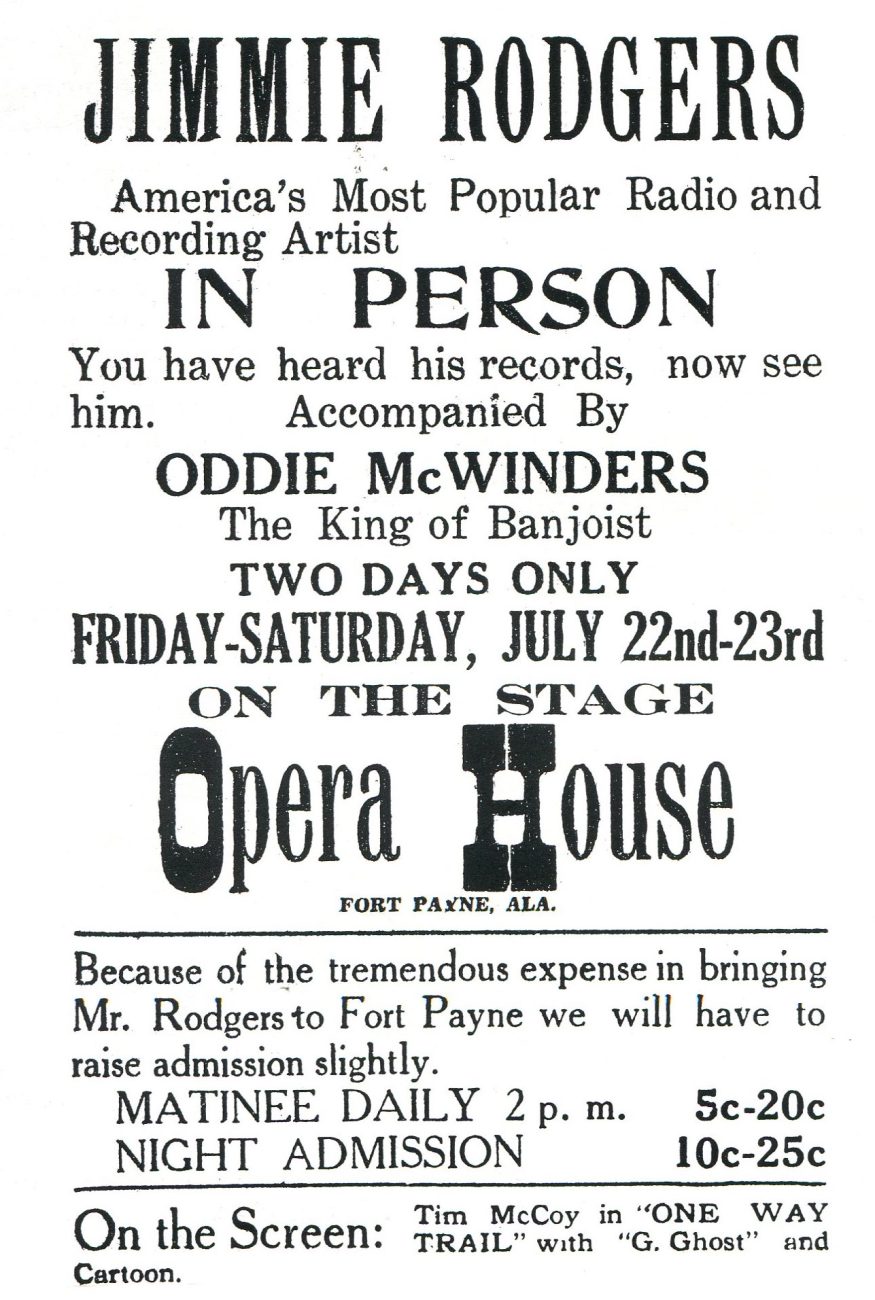
Despite this financial hardship, Stancil and Griffin still managed to secure well-known acts for the Opera House, including country music star Jimmie Rodgers and banjo player Oddis McWinder. They would also host a few unconventional acts, including a performance in 1934 consisting of a man lying in a casket in the lobby. His depiction was purportedly so realistic that owner Leona Davis staunchly objected to the performance; despite her objections, the show went on.
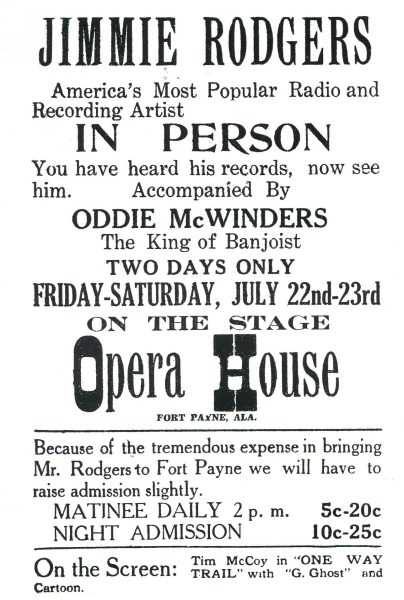
Alongside these unusual acts, popular “talking” films continued to be shown, but by 1935 the Opera House Theatre was in competition with other theaters in the area. Ultimately it could not compete, and The Lady in Red and a film starring actor Charles Frederick Gebhart, more commonly known as Buck Jones, were among the last shown before it shut its doors on October 1, 1935.
In the 1940s, an upholstery business briefly operated on the first floor before the building transitioned into a warehouse. Following this, it would continue to fall into disrepair until 1969, when it was selected as the local headquarters for Alabama’s 150th, or sesquicentennial, celebrations. This selection brought renewed public interest to the historic building and led to the formation of Landmarks of DeKalb County, Inc., that same year to preserve it.
Following an impressive membership drive, the new nonprofit quickly secured the funds needed to purchase the building, and on October 2, 1969, Davis signed the deed to Landmarks, ending 53 years of ownership. The decades following this purchase would see multiple renovations undertaken by Landmarks to restore the building. Local supporters generously donated funds as well as many supplies and furnishings, including the curtain and seating from the Temple Theatre in Birmingham (a 1980s fire in the adjacent building would see smoke damage to the curtain, which was replaced with its current red curtain that was donated by the band Alabama). Other improvements undertaken over the years include, but are not limited to, new flooring, stage lights, upgrades to the electric wiring, and a sound system.
From the Landmarks Players, a theater group of the 1970s and 1980s, to the musical performances and films of today, the Opera House continues to serve its original purpose. It hosts live musical performances, plays, and movie nights showcasing a range of films from the past to the present. In addition to performances, it has also seen a return to hosting lectures for “intellectual improvement” and hosts new events for the holidays, including photos with Santa at Christmas and trick-or-treating at the Opera House for Halloween. It is located at 510 Gault Avenue North in the Opera House block.
Additional Resources
- The Heritage of DeKalb County Alabama, Volume 2. Clanton, Ala.: Heritage Publishing Consultants, 2008.
- Howard, Elizabeth S., ed. The DeKalb 150 Legend. Landmarks of DeKalb County, Inc., 1986.
- Howard, Elizabeth S. and James Ray Kuykendall, eds. Landmarks 30th Anniversary Legend (1969-1999). Landmarks of DeKalb County, Inc., 1999.