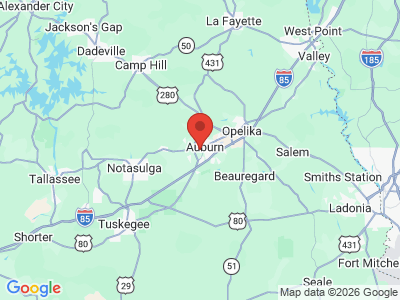
Auburn University Men's Basketball
 Neville Arena
The Auburn University men's basketball team played its first game on January 19, 1905, only 14 years after pioneering sports coach James Naismith founded the sport. Since that time, the team has enjoyed occasional stretches of success with a number of well-known players such as Charles Barkley and Chuck Person. Overall, however, the team has not had the success of better-known southern basketball teams such as the University of Kentucky. The Auburn Tigers have made the National Collegiate Athletic Association (NCAA) Basketball Tournament 14 times and have won three Southeastern Conference Tournaments. The 2018-19 and 2024-25 seasons have been their most successful. In 2019, Auburn advanced to the NCAA Final Four, the first ever appearance for any men’s program in the state; the team repeated the feat in 2025. In 2026, however, the team became the first from the state to win the National Invitation Tournament.
Neville Arena
The Auburn University men's basketball team played its first game on January 19, 1905, only 14 years after pioneering sports coach James Naismith founded the sport. Since that time, the team has enjoyed occasional stretches of success with a number of well-known players such as Charles Barkley and Chuck Person. Overall, however, the team has not had the success of better-known southern basketball teams such as the University of Kentucky. The Auburn Tigers have made the National Collegiate Athletic Association (NCAA) Basketball Tournament 14 times and have won three Southeastern Conference Tournaments. The 2018-19 and 2024-25 seasons have been their most successful. In 2019, Auburn advanced to the NCAA Final Four, the first ever appearance for any men’s program in the state; the team repeated the feat in 2025. In 2026, however, the team became the first from the state to win the National Invitation Tournament.
Known in 1905 as Alabama Polytechnic Institute, the school's Tigers defeated Tulane 27-7 in their first game. The team was coached by Mike Donahue, who was also the head football coach, and Frank Jones was the captain. Auburn went 5-1-1 during that debut season. A 14-14 tie against the Birmingham Athletic Club is the only tie game in the history of the team. As did most college basketball teams during the early 1900s, Auburn usually played fewer than a dozen games each season and often competed against YMCA teams, athletic clubs, and even high schools. Donahue remained the head coach through the team's first 16 seasons. He retired after leading the Tigers to a victory over Clemson University in the first round of the inaugural Southern Conference Tournament in 1921, before losing to the University of Georgia in the second round.
Auburn's first outstanding team was the 1927-28 squad, which went 20-2. Both losses were by one point to the University of Mississippi, with the second loss occurring in the championship game of the Southern Conference Tournament. Four years later, the Tigers produced a 12-3 team led by forward Jack Stewart, who became the first Auburn player chosen to a post-season All-America team honoring the best college players in the nation.
 Auburn v. Florida, 1946
From 1934 to 1942 and again in 1946, the Tigers' head basketball coach was Ralph "Shug" Jordan, who would later become the most successful football coach in Auburn history. Jordan went 95-75 in his 10 seasons, including a 41-15 record from 1936 to 1939. In 1941, Earl "Shag" Hawkins became Auburn's first scholarship basketball player. Proceeds from a five-cent soft-drink vending machine in the school's Alumni Gym went toward paying for Hawkins's scholarship. The investment paid off, as Hawkins was the first Auburn player named to the All-Southeastern Conference (SEC) tournament team and the first to lead the SEC in scoring (15.3 points per game in 1940-41).
Auburn v. Florida, 1946
From 1934 to 1942 and again in 1946, the Tigers' head basketball coach was Ralph "Shug" Jordan, who would later become the most successful football coach in Auburn history. Jordan went 95-75 in his 10 seasons, including a 41-15 record from 1936 to 1939. In 1941, Earl "Shag" Hawkins became Auburn's first scholarship basketball player. Proceeds from a five-cent soft-drink vending machine in the school's Alumni Gym went toward paying for Hawkins's scholarship. The investment paid off, as Hawkins was the first Auburn player named to the All-Southeastern Conference (SEC) tournament team and the first to lead the SEC in scoring (15.3 points per game in 1940-41).
The Tigers enjoyed some of their greatest success during the 1950s and early 1960s under head coach Joel Eaves. Auburn won 68 percent of its games (213-100) during that 14-year span and went 106-28 during Eaves's final six seasons. The Auburn Memorial Coliseum basketball arena was renamed in his honor in 1987. (The stadium was renamed Beard-Eaves Coliseum in 1993, in honor of Jeff Beard, Auburn's athletic director from 1951-72.) His 1957-58 team went 16-6 and was ranked number 16 in the final Associated Press top-20 poll, marking the first time the Tigers had finished a season in the national rankings. The following season, Auburn started 19-0 and was ranked number 2 in the nation before losing two of its final three games and finishing ranked number 8. Both those teams were led by forward Rex Frederick, who still holds school records for the most rebounds in a game (27) and season (325) and for his career rebounding average (14.3 per game).
The Tigers won their first SEC championship in 1959-60 with a team that was referred to as "Snow White and the Seven Dwarfs" because Eaves had white hair and none of his top seven players that season was taller than 6-foot-4. Auburn closed the season with nine consecutive victories, including a one-point upset of national powerhouse Kentucky, to finish with a 19-3 record.
Eaves retired in 1963 and was replaced by Bill Lynn, whose teams went 130-124 in 10 seasons. Despite the mediocre record, Lynn's teams did produce two of the top scorers in program history in forward Lee DeFore and guard John Mengelt, who would go on to a 10-year career in the NBA. DeFore was the first Auburn player to reach 1,000 points in his career, finishing with 1,386 points and capped by a senior season in 1966 during which he averaged 23.7 points per game, led the SEC in scoring, and was named to the All-America team. By the time he left Auburn, DeFore had broken nine team scoring records. Most of those records were broken a few years later by Mengelt, who was a two-time All-America selection in 1969 and 1970. He scored 1,920 points over three seasons (Mengelt played before freshman became eligible to play on varsity teams in 1972), a record at the time. On Feb. 14, 1970, Mengelt scored 60 points against the University of Alabama, a school record for most points in a game that still stands.
The Tigers welcomed two more high scorers (and future NBA stars)—guard Eddie Johnson and forward Mike Mitchell—to campus in the mid-1970s. They are the only four-time All-SEC selections in program history. Johnson averaged 19.5 points per game throughout his career and finished just 12 points shy of becoming the first Auburn player to reach 2,000 points. Mitchell ended his career a year later, finishing with 2,123 points, a record that stood until the mid-1980s. He averaged 20.4 points and 9.6 rebounds per game for his career. His 996 career rebounds remain the school record. Despite the individual success of Johnson and Mitchell, Auburn had only two winning seasons in the five-year span during which they played, three of those years together, and went 42-48 in SEC play.
In 1978, Paul Lambert was hired from Southern Illinois to become Auburn's 15th head basketball coach. But before he could even hold his first practice, Lambert died in a hotel fire in Columbus, Georgia. For many years, the Paul Lambert Memorial Trophy for leadership was presented at the annual Auburn basketball awards banquet. It was later also named for Tommy Joe Eagles who coached from 1989-94.
 Charles Barkley at Auburn
In the wake of the tragedy, Auburn turned to a little-known head coach from East Tennessee State, Sonny Smith. The Tigers failed to produce a winning record in Smith's first four seasons, and they went 15-13 in his fifth. Beginning with the 1983-84 season, however, Auburn qualified for the NCAA national championship tournament five consecutive years. In 1986, the Tigers were only one victory away from advancing to the NCAA National Semifinal (Final Four) of the tournament, but they lost to eventual tournament champion University of Louisville 84-76.
Charles Barkley at Auburn
In the wake of the tragedy, Auburn turned to a little-known head coach from East Tennessee State, Sonny Smith. The Tigers failed to produce a winning record in Smith's first four seasons, and they went 15-13 in his fifth. Beginning with the 1983-84 season, however, Auburn qualified for the NCAA national championship tournament five consecutive years. In 1986, the Tigers were only one victory away from advancing to the NCAA National Semifinal (Final Four) of the tournament, but they lost to eventual tournament champion University of Louisville 84-76.
Smith coached several of the greatest players in Auburn basketball history. Topping that list is Charles Barkley, a 6-foot-4-inch power forward dubbed "The Round Mound of Rebound." He set several Auburn records at the time, including career shooting percentage (.626) and blocked shots (145) and later won Olympic gold medals in 1992 and 1994. Among the players on Smith's 1985-86 team that nearly made the Final Four were two future first-round NBA draft picks: forward Chuck Person and forward Chris Morris. Nicknamed "The Rifleman," Person holds Auburn's scoring record with 2,311 points. Morris was a two-time All-SEC player ranked in the top-10 in Auburn history in points (1,717) and rebounds (860).
Smith left Auburn after the 1988-89 season, and the Tigers went 10 years without making an appearance in the NCAA Tournament. Cliff Ellis took over from Tommy Joe Eagles in 1994. His 1998-99 team, which went 29-4 (then a record for most victories in program history), won the regular-season SEC championship, and was ranked as high as number two nationally. Ellis was named the national Coach of the Year, and forward Chris Porter won the SEC Player of the year Award. The Tigers went 24-10 the following season, a season marred by pre-season All-American Porter being dismissed from the team during the season for accepting money from a sports agent.
 Auburn v. Alabama, 2009
The Tigers later appeared in the NCAA Tournament in 2003, when they advanced to the third round (Sweet 16) after upsetting eighth-ranked Wake Forest, finally losing to eventual national champion Syracuse 79-78. Ellis was replaced after the 2003-2004 season by former University of Tennessee at Chattanooga coach Jeff Lebo. Auburn made it to the postseason National Invitation Tournament (NIT) in 2009 after a 15-17 season. In the NIT, the Tigers were upended in the quarterfinals by Baylor University 72-74. Under six seasons with Lebo, Auburn posted mediocre records, 96-93 overall, and he was replaced in 2010 by University of Texas at El Paso coach Tony Barbee. Auburn opened its new 9,121-seat Neville Arena in 2010, replacing the Beard-Eaves-Memorial Coliseum, which had been the Tigers home court since 1969.
Auburn v. Alabama, 2009
The Tigers later appeared in the NCAA Tournament in 2003, when they advanced to the third round (Sweet 16) after upsetting eighth-ranked Wake Forest, finally losing to eventual national champion Syracuse 79-78. Ellis was replaced after the 2003-2004 season by former University of Tennessee at Chattanooga coach Jeff Lebo. Auburn made it to the postseason National Invitation Tournament (NIT) in 2009 after a 15-17 season. In the NIT, the Tigers were upended in the quarterfinals by Baylor University 72-74. Under six seasons with Lebo, Auburn posted mediocre records, 96-93 overall, and he was replaced in 2010 by University of Texas at El Paso coach Tony Barbee. Auburn opened its new 9,121-seat Neville Arena in 2010, replacing the Beard-Eaves-Memorial Coliseum, which had been the Tigers home court since 1969.
Auburn had four losing seasons with Barbee, who was replaced by successful University of Tennessee coach Bruce Pearl, who was under a cloud for NCAA recruiting violations. After two sub-par seasons, Auburn returned to the win column in 2016-17 with an 18-14 overall record, but went 7-11 in the SEC. In fall 2017, assistant coach and former star player Chuck Person was indicted in a wide-ranging bribery scandal involving numerous NCAA basketball programs and was fired by Auburn; he later pleaded guilty. (In December 2021, the NCAA Committee on Infractions suspended Coach Pearl for two games that year and placed the basketball program on probation until 2025, and also vacated 12 victories.) During the 2017-18 campaign, Pearl and the Tigers rebounded with a 26-8 record and went 13-5 in the SEC, tying Tennessee for the best conference record. Auburn's successful run in the SEC Tournament was ended, however, by in-state rival Alabama 81-63. Auburn then lost to Clemson 84-53 in the second round of the NCAA Tournament.
 AU Coach Bruce Pearl
In the 2018-19 season, Auburn went 30-10 overall. The Tigers were highly ranked in preseason polls but struggled against conference opponents, 11-7. The team rallied, however, and took its second SEC Tournament with an 84-64 win over Tennessee and earned a second consecutive bid in the NCAA Tournament. The Tigers continued their winning streak, dominating perennial favorites Kansas (89-75) and North Carolina (97-80) before defeating conference rival Kentucky in overtime (77-71) to advance to the school's first ever Final Four appearance against Virginia. Auburn overcame a slow start and kept the game close, but Virginia handed Auburn a 63-62 loss in the final seconds. Virginia went on to defeat Texas Tech in the final.
AU Coach Bruce Pearl
In the 2018-19 season, Auburn went 30-10 overall. The Tigers were highly ranked in preseason polls but struggled against conference opponents, 11-7. The team rallied, however, and took its second SEC Tournament with an 84-64 win over Tennessee and earned a second consecutive bid in the NCAA Tournament. The Tigers continued their winning streak, dominating perennial favorites Kansas (89-75) and North Carolina (97-80) before defeating conference rival Kentucky in overtime (77-71) to advance to the school's first ever Final Four appearance against Virginia. Auburn overcame a slow start and kept the game close, but Virginia handed Auburn a 63-62 loss in the final seconds. Virginia went on to defeat Texas Tech in the final.
Following a disappointing 2020-21 campaign, the Tigers bounced back in the 2021-22 season posting a 22-1 record at one point, a 19-game winning streak, and spending several weeks ranked number one in the nation. The team faltered late in the season, though, losing in the first round of the SEC tournament and in the second round of the NCAA tournament to the University of Miami Hurricanes 79-61, having been outplayed for much of the game. The following season, the Tigers fell against Arkansas in the second round of the SEC Tournament but rallied to defeat Iowa in the first round of the NCAA tournament. Auburn then lost in the second round to regional number one seed Houston 81-64 and finished with a 21-13 record.
The Tigers had a fairly successful 2023-24 season. They won their third SEC Tournament, defeating Florida 86-67 in the final. The Tigers then entered the NCAA Tournament as fourth regional seed but lost in the first round to Ivy League Tournament champion Yale 78-76. The Tigers finished the season with a 27-8 record. During the season, forward/center Johni Broome made the notable list of NCAA players who have scored 2,000 points and made 1,000 rebounds, which include his games played at Morehead State.
In the 2024-25 campaign, Auburn regrouped and enjoyed eight straight weeks as the number one team in the nation but lost in the SEC Tournament to eventual champion Florida. The team entered the 2025 NCAA Tournament as the overall top seed. It then cruised through the tournament against Alabama State, Creighton, and Michigan State before losing in its second Final Four appearance to SEC rival and eventual champion Florida 79-73. The Tigers ended the season with a 32-6 record, the most wins in program history up to that point, and forward Broome was named first team All American, SEC Player of the Year, and The Sporting News men’s player of the year.
After 11 seasons, in September 2025 Coach Pearl stepped down with a 234–125 record at Auburn, making him the winningest coach in program history so far. His son, assistant coach Steven Pearl, was named his replacement.