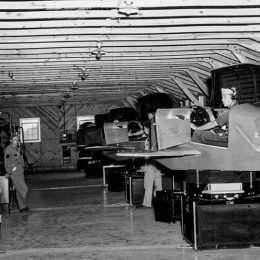
Allied Flight Training in Alabama during World War II

During World War II, U.S. Army Air Forces (AAF) operated five flight schools in Alabama that played a significant role in training nearly 6,800 British and 2,900 French cadets (and to a lesser degree, Chinese and Mexican cadets) during the war. The Alabama schools included the Alabama Institute of Aeronautics, Inc., at Hargrove Van de Graaff Field (present-day Tuscaloosa National Airport) in Tuscaloosa, Tuscaloosa County; Gunter Field and Maxwell Field in Montgomery, Montgomery County; Craig Field in Selma, Dallas County; and Napier Field in Dale County.
Overall, the AAF opened more than 500 flight schools and contracted with a number of civilian flight schools across the country to provide flight and technical training to American and international flight cadets. Most of the pilots were from Britain, which sent over 12,561 trainees, or 59 percent of the cadets, followed by France (4,113; 19 percent), and China (2,238; 10.5 percent). The remaining 2,388 trainees (11.2 percent) came from 28 other countries. In total, the AAF trained more than 21,300 pilots from 31 different countries using funds authorized by the March 1941 Lend-Lease Act. By the end of the training program in Alabama in November 1945, 78 RAF cadets and 20 FFAF cadets had died in training accidents, all of whom were buried in a special section of Oakwood Cemetery in Montgomery.
Training the British

When World War II began, Britain's Royal Air Force (RAF) had limited resources to provide flight training for new pilots. The RAF was beset by German air attacks in the summer and fall of 1940 (known collectively as the Battle of Britain), a scarcity of airfields, aircraft, and pilots for home defense, and overcast weather. Additionally, the British government was still developing its extensive flight training program, the British Commonwealth Air Training Plan (BCATP), that would eventually include flight schools in Canada, Australia, Rhodesia (now Zimbabwe), and South Africa and train more than 160,000 air crew. By late 1940, however, the British government was running out of hard currency to purchase war materiel and services. As a result, the government turned to the United States in early 1941 to provide facilities to train RAF flight crews, funded by the recently passed Lend-Lease Act.
In March 1941, U.S. officials agreed to provide up to one-third of the capacity of the AAF’s flight schools to train up to 4,000 RAF pilots annually. Earlier, on July 8, 1940, the AAF had established a flight training facility at Maxwell Field called the Southeast Air Corps Training Center (SEATC) (renamed the Eastern Flying Training Command in July 1943), to conduct the flight training program’s three phases (primary, basic, and advanced) to American (and later international) flight cadets in the southeastern United States. Between June 1941, when the program welcomed its first British cadets, and September 1942, when the RAF officially ended the program, the RAF sent more than 7,180 RAF cadets to Halifax, Nova Scotia, where they were processed at a personnel center in Canada and then sent by train to primary schools in the southeastern United States.

The SEATC oversaw 12 flight schools in Alabama, Georgia, and Florida to conduct the AAF flight training program for the soon-to-arrive RAF cadets. The Alabama schools consisted of the civilian Alabama Institute of Aeronautics, Inc. at Van de Graaff Field, for primary training; Gunter Field, for basic training; and Craig Field, Napier Field, and Maxwell Field, for advanced single-engine training.
As the program progressed, the primary and basic schools experienced an increasing number of eliminations, or “wash outs,” some of whom were allowed to re-enroll in the respective schools, although the majority returned to Britain to serve in other military specialties. In August 1942, the RAF notified the SEATC that it would terminate its flight training program in the United States with the start of the September class, which would graduate on February 28, 1943, as the RAF's BCATP had begun to produce large numbers of flight officers at its facilities in Canada, New Zealand, and other countries in the British Commonwealth.
When the last class with RAF cadets graduated on February 28, 1943, the AAF advanced schools had graduated a total of 4,100 cadets, 53 percent of those who came to the United States for flight training, of which one-third received an officer’s commission. The Van de Graaff Field primary school had graduated 1,273 RAF cadets, and the Gunter Field basic school had graduated 2,114 cadets. The advanced single-engine school at Craig Field had graduated 1,392 cadets; the Maxwell Field advanced single-engine school, which closed in August 1942, 433; and the advanced school at Napier Field, 1,340 RAF cadets. In addition, the Flight Instructor’s School at Maxwell had graduated 457 RAF advanced school graduates to serve at flight schools, where they could help alleviate the shortage of flight instructors during the early war years as the AAF expanded its flight training program.
Training the French

Within three months after RAF flight training ended in early 1943, American and British military forces had cleared North Africa of Axis forces. Gen. Charles de Gaulle, head of the Free French government-in-exile in Britain, now had general control of French North Africa and asked the AAF to train pilots for its small but growing air force. Twelfth Air Force in North Africa had already begun training Frenchmen as pilots and aircraft mechanics and proposed a more formal training program in the United States for French flight cadets. As a result, the SEATC designated five flight schools in Alabama, Georgia, and South Carolina to train French pilots and three other schools for enlisted technical training. The Alabama schools were the civilian primary school at Van de Graaf Field (until September 1944), the basic school at Gunter Field, and the advanced single-engine schools at Craig Field.
The French cadets arrived in the Southeast in small groups and went to Craig Field for processing and a pre-flight program. When the number reached 100 cadets, they were put in a flight class. Between June 1943 and November 1945, when the U.S. government terminated the French flight training program, more than 2,000 French flight cadets had arrived in the United States, of which 1,351 completed the three-phase flight training program. In addition, AAF schools trained 253 bombardiers, 74 navigators, and 955 gunners. Between June 1943 to September 1944, when the AAF transferred French flight training to the Hawthorne School at Orangeburg, South Carolina, the primary school at Van de Graaff Field trained 938 French flight cadets. Gunter Field's basic school had trained 1,300 French cadets by the end of the war. In addition, Craig Field graduated 650 French cadets from the advanced single engine school.

The language barrier was the most significant problem for the FFAF training program. The French flight cadets did not speak or read English, and most of the American instructors did not speak or understand French. The training center had to translate all of its manuals and aids into French, and improving the accuracy of those translations was a continual process. The program scoured the command for French-speaking classroom and flight instructors but could not provide enough with sufficient fluency in European French. As a result, the flight schools hired translators to assist the classroom instruction for the French students. For actual flight lessons, the flight instructors and French students developed a system of hand gestures so that the instructors could communicate to the student in the aircraft the maneuver he was to perform.
Local Impact
During the war, the local communities near the flight schools in Alabama welcomed the RAF and FFAF cadets. The cadets participated in military parades on their respective installations, whose commanders often allowed local residents to view them on their installations and in the local communities. Local civic organizations and private individuals regularly invited both American and British and later the French cadets to local social activities. Some of the French cadets visited Birmingham because it had a larger French-speaking community than Montgomery. A number of RAF and FFAF cadets married local women and, after the war, some returned to live in the United States.
By the end of World War II, the flight training of RAF and FFAF flight cadets in Alabama and throughout the Southeast significantly contributed to the Allied war effort, especially for France. Approximately 50 percent of the postwar French Air Force pilots had graduated from AAF flight schools. These wartime RAF and FFAF flight training programs also laid the groundwork for the far more extensive U.S. Air Force flight and technical training and professional military education programs, including those at Air University, Maxwell Air Force Base, that evolved after the start of the Cold War in the late 1940s.
Additional Resources
- Guinn, Gilbert S. The Arnold Scheme British Pilots, The American South and Allies’ Daring Plan. Charleston, S.C.: The History Press, 2008.
- Kane, Robert B. So Far from Home Royal Air Force and Free French Air Force Flight Training at Maxwell and Gunter Fields during World War II. Montgomery, Ala.: NewSouth Books, 2016.