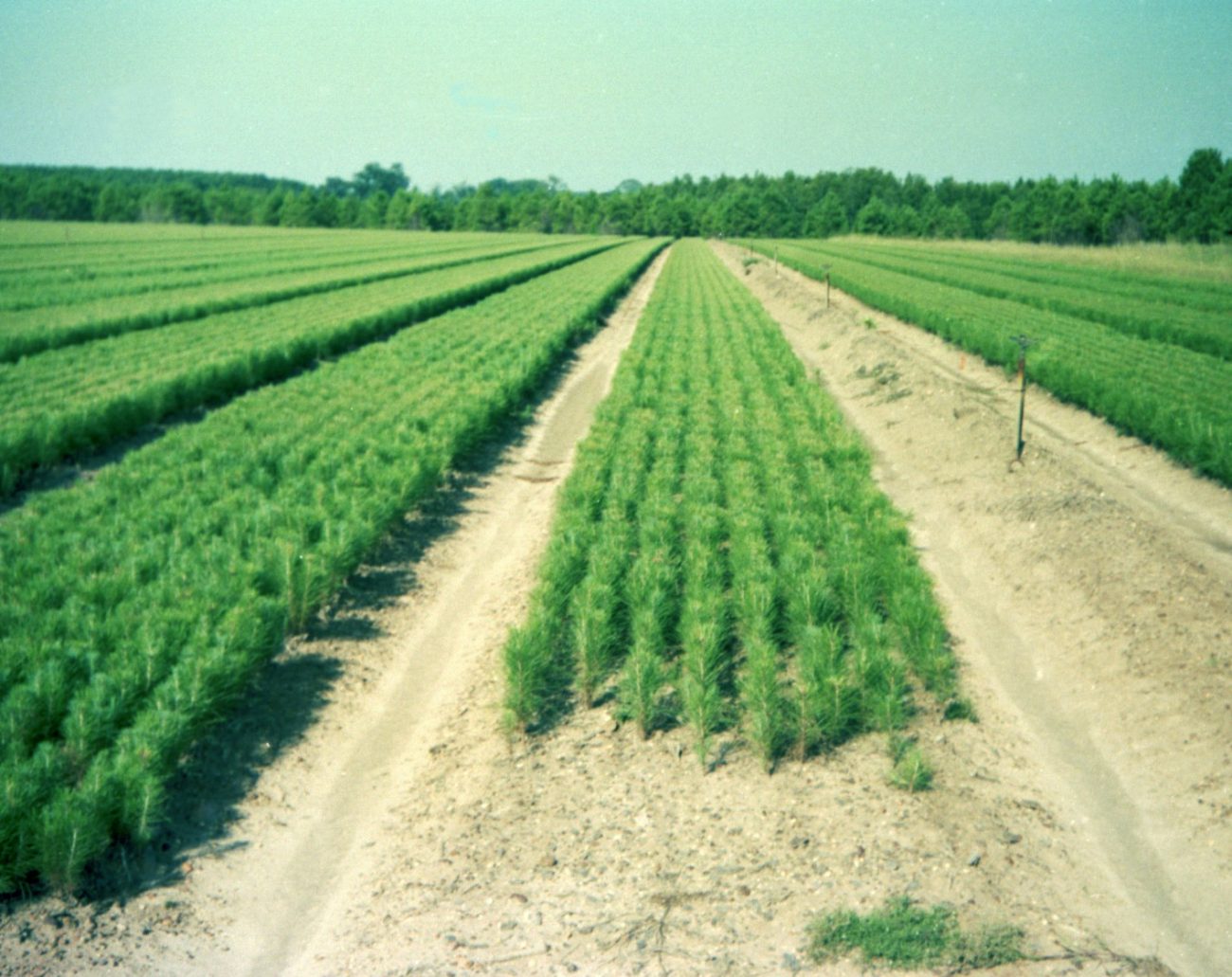
Alabama Forest Nurseries
Alabama’s first forest nursery opened in Sumter County in 1926, the direct result of the establishment of the U.S. Forest Service (USFS) and the Alabama Forestry Commission (AFC) in the early decades of the twentieth century. The nursery provided landowners with seedlings to combat serious erosion problems and to offer landowners a new “crop” to grow, which was especially important after the arrival of the boll weevil in the 1910s devastated cotton production across the state. The establishment of the Tennessee Valley Authority (TVA) and the Civilian Conservation Corps (CCC) as part of Pres. Franklin D. Roosevelt’s New Deal in 1933 led to the development of a TVA and USFS-managed nursery in Muscle Shoals and a ready workforce, which planted millions of trees in Alabama between 1933 and 1942. After World War II, Auburn University’s newly established forestry program began contributing to the nursery effort, conducting research on tree production and the management of pests and diseases. Though the TVA nursery closed in 1960, the state operated three forest nurseries until the 1990s, when operations were consolidated into a single nursery. At the same time, private forest industry nurseries began operating across the state. Their ability to provide the trees needed to sustain Alabama’s forest products industry led to the closure of the final state nursery in 2006.
By the early twentieth century, decades of agricultural expansion, logging, and poor land management had left Alabama’s forests and soils severely degraded. Indigenous Alabamians managed Alabama’s forests to enhance their hunting grounds and facilitate movement, often using fire to accomplish these goals. The growing influx of migrants from the eastern United States into the state in the early nineteenth century, however, brought widespread deforestation as land was cleared for farming, and the demand for wood for construction, fuel, and early industry grew. After the Civil War, the expansion of railroads gave logging companies easier access to Alabama’s forests, which they harvested and left to regrow naturally, leaving huge piles of logging debris in their wake. These practices contributed to destructive wildfires, which spread across the state in the late nineteenth and early twentieth centuries. The sharecropping and tenant farming systems that emerged after the Civil War placed additional strain on the land, encouraging continuous cultivation, overgrazing, and the clearing of trees on hillsides and other marginal areas, which accelerated soil erosion.
Interest in Managing Forests
The growing problems in Alabama’s forests after the Civil War—problems shared by other states—led to the professionalization of forestry in the United States. Although the nation had long relied on European-trained foresters, by the late nineteenth century, Cornell University and Yale University, along with the Biltmore Forestry School in North Carolina, began offering educational programs to train foresters. By the early twentieth century, lumber was a primary product and some lumber companies in Alabama began actively managing the forest land they owned. Initially, they had to rely on foresters trained in programs outside of the state. Although Alabama Polytechnic Institute (API, present-day Auburn University) began offering forestry courses in the 1890s, the school did not offer a degree program until 1946. Managing forests at this time involved a variety of tactics, including selective harvests and encouraging the natural regeneration of desired tree species, especially yellow pine, which accounted for the bulk of Alabama’s lumber output. The establishment of the U.S. Forest Service (USFS) in 1905 accelerated state-level action on forest-related issues, leading Alabama to create its first forestry commission in 1907. Although the legislature allocated minimal funds ($500.00 annually), the Forestry Commission (FC) of 1907 began educating landowners on timber management and fire protection. The commission also used property tax incentives to encourage the reforestation of land cleared by logging or farming.
While the FC continued its work with limited resources, the problems facing Alabama’s forests and agricultural lands grew. In 1922, the Alabama Commissioner of Game and Fish (present-day Alabama Department of Conservation and Natural Resources) gathered concerned citizens together to draft new laws to better manage Alabama’s natural resources. One result was the Alabama Forestry Act of 1923, which established the State Commission of Forestry, today’s Alabama Forestry Commission (AFC), and authorized the hiring of professional staff to carry out the AFC’s work. The new law also authorized the AFC to assist private landowners in forest management, promote public awareness of the economic and environmental value of forests, prevent and suppress forest fires, and acquire and manage state forests. The following year, the U.S. Congress passed the Clarke-McNary Act, which transformed forest management and development across the United States. Sections 4 and 5 encouraged cooperation between federal and state agencies in providing seeds and seedlings for the reforestation of public and private lands and supported efforts to help landowners establish productive timber crops. As a result, many states established forest nurseries to supply low-cost or free seedlings to landowners. Together, these state and federal initiatives promoted reforestation to address erosion, wildfire, and habitat loss while ensuring a sustainable, economically valuable timber supply.
First State Nursery Takes Shape
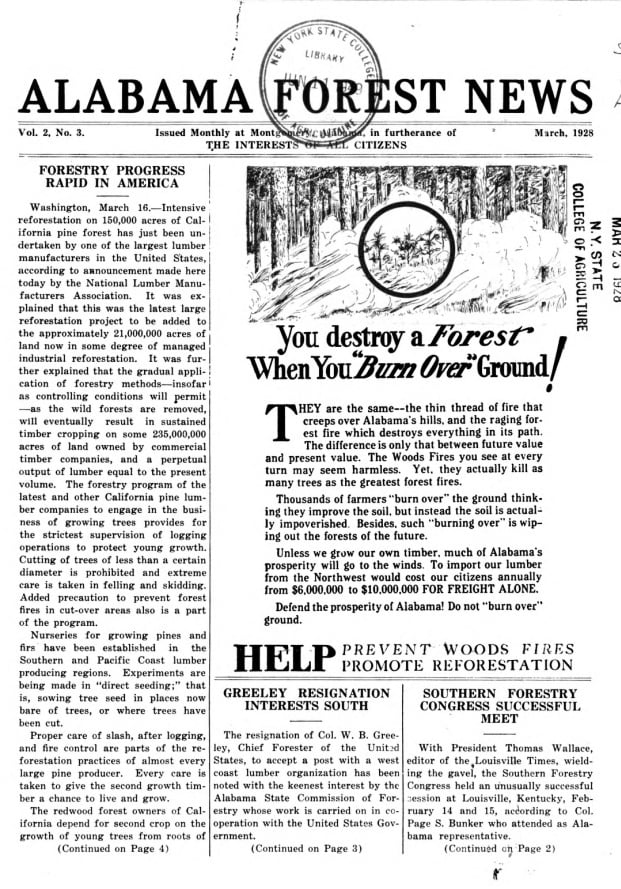
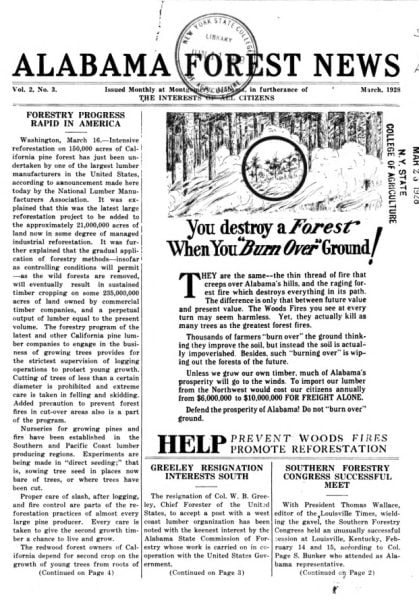
Following the Clarke-McNary Act, Alabama’s state forest nursery program began to take shape. In 1926, the AFC’s State Forest Nursery (SFN) opened in Sumter County on 40 acres donated by a private citizen. Initially, the nursery distributed enough free seedlings for landowners to plant one-half to one acre; landowners had to pay for additional seedlings at cost. The program began modestly, serving landowners in Bibb, Chilton, Shelby, and Perry counties in 1926. The AFC’s newsletter, Alabama Forest News, launched in 1927, helped promote the nursery’s tree program and offered guidance on tree planting and forest management. By 1929, the nursery distributed a variety of seedlings, including approximately 800,000 black locust and 400,000 pines, including slash, loblolly, and longleaf, which were economically valuable species that could be grown in different regions across the state. The nursery also distributed around 14,000 persimmons and oaks, which wildlife favored for the fruit and mast they produced. The onset of the Great Depression that same year, however, slowed production as federal funding declined, though the nursery continued to operate on a limited scale.
New Deal Assistance
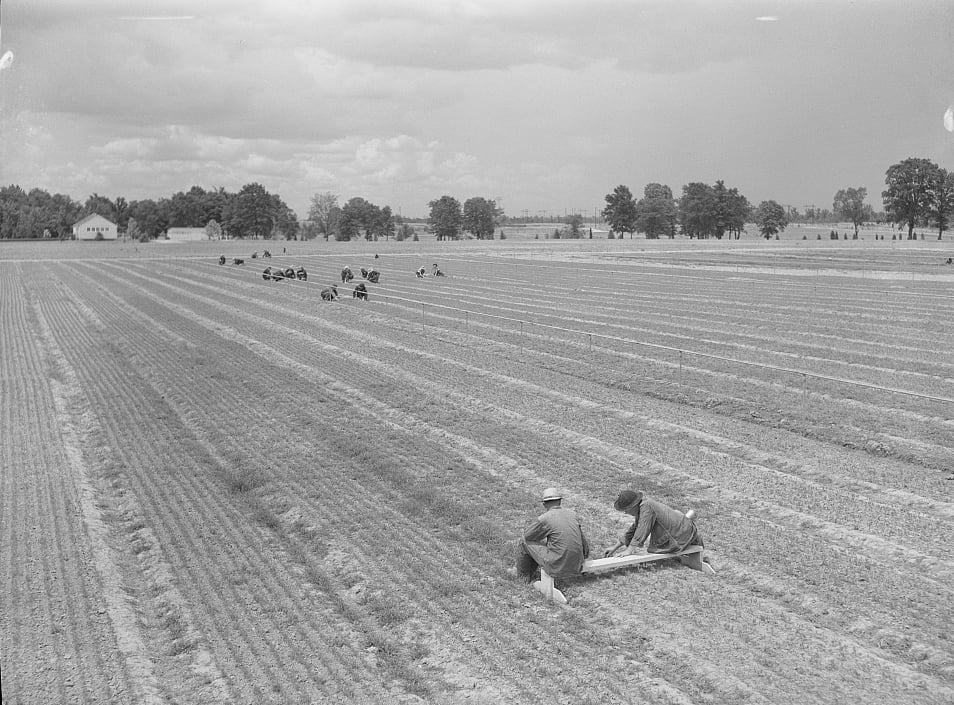
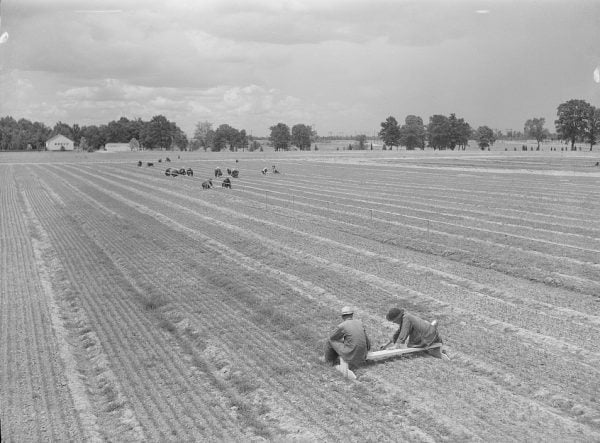
Beginning in 1933, President Roosevelt’s New Deal helped direct more federal resources and staff to improving Alabama’s forests. The establishment of a second forest nursery followed the formation of the TVA. Located on the Wilson Dam Reservation in Muscle Shoals, Colbert County, TVA’s Muscle Shoals Forest Nursery (MSFN) produced tree seedlings for planting in Alabama and west Tennessee. As initially conceived, the nursery occupied 74 acres of reservation land; by 1954, the site had grown to 100 acres. Under the direction of a small staff of trained TVA and USFS foresters, the CCC provided the bulk of the workforce required to gather seed, build and manage the MSFN, and to plant a variety of coniferous and hardwood trees across north Alabama on both public and private land. Production at the MSFN grew rapidly; by 1935-36 (the third growing season), the nursery produced more than six million trees, enough to reforest between 8,000 and 12,000 acres, depending on planting density.
The SFN also benefited from the New Deal. Funds from the Civil Works Administration (CWA) supported experiments in nursery production methods at the SFN. The CCC also worked at the SFN, gathered hardwood and coniferous seeds for planting, and planted trees in Alabama’s state forests and new state parks. Using CCC labor, the number of trees grown at the SFN increased to more than one million per year. In 1938, upwards of 200 landowners received seedlings from the nursery, a dramatic increase from the 38 landowners who received trees in 1932. In 1939, the AFC moved the SFN to a new 200-acre site near Autaugaville, Autauga County (renamed the John R. Miller Nursery in 1950 after the vice president of the T.R. Miller Mill Company who was one of the early supporters of reforestation and conservation efforts in Alabama), citing poor soil, limited rail access for shipping seedlings, and the spread of white pine blister rust (Cronartium ribicola) near the Sumter County location. The availability of federal funds and CCC labor to help construct the new infrastructure also facilitated the move.
The MSFN and the SFN followed the USFS “bareroot” forest nursery model. Under this model, nursery production required year-round labor and careful management. After preparing and leveling seedbeds, staff planted large quantities of seed, mulching the beds with materials such as sawdust, wheat straw, or pine straw, and sometimes covering them with fabric to protect germinating seedlings. Throughout the growing season, the staff maintained the irrigation systems, hand-weeded seedbeds, monitored for insects and disease, and pruned certain seedling species to ensure uniform growth. In the late fall through early spring, when the seedlings lay dormant, workers “lifted” them from the seed beds (initially by hand), removed the soil from the roots to leave them bare (hence “bareroot”), graded and culled inferior stock, bundled acceptable seedlings, and stored them in cool, moist conditions until distribution. To keep nursery soil fertile, the nurseries relied on fertilizers and cover crops, including vetch, rye, and cowpeas, which were plowed back into the soil as green manure.
The United States’ entry into World War II led to the CCC program’s conclusion in 1942, which reduced staffing at both the MSFN and the SFN. The dissolution of the CCC also limited the TVA and AFC’s ability to carry out large-scale planting projects, as they lost a large, free workforce. Although the war reduced seedling demand, nursery production rebounded in its aftermath as demand from landowners increased. In 1949, the AFC opened the third nursery in the state, located on 25 acres owned by API/Auburn University (renamed in 1975 to the Jake Stauffer Forest Nursery; Stauffer worked with the AFC from 1926 to 1970, serving as the Alabama State Forester from 1942 to 1970). In addition to supplying seedlings to landowners, the Stauffer Nursery became a laboratory for students enrolled in Auburn’s new forestry degree program.
Demand for seedlings, however, continued to outpace production capacity at the two state nurseries. In 1951, after producing more than 13 million trees and supplementing their stock with seedlings from the MSFN and the Louisiana State Nursery, the AFC still had to deny requests from 150 landowners. The final expansion to the AFC’s nursery program came the next year, when the state appropriated $100,000 to establish the E.A. Hauss Nursery near Atmore, Escambia County. Edward A. Hauss served as president of the Alger-Sullivan Lumber Company, which donated the initial 50 acres for the nursery. By the time of its closure, the nursery had grown to 400 acres of leased and owned land.
Private Nurseries Step In
Throughout the 1950s, demand for trees was further boosted by the construction of five new pulp and paper mills in Alabama and by the establishment of the U.S. Department of Agriculture’s (USDA) Soil Bank Program in 1956, which encouraged the conversion of less-productive cropland into pasture, forest, and wildlife habitat. At the same time, production at the MSFN began to shift. Like many TVA initiatives, it had been conceived as a short-term catalyst—in this case, to promote reforestation and encourage the development of state nurseries—rather than as a permanent institution. Reduced federal appropriations forced the TVA to place the nursery on standby in 1954. When it reopened, the TVA imposed annual limits on seedling distribution to both private landowners and the state for use in collaborative planting projects, and in 1957, began charging for seedlings that had previously been free. State nurseries in Alabama and other states in TVA’s service area expanded their production to address these changes. By 1960, with state, federal, and a growing number of private nurseries across the TVA region able to meet demand, the MSFN closed.
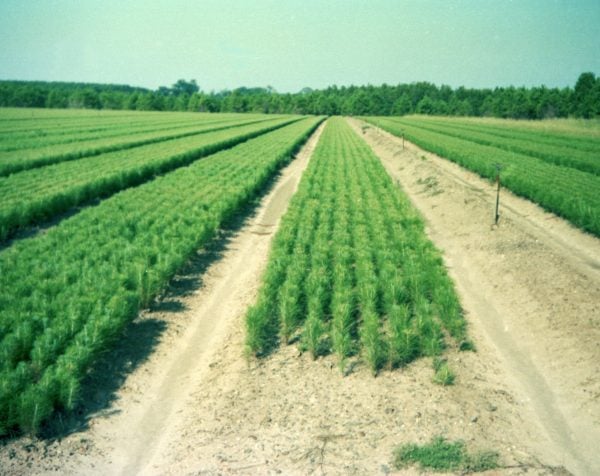
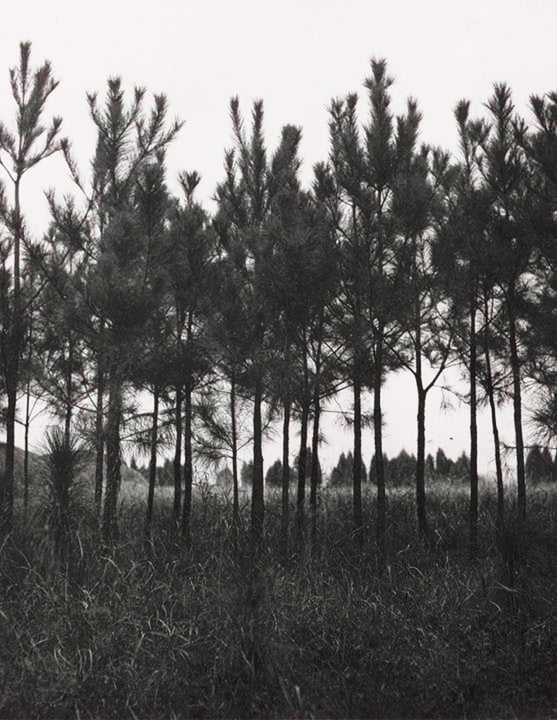
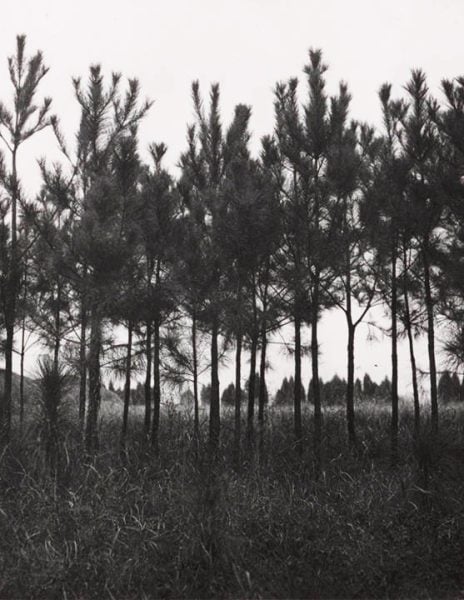
By the mid-twentieth century, planting on private and industry-owned lands, along with natural forest regeneration and improved fire protection, had increased Alabama’s timber inventories, reversing the steep decline of the previous century. The forest products industry, however, favored fast-growing, single-species crops that could be harvested at once, driving nursery production toward pine species. To service this need, from its opening in 1952 into the 1990s, the Hauss Nursery produced only three tree species: loblolly, longleaf, and slash pines. The other two nurseries produced a mix of pine and hardwoods, including yellow poplar, black walnut, black locust, and catalpa, though pine species made up the bulk of their production. In the 1970s and 1980s, forest product companies, including ArborGen, Summit, Weyerhaeuser, Rayonier, and Westervelt, established their own forest nurseries across the state to produce seedlings for planting on company-owned or managed land. The number of privately-owned nurseries serving specialized markets also grew.
The AFC’s nurseries underwent significant changes as the twentieth century drew to a close. Although the USDA’s Conservation Reserve Program (1986-present), which encourages tree planting by paying farmers to convert marginal cropland and environmentally sensitive areas from production to vegetative cover to prevent erosion and create habitat, kept demand for seedlings high, the AFC closed the Stauffer and Miller nurseries in the early 1990s. This left the Hauss Nursery as the sole AFC forest nursery. Increased mechanization and more efficient production methods meant that consolidating operations at one site made financial sense. Seed quality had also improved; instead of being gathered from Alabama’s forests, seed came from the AFC-managed seed orchards, including the Thorsby Seed Orchard in Chilton County and another located in the Geneva State Forest in Geneva County, where seed from carefully selected parent trees produced seedlings with higher survival rates. As a result of broader industry concerns about the issues of forest monoculture (producing one crop), which promoted pests, disease, and a lack of wildlife habitat, and the consolidation of operations, the AFC moved away from producing only pine trees at the Hauss Nursery, adding wildlife-beneficial hardwood species such as oaks, yellow poplar, crabapple, persimmon, Chinese chestnut, and green ash.

Nursery production in the state also shifted in other ways. While the AFC’s forest nurseries mainly produced bareroot trees, in the 1980s the AFC saw an opportunity to produce container-grown hardwoods in greenhouses, an intensive method that requires less land than traditional bareroot production. Unlike bareroot stock, container seedlings retain their root plug during transport, reducing transplant shock and often improving survival, particularly for many hardwood species. In 1989, the Wallace State Community College campus in Hanceville, Cullman County, received funding from the AFC to establish the Jack Hopper Nursery to produce trees using the container method and to train students in nursery management. The AFC continues to purchase trees from the Hooper Nursery to distribute through its educational outreach programs.
In 2006, the Hauss Nursery closed, marking the end of state-run nursery production. Alabama’s private and industry forest nurseries continue to produce millions of seedlings for planting on industry-owned lands and to sell to private landowners and forestry firms. In 2023, output exceeded three million hardwood seedlings (container and bareroot) and 126 million bareroot conifer seedlings, putting Alabama behind only Georgia and South Carolina for seedling production in the entire United States. The state has also become a center for research on forest tree seedling quality and production methods through the Southern Forest Nursery Management Cooperative (SFNMC), which was formed in 1972 and is headquartered at Auburn University. In addition to Auburn University, SFNMC members include six forest products industry companies, seven state forestry agencies, and the USFS. Collectively, the SFNMC produces roughly 70 percent of all seedlings grown in the United States each year.
The closure of the state and TVA forest nurseries, however, did not mark the end of the use of these sites. The AFC continues to actively manage timber on its former nursery properties. Additionally, the Stauffer Nursery has operated as a hardwood seed orchard and served as a research site for oak silvopasture. Silvopasture is a land-use system that combines trees maintained for specific purposes (usually timber or nuts), forage, and livestock, providing multiple income streams for landowners, improving animal welfare and soil conditions, and promoting ecological diversity. The Hauss Nursery became the Hauss Demonstration Forest, where longleaf and silvopasture research is carried out. A portion of the former MSFN site is now home to a test orchard for the American Chestnut Foundation, which is working to develop a blight-resistant American chestnut tree. American chestnut trees were once common in the eastern United States until they were decimated by Cryphonectria parasitica beginning in the early 1900s.
Throughout the twentieth century, Alabama’s forest nursery system transformed from a government-led effort into a network of public-private partnerships. Although state and TVA nurseries have closed, seedling production continues across the state. Guided by scientific advances and an evolving understanding of forest management, the forest nursery system that has emerged reflects a recognition of the need to balance the needs of the forest products industry, private landowners, and the long-term ecological health of Alabama’s forests.
Additional Resources
- Clark, Thomas. The Greening of the South: Recovery of Land and Forest. Lexington, KY: University Press of Kentucky, 1984.
- McCarthy, Dennis M. and and Clyde W. Voigtlander, eds. The First Fifty Years: Changed Land, Changed Lives, State of the Environment in the Tennessee Valley, 1983. Knoxville, TN: Tennessee Valley Authority, 1983.
- Hays, Samuel P. The American People and the National Forests: The First Century of the U.S. Forest Service. Pittsburgh, PA: University of Pittsburgh Press, 2009.