Florence Mound and Museum
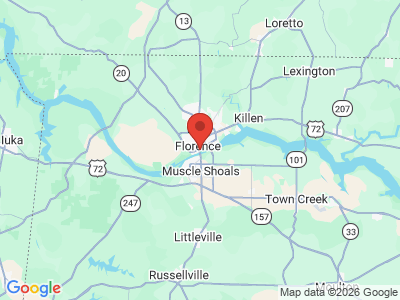
The Florence Mound and Museum interprets the Native American history of what is now northwest Alabama and sits adjacent to an ancient earthen mound built by Native Americans during the Woodland Period, approximately 1,700 years ago. The mound is located on the banks of the Tennessee River in Florence, Lauderdale County, and is the largest indigenous structure in the Tennessee River Valley. In 1968, the city of Florence established the Indian Mound Museum adjacent to the site. The museum closed in March 2015 and was replaced with a much larger facility in 2017. The museum hosts programs, tour groups, and events throughout the year.

Native Americans built the earthwork during a cultural era that archaeologists refer to as the Woodland period. During this time, people lived in small villages, created extensive trading networks, and subsisted by hunting, gathering, and horticulture. People adopted the bow and arrow as a weapon, began to cultivate food crops, and created distinctive pottery for food storage. They also began to manipulate the environment through the burning of forests and building of burial and ceremonial structures. These earthworks and mounds, which are structures that express how people understood the world, appear associated with those built by some of the peoples living in the Ohio, Mississippi, and Tennessee River Valleys. Some mounds were built as burial structures, and others were constructed for ceremonial purposes. Similar mounds exist in other parts of Alabama, including Oakville near Moulton, Lawrence County, and in Florida, Georgia, Mississippi, and Tennessee. Many similar mounds were flooded when the Tennessee Valley Authority began damming the river.
Florence's mound is an earthen four-sided structure with a base measuring 310 by 230 feet and a summit that rises 43 feet and measures approximately 145 by 95 feet on top. The mound was once surrounded by an earthen wall, which likely reached 12 to 15 feet high. Archaeological and historical accounts offer a limited insight into the purpose of the earthwork at Florence. Theories about the use of the mound center on ceremonial practices, such as large, seasonal gatherings. Themes of renewal and rebirth are persistent within southeastern Native American cultures and the earthwork itself. The mound is constructed of varying layers of materials that record the ecosystem of the people who engineered the structures. Clay, pottery sherds, debitage (chips and flakes of stone left over from the shaping of tools), and soil from the nearby river were all found within the mound. For example, many southeastern Native American creation stories begin with an animal diving into the water to bring mud to the surface to form the world. It is possible that earth brought from the river to the top of the Florence mound is a manifestation of this belief. Similarly, the earthwork was built entirely to be exposed to the rising river along the flood plain. Water certainly played an integral role in the design of the earthwork.

Wilkins Tannehill created the first known depiction of the earthwork in the 1820s. It illustrates a six-sided mound with a semi-circular embankment surrounding three sides of the mound. A notation along with illustration reported the dimensions as roughly 446 feet around the base and roughly 148 feet around the top and a height of 45 to 50 feet. These dimensions and shape of the mound and embankment were later recorded in an 1838 article in the Western Messenger. This account, with information contributed by David Hubbard, described the mound as being 132 feet from the Tennessee River and not much higher than the river’s high-water mark. He noted that it was hexagonal and made of soil mixed with sand. Accounts from both Tannehill and Hubbard were incorporated in the 1848 compilation Ancient Monuments of the Mississippi Valley.
Inconsistencies in the dimensions of the mound in early descriptions and the present likely result from increasing farming damage over time. For example, early records show a six-sided mound, but the current structure has only four sides. Likewise, much of the embankment that surrounds the mound has been destroyed, although archaeologists theorize that one section may have been used for a stretch of the nearby (now defunct) Louisville & Nashville Railroad, which crossed the river near the earthwork.
Archaeologists have conducted several excavations to determine the age and uses of the mound. In 1914, businessman and amateur archaeologist Clarence Moore dug 34 test pits at the summit of the mound but did not find any artifacts, which indicates that the people who built the mound were likely not living on it. Excavations conducted at the base of the mound by the University of Alabama in 1996 also did not uncover much evidence of how humans used the site. The following year, the University of Alabama conducted another excavation, this time on the slope near the top of the mound. This excavation revealed some important information about the mound's construction. Archeologists discovered two distinct soil layers that indicate the mound was constructed during two periods. They also found a layer of refuse between the soil layers that was deposited during construction. It contained a number of artifacts, including a variety of pottery sherds and pieces of flaked stone tools. These artifacts allowed archaeologists to date the mound to the Middle Woodland period, from approximately 1 CE to 500 CE. Prior to these excavations, many scholars believed that the mound dated to the later Mississippian period (from approximately 1000 to 1550).
The land on which the earthwork complex is located was incorporated into the city of Florence upon its founding in 1818. As the U.S. government worked to remove the Chickasaws, Choctaws, Creeks, and Cherokees from their ancestral lands, non-Native peoples moved to north Alabama to purchase land for planting crops, particularly cotton. The mound and the land around it were valued primarily for their agricultural benefits by these settlers because they were located in a flood plain. During the second half of the nineteenth century, the property encompassing the mound was owned by the Katchelman family, immigrants from Bavaria. They saw it as an exceptional location for a vegetable farm and cultivated areas on the slope, around the base of the mound, and on the floodplain stretching down towards the river. They built their first home on top of the mound before moving to a new home at the base. Ownership of the property changed hands during the first half of the twentieth century, and in February 1945, Martha Ashcraft Dabney and daughter Ida Josephine Dabney Brabson donated the mound to the city of Florence for use as a park and educational site; they included enough land at its base to build a narrow roadway around it connecting it to the city.

In 1968, the city opened the mound and museum to the public and marked the event with a day of celebration. The original building occupied by the museum was once the home of Florence's first FM radio station and also served as a recording studio during the 1960s. In 2013, the city council set aside $1.077 million to replace the 1,200-square-foot museum, which had not been updated since 1968 and was prone to flooding. With an increase in funding, the city spent $1.76 million on a new 3,500-square-foot facility that includes meeting space and space for temporary exhibits.
The current museum, which opened in 2017, explores the Native American history of the northwest Alabama area, with exhibits that chronicle an archaeological timeline while combining aspects of contemporary Native American culture. The museum houses artifacts, including projectile points, lithic tools, pottery, and jewelry related to Native American people stretching back nearly 13,000 years. The museum also displays contemporary reproductions of Native American clothing and pottery. Display panels discuss American Indian life during the different eras and show visitors how people used the various objects on display. The entire site, although now heavily developed, retains its significance within the Tennessee River Valley as a space for gathering, contemplation, and understanding.
Additional Resources
- McDonald, William Lindsey. "A Profile of the Indians at Muscle Shoals, Alabama." The Journal of Muscle Shoals History, I (1973): 11-15.
- ---. Lore of the River . . . The Shoals of Long Ago. Florence: Bluewater Publishing, 2007.
- Fontaine, Edward. How the World Was Peopled: Ethnological Lectures. 1884, 101–102.
- Ball, Donald B. “Notes on an 1838 Account and Map of the Florence Mound (1LU10), Lauderdale County, Alabama.” Journal of Alabama Archaeology 59, nos. 1 and 2 (2013): 53–57.
- Squier, E. G., and E. H. Davis. Ancient Monuments of the Mississippi Valley. 1848, 109–110.
- Weiss, Mary Shannon. Alabama Mound Exploration by the Smithsonian Institution's Bureau of Ethnology, 1882–1886: A Thesis. University of Alabama, 1998, 98.
- Allen, Chadwick. Earthworks Rising. Minneapolis: University of Minnesota Press, 2022.